In 2026, short-form video stopped being the side format. On YouTube, Shorts are now most of what gets uploaded, one research firm estimates, and in the US, Alphabet says, they earn more per watch hour than the long videos they were supposed to cannibalize. Meta says Reels alone brings in revenue at a run rate of more than $50 billion a year. TikTok, after a year in court, is now run in the US by a new joint venture.
The headline numbers got harder to read, though. The best-known one, YouTube's "200 billion daily views", was first stated after YouTube changed how it counts a Shorts view, so it can't be compared with the 70 billion it replaced. And the independent surveys people quote measure whole platforms, not formats. This report pulls together what the platforms, independent researchers and our own measurements say about short-form video in 2026, and marks where numbers can't be compared. Platform figures are the platforms' claims; every number links to its source.
Key findings
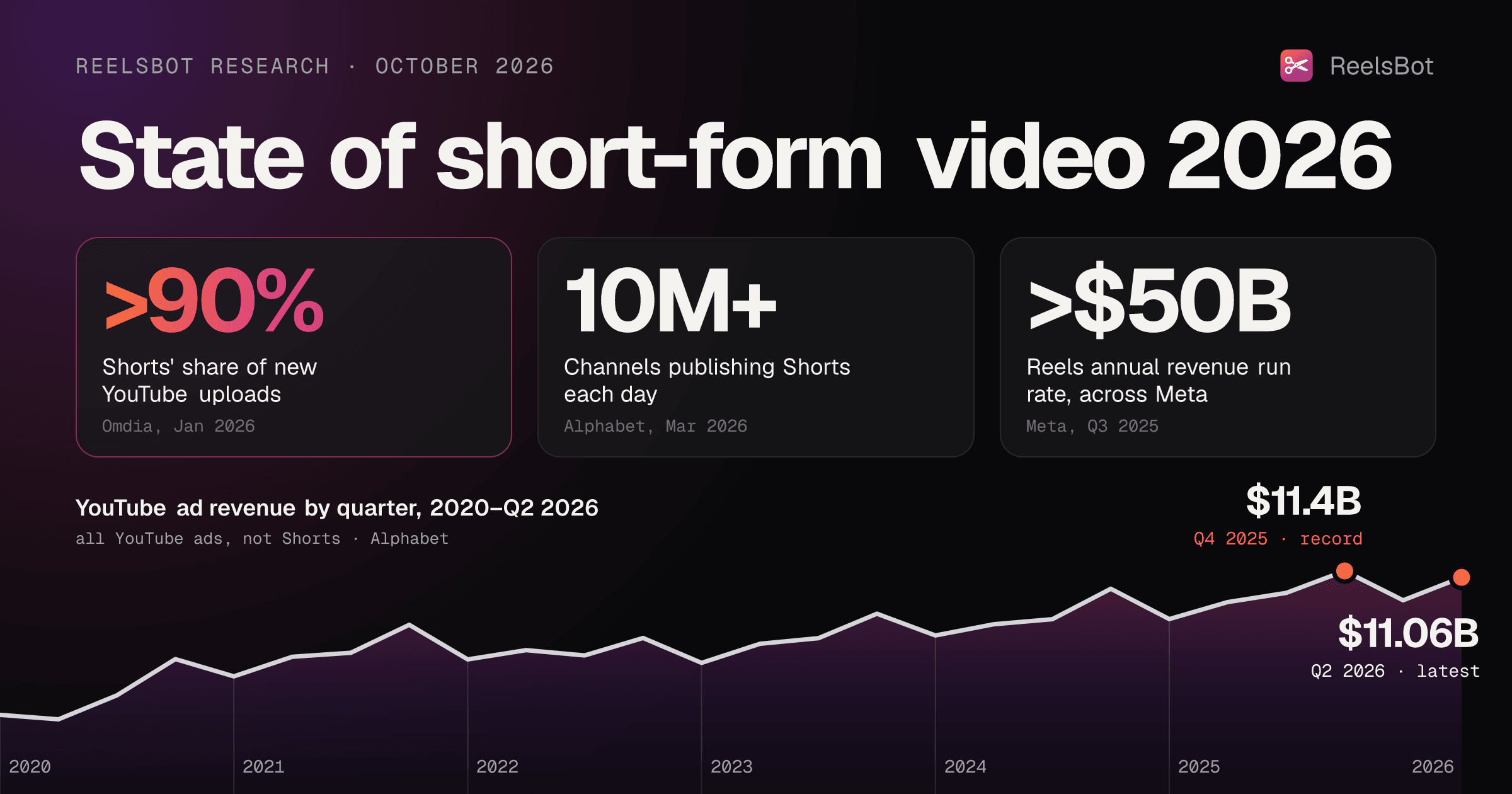
- 1Shorts make up "over 90%" of new uploads to YouTube, according to Omdia, and Alphabet says more than 10 million channels were publishing Shorts each day as of March 2026.
- 2In our sample of 48 creator-led channels from YouTube's 100 most-subscribed, 31 posted mostly Shorts from 1 January to 26 October 2026. The median channel's uploads were 74.5% Shorts (a count of uploads, not views).
- 3YouTube's 200 billion daily Shorts views can't be compared with the old 70 billion: since 31 March 2025, a view counts every start or replay with no minimum watch time. On the old count, the stated figure sat at 70 billion from October 2023 to October 2024.
- 4YouTube's own press page kept saying 70 billion until 29 January 2026, seven months after its CEO announced 200 billion (our Wayback series).
- 5Alphabet says US Shorts reached parity with long-form in revenue per watch hour in Q2 2025, then passed it in Q3 2025. YouTube ads brought in $11.06 billion in Q2 2026, up 12.9%.
- 6Meta says Reels has an annual run rate of over $50 billion. By our math that's about a quarter of Meta's annualized ad revenue.
- 7
- 8TikTok's US business now sits in a joint venture in which ByteDance keeps 19.9%. TikTok hasn't published a global user count since 2021.
Short-form is now the default upload#
The clearest change of the last two years is on the supply side. In January 2026 the research firm Omdia said YouTube had reached 29 billion videos and that Shorts now represent "over 90% of all new uploads". Omdia hasn't published its method, so treat that as its estimate. YouTube's own numbers point the same way. In October 2024 Alphabet said that of all the channels uploading to YouTube each month, 70% were uploading Shorts. In April 2026 Sundar Pichai said that as of March, over 10 million channels were publishing Shorts each day.
Uploads aren't attention, though. The same Omdia release says the top 1% of videos generate 91% of all viewing time. Most videos, of any format, are watched very little.
To see what the biggest creators actually do, we measured it. We took Wikipedia's list of the 100 most-subscribed YouTube channels, kept the 48 led by creators (people, families and creator groups, not labels, TV networks or kids' studios) and counted the uploads on each channel's public Shorts and Videos tabs from 1 January to 26 October 2026.
How much of each top creator channel's 2026 output is Shorts
Number of channels by Shorts share of uploads, 48 creator-led channels from YouTube's top 100, 1 Jan–26 Oct 2026
| Label | Value |
|---|---|
| 90% or more | 13 |
| Over 50%, under 90% | 18 |
| 25% to 50% | 7 |
| Under 25% | 10 (2 at zero) |
Source: ReelsBot measurement, public channel tabs via yt-dlp, crawled 26 Oct 2026
 ReelsBot
The median channel's 2026 uploads were 74.5% Shorts, and 13 channels were at 90% or more. At the far end are Shorts factories: KIMPRO posted 778 Shorts and 14 long videos this year, ISSEI 655 Shorts and none.
The shift isn't one-way. For the 31 channels we could measure in both 2023 and 2026, the median Shorts share rose from 40.2% to 58.8%, but 15 channels raised it and 13 lowered it. What changed most is how often the typical big creator posts.
Big creators post more Shorts, and slightly fewer long videos
Median uploads per month, the same 31 creator-led top-100 channels, 2023 vs 1 Jan–26 Oct 2026
| Label | Value |
|---|---|
| Shorts · 2023 | 2.1 |
| Shorts · 2026 | 4.7 |
| Long-form · 2023 | 4.2 |
| Long-form · 2026 | 3.3 |
Source: ReelsBot measurement, public channel tabs via yt-dlp, crawled 26 Oct 2026
The 200 billion views problem#
If you've read anything about Shorts this year, you've seen "200 billion daily views". It's real, in the sense that YouTube says it. Neal Mohan announced it at Cannes Lions on 18 June 2025 and Pichai repeated it on the next earnings call. But it isn't growth from the 70 billion that came before.
On 31 March 2025, YouTube changed what a Shorts view is. Its Help page now says views "count the number of times that a Short starts to play or replay, with no minimum watch time requirement". Before that, a view counted only after a Short had played for "a certain number of seconds", as TechCrunch put it. YouTube kept the old measure under a new name, "Engaged views", and tells creators to use it to compare their Shorts. Earnings and Partner Program eligibility still run on engaged views, TechCrunch reported, quoting YouTube.
YouTube's stated daily Shorts views, on two different counts
Daily views as stated by Alphabet and YouTube, by date stated, Feb 2021–Feb 2026
| Series | x | y |
|---|---|---|
| Before the 31 Mar 2025 count change | 2 Feb 2021 | 3.5B |
| Before the 31 Mar 2025 count change | 27 Apr 2021 | 6.5B |
| Before the 31 Mar 2025 count change | 27 Jul 2021 | 15B |
| Before the 31 Mar 2025 count change | 1 Feb 2022 | 15B |
| Before the 31 Mar 2025 count change | 26 Apr 2022 | 30B |
| Before the 31 Mar 2025 count change | 25 Oct 2022 | 30B |
| Before the 31 Mar 2025 count change | 2 Feb 2023 | 50B |
| Before the 31 Mar 2025 count change | 24 Oct 2023 | 70B |
| Before the 31 Mar 2025 count change | 30 Jan 2024 | 70B |
| Before the 31 Mar 2025 count change | 29 Oct 2024 | 70B |
| Stated after the count change | 18 Jun 2025 | 200B |
| Stated after the count change | 23 Jul 2025 | 200B |
| Stated after the count change | 4 Feb 2026 | 200B |
Sources: Alphabet earnings calls; YouTube blog; YouTube Help
On the old count, YouTube said 70 billion on 24 October 2023 and was still saying "over 70 billion" on 29 October 2024. The only like-for-like number since then is from April 2025: "engaged views grew by over 20% in the first quarter", with no comparison period given. Shorts kept growing on the old count, then. The jump to 200 billion came after the definition changed.
YouTube's own press page tells the same story. We pulled 74 monthly Wayback Machine captures of blog.youtube/press from September 2020 to October 2026, then checked the changes day by day.
What YouTube's press page said about Shorts
Daily Shorts views stated on blog.youtube/press, Wayback captures, Sep 2023–Oct 2026
| x | y |
|---|---|
| 23 Sep 2023 | 70B (first shown) |
| 1 Apr 2025 | 70B (count change) |
| 2 Jul 2025 | 70B (CEO announcement) |
| 29 Jan 2026 | 70B |
| 30 Jan 2026 | 200B (page updated) |
| 26 Oct 2026 | 200B |
Source: ReelsBot measurement, Internet Archive captures of blog.youtube/press, checked 26 Oct 2026
Since Cannes, YouTube has repeated 200 billion (January 2026 CEO letter, February 2026 earnings call) without a growth figure. In April 2026 it cited channels publishing Shorts instead, and Pichai's Q2 2026 remarks carried no Shorts metric at all. TechCrunch reported that the change aligned Shorts with TikTok and Instagram Reels, which also count starts and replays. But the line from 70 to 200 billion is a change of ruler, not a tripling.
The money caught up#
Alphabet doesn't report Shorts revenue. YouTube ads cover every format, and creator payments sit inside a cost line that isn't broken out. What it has done, call by call, is describe the gap between Shorts and long-form closing.
How Shorts monetization caught up with long-form in the US
1 Feb 2023
1 Feb 2023
Shorts ad revenue sharing starts
Creators keep 45% of their share of the Shorts Creator Pool, against 55% on long-form.Source: YouTube Help
25 Apr 2024
25 Apr 2024
Monetization rate vs in-stream 'more than doubled' in 12 months
Source: Alphabet Q1 2024 call
4 Feb 2025
23 Jul 2025
23 Jul 2025
Parity: as much revenue per watch hour as in-stream
Ahead of in-stream in some countries.Source: Alphabet Q2 2025 call
29 Oct 2025
10 Aug 2026
10 Aug 2026
A 10M-views gate for Shorts revenue share announced
Takes effect 1 Feb 2027.Source: YouTube Blog
"Parity" is about YouTube's revenue, not creators' share of it. Shorts creators keep 45% of their Creator Pool allocation, YouTube's Help page says, against 55% on long-form, and Alphabet's CFO said on the Q3 2025 call that the lower Shorts share "helps to improve some of our gross margins". On the Q2 2025 call, YouTube said it was seeing "both the volume and the price of ads in Shorts increase, particularly in developed markets".
The rules are also changing. From 1 February 2027, a channel will need 10 million qualified Shorts views in the past 90 days to earn any Shorts ad or Premium revenue share. That's about 111,000 qualified views a day. Channels below it stay in the Partner Program and keep long-form earnings. We'll look at what Shorts pay, and who that threshold affects, in a separate post.
YouTube's overall ad business keeps growing, with Shorts inside it.
YouTube ads revenue by quarter
US dollars, all formats, Q1 2020–Q2 2026
| x | y |
|---|---|
| Mar 2020 | $4B |
| Jun 2020 | $3.8B |
| Sep 2020 | $5B |
| Dec 2020 | $6.9B |
| Mar 2021 | $6B |
| Jun 2021 | $7B |
| Sep 2021 | $7.2B |
| Dec 2021 | $8.6B |
| Mar 2022 | $6.9B |
| Jun 2022 | $7.3B |
| Sep 2022 | $7.1B |
| Dec 2022 | $8B |
| Mar 2023 | $6.7B |
| Jun 2023 | $7.7B |
| Sep 2023 | $8B |
| Dec 2023 | $9.2B |
| Mar 2024 | $8.1B |
| Jun 2024 | $8.7B |
| Sep 2024 | $8.9B |
| Dec 2024 | $10.5B |
| Mar 2025 | $8.9B |
| Jun 2025 | $9.8B |
| Sep 2025 | $10.3B |
| Dec 2025 | $11.4B ($11.4B record) |
| Mar 2026 | $9.9B |
| Jun 2026 | $11.1B |
Counting subscriptions, YouTube revenue "exceeded $60 billion" in 2025. YouTube says it paid over $100 billion to creators, artists and media companies over the previous four years, but not how that splits between them.
Meta tells a faster story. Instagram Reels crossed a $1 billion ad run rate in mid-2022, and in October 2025 Mark Zuckerberg said "Reels now has an annual run rate of over $50 billion".
Reels' annual revenue run rate, as Meta stated it
US dollars per year, by earnings-call date, Jul 2022–Oct 2025
| x | y |
|---|---|
| 27 Jul 2022 | $1B ($1B) |
| 26 Oct 2022 | $3B (~$3B) |
| 26 Jul 2023 | $10B ($10B+) |
| 29 Oct 2025 | $50B ($50B+) |
Sources: Meta earnings call transcripts; Meta 8-K filings
Some of it reaches creators. Facebook paid creators nearly $3 billion in 2025, 35% more than in 2024, and 60% of that went to Reels, which on Facebook include long-form videos, Meta says. Meta hasn't published an Instagram total. TikTok publishes no rate at all: its Creator Rewards Program pays only for original videos over one minute, from accounts with 10,000 followers and 100,000 views in the last 30 days, and counts only qualified views of at least five seconds.
Advertisers have followed the format. In the IAB's latest report, US spending on social video, which the IAB defines as short-form video on social platforms including YouTube, overtook connected TV in 2025.
US social video ad spend passed connected TV
US dollars per year, 2021–2026 (2026 is IAB's estimate)
| Series | x | y |
|---|---|---|
| Social video | 2021 | $13.8B |
| Social video | 2022 | $16.3B |
| Social video | 2023 | $19.5B |
| Social video | 2024 | $23.7B |
| Social video | 2025 | $28.2B |
| Social video | 2026 | $31.9B |
| Connected TV | 2021 | $15.2B |
| Connected TV | 2022 | $18.6B |
| Connected TV | 2023 | $20.3B |
| Connected TV | 2024 | $23.6B |
| Connected TV | 2025 | $26.5B |
| Connected TV | 2026 | $29.3B |
Who is watching#
In Pew's 2026 survey of 5,511 US adults, YouTube remains the most-used platform, and TikTok's reach has settled after years of growth.
Which platforms US adults use
% of US adults who say they ever use each, survey Jan 30–Jun 18, 2026, n = 5,511
| Label | Value |
|---|---|
| YouTube | 84% |
| 70% | |
| 51% | |
| TikTok | 37% (21% in 2021) |
| 33% | |
| 31% | |
| Snapchat | 26% |
| 25% | |
| X | 18% |
Age is where the gap shows. Among 18–29s, 95% use YouTube, 79% Instagram and 65% TikTok; among over-65s it's 65%, 21% and 11%. Among US teens, 21% say they're on TikTok "almost constantly", up from 16% in 2022. One in five US adults (20%) now regularly get news on TikTok, up from 3% in 2020. The one independent format-level number we found is British: 70% of UK 13–17s say they watched YouTube Shorts in the past three months, per Ofcom.
The other shift is the screen. YouTube's share of all US TV-set viewing keeps setting records in Nielsen's monthly Gauge.
YouTube's share of US TV viewing
% of total TV-set viewing time, all YouTube formats, selected months, Jun 2024–Aug 2026
| x | y |
|---|---|
| Jun 2024 | 9.9% |
| Jul 2024 | 10.4% |
| Jul 2025 | 13.4% |
| Jul 2026 | 14.2% |
| Aug 2026 | 15.8% |
Vertical video is on TVs too. In February 2025 YouTube said connected TV made up 15% of Shorts viewing in the US. It's the only Shorts-on-TV share we found.
Reels runs on reshares#
Meta measures Reels' reach less by views than by sharing. The reshare counts it gives on earnings calls have more than doubled in under two years.
Reels reshares per day
Times Reels are reshared each day, as stated on Meta earnings calls, Apr 2023–Jan 2025
| Label | Value |
|---|---|
| Apr 2023 | 2B+ |
| Feb 2024 | 3.5B |
| Jan 2025 | 4.5B+ |
Sources: Meta Q1 2023 call; Q4 2023; Q4 2024
Meta's other recent numbers are about what gets made and what gets recommended. In January 2026 it said that "nearly 10% of the Reels people view each day are now created in our Edits app", the editor it launched in April 2025. In April 2026 it said same-day posts were more than 30% of recommended Reels, more than double a year earlier. Instagram itself passed 3 billion monthly actives in Q3 2025.
TikTok's year in court#
TikTok's numbers are the thinnest of the three. Its last official global figure is "more than 1 billion people" a month, from September 2021. It publishes no daily users, time spent or daily views, so we don't use the third-party estimates that circulate. In January 2025 the Supreme Court put its US base at over 170 million users. The new US company says it serves more than 200 million Americans and 7.5 million businesses.
How TikTok's US business changed hands
24 Apr 2024
24 Apr 2024
Divest-or-ban law signed
Protecting Americans from Foreign Adversary Controlled Applications Act: divest within 270 days.17 Jan 2025
19 Jan 2025
20 Jan 2025
4 Apr 2025
4 Apr 2025
Delay extended to 19 Jun 2025
Then to 17 Sep (order of 19 Jun) and 16 Dec 2025 (order of 16 Sep).Source: White House
25 Sep 2025
25 Sep 2025
Order approves a 'qualified divestiture' framework
Another 120 days without enforcement.Source: White House
18 Dec 2025
23 Jan 2026
23 Jan 2026
TikTok USDS Joint Venture LLC announced
Silver Lake, Oracle and MGX hold 15% each; ByteDance retains 19.9%.Source: TikTok newsroom
Two parts of the deal matter to creators. The joint venture says it will "retrain, test, and update the content recommendation algorithm on U.S. user data", so US and non-US feeds could drift apart. That's our inference; there's no data on it yet. And its safeguards also cover CapCut, the editor many short-form creators use.
What this means if you make videos#
- Compare Shorts on engaged views. Since 31 March 2025, "views" include every start and replay. Use Engaged views in YouTube Analytics, as YouTube suggests, when you compare Shorts with each other or across that date, and be wary of anyone comparing view counts from before and after.
- Add Shorts, but don't drop what works. In our top-channel sample, the median creator more than doubled their Shorts cadence (2.1 to 4.7 a month) and posted about one fewer long video a month, without dropping long-form. 13 of the 31 channels we could compare actually posted a smaller share of Shorts in 2026 than in 2023.
- Plan for 1 February 2027. Shorts revenue share will need 10 million qualified views in 90 days, about 111,000 a day. If you're far below that, treat Shorts as discovery for long-form, Shopping and brand deals rather than as an income line.
- Cut a 1–3 minute vertical master. Shorts accept up to three minutes for square or taller video, Reels up to three minutes (for US creators from January 2025), and TikTok's Creator Rewards pays only for videos over one minute. One edit in that range fits all three.
- Earn the first seconds. The views that pay are watched views: engaged views on YouTube, qualified views of five seconds or more on TikTok. A slow intro or dead air at the top costs you the count that matters, even if the raw view number looks fine.
- Post fresh and make it shareable. Meta points to reshares (4.5 billion a day in January 2025) and says same-day posts are more than 30% of recommended Reels.
- Assume some viewers are on a TV. YouTube said in early 2025 that 15% of US Shorts viewing was on connected TVs, and YouTube as a whole is now 15.8% of US TV time. Captions and on-screen text should still read from across a room.
We're building ReelsBot, a Mac app that turns raw talking-head clips into a cut: it removes retakes, stutters and dead air, lets you edit by transcript and burns in captions in 9:16. It's coming soon with a waitlist; until then our free video posting checklist covers the steps before you upload.
Methodology#
Sources. Platform figures come from primary filings and statements: Alphabet and Meta earnings releases (SEC 8-K exhibits) and call transcripts, the YouTube, Instagram and TikTok newsrooms and Help pages. Independent figures come from Pew Research Center, Nielsen, Ofcom, the IAB and Omdia. Aggregator "statistics" sites were used only as leads. We re-opened the primary page behind each headline number on 26 October 2026 and matched the exact sentence. The full data pack, with every claim, tier and source, is kept with our research files.
Cut-off. Everything here was public by 26 October 2026. Alphabet reports Q3 2026 on 28 October, so YouTube's series ends at Q2 2026. Meta reported Q3 2026 on 21 October without a new Reels figure in its release.
Our channel sample. The 48 creator-led channels from Wikipedia's list of the 100 most-subscribed YouTube channels (June 2026). We excluded record labels, music artists, TV networks, media companies, kids' animation studios, WWE and 5-Minute Crafts. For each channel we listed the public Shorts and Videos tabs with yt-dlp (live streams excluded) and found each year's first upload from public watch-page dates. Where a capped list didn't reach back to a year, we dropped that year for that channel rather than estimate it. For 2026, four channels hit our 1,200-video list cap: three on Shorts, whose Shorts share is a lower bound, and one on long videos, whose share is an upper bound. We re-derived every year boundary for MrBeast, Dude Perfect and Mark Rober through a second method, and all 48 checked items matched.
Limits: this is today's top 100, so it over-represents channels that may have grown because of Shorts, and which channels count as creator-led is our judgment call. Deleted and private videos are invisible. We count uploads, not views or watch time. YouTube's Shorts definition widened to three minutes on 15 October 2024, which moved some videos between tabs. The year-by-year groups differ, so only the 31-channel 2023 vs 2026 comparison is like-for-like.
Our press-page series. 74 monthly Internet Archive captures of blog.youtube/press, September 2020 to October 2026, with every change narrowed to the day using daily captures and checked by hand against the live page.
Open questions#
- Which count does YouTube's 200 billion use? YouTube hasn't said, and it has never published total engaged views.
- How much of YouTube's record TV share is Shorts? Neither YouTube nor Nielsen says, and Ofcom says the viewing data isn't available.
- How many Partner Program channels fall below the 10-million-view Shorts gate in February 2027? YouTube gave no number.
- What does a Short actually pay per view? YouTube's statements are relative and per watch hour, and TikTok publishes no rate.
- How big is TikTok now? No official global users since 2021 and no daily users or time spent, and it's unclear whether the US joint venture will report its own numbers.
- What do Reels earn creators on Instagram? Meta has published a Facebook total, not an Instagram one.