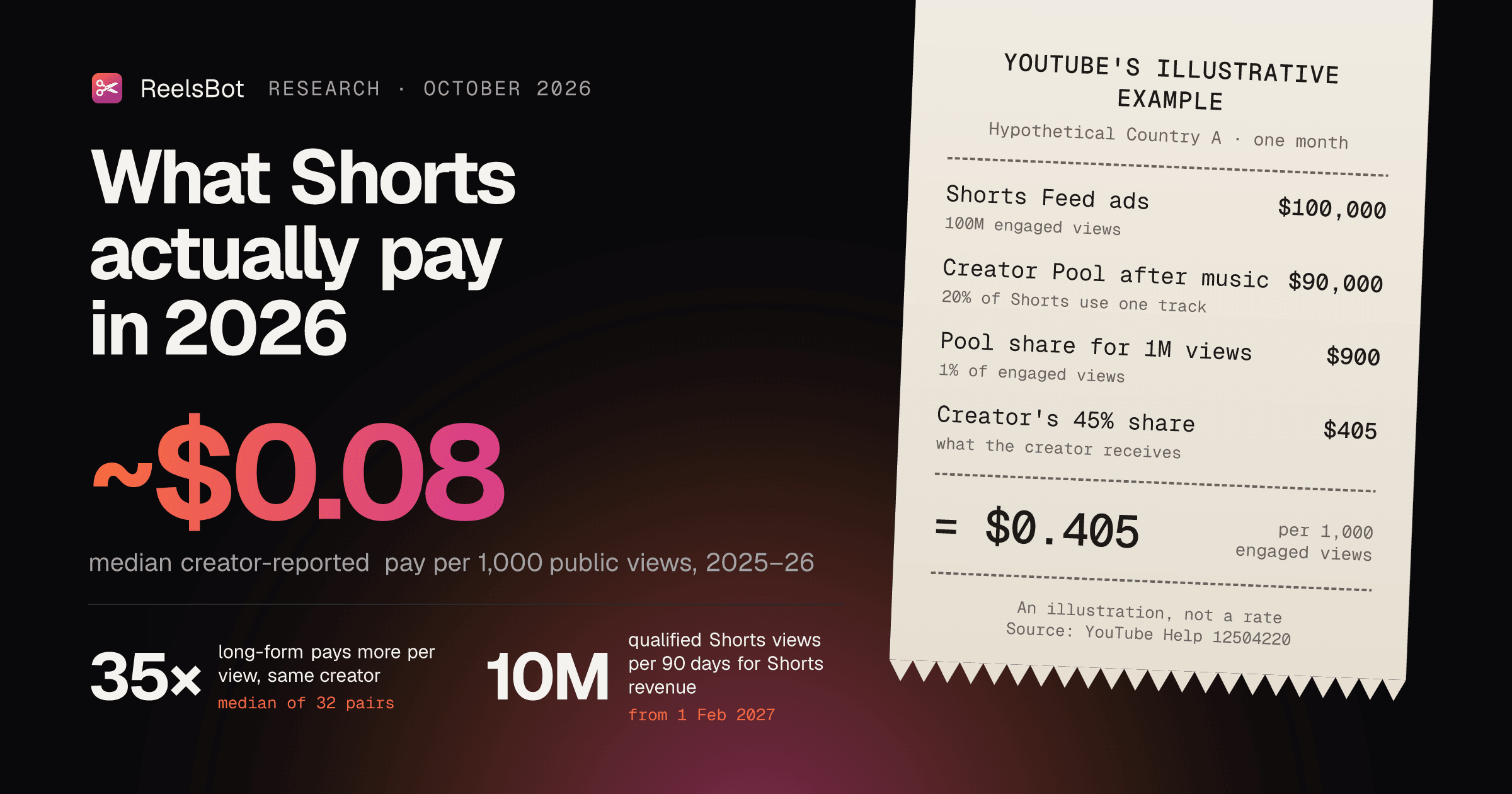
YouTube has never published what a Short pays. Its Help Center explains the mechanics (a monthly pool of ads, a cut for music, a 45% share) and gives one hypothetical example in dollars. What creators show from their own YouTube Studio is lower. In the first-hand payout reports we collected from creators' own videos and posts, the median Shorts rate for 2025–26 works out to about 8 cents per 1,000 public views (99 creator-years), roughly $80 per million. Where a creator gave both numbers, their long videos paid a median 35 times more per view.
The rules change on 1 February 2027. From then, YouTube will share Shorts ad and Premium revenue only with channels that had 10 million qualified Shorts views in the previous 90 days, and by our count the window that decides February's pay opened on 18 October. Below: what a Short view pays, why so little, what changes in February, and how many of 134 active Shorts channels we sampled clear the new bar today, with TikTok and Facebook for comparison. Every rate says which kind of view it is per, because on Shorts that changes the number by about half.
Key findings
- 1Creators report a median $0.081 per 1,000 public Shorts views in 2025–26 (99 creator-years in our self-selected sample of creators' own videos and posts), about $81 per million. Per engaged view, the view YouTube pays on, that's roughly $0.16.
- 2For the same creator, long-form paid a median 35× more per view than Shorts (32 creator pairs). Long-form paid more in every pair, by at least 3×.
- 3Most of the drop in per-view Shorts pay from 2024 to 2025 looks like YouTube's 31 March 2025 change to what counts as a view, not a pay cut. Converted back to engaged views, creators' 2025 and 2026 reports come to about $0.16, close to 2024's $0.146 on the old count.
- 4"45%" is a ceiling. YouTube's own worked example leaves creators 40.5% of Shorts Feed ad revenue once music is paid, and works out to $0.405 per 1,000 engaged views. That's an illustration, not a rate.
- 5From 1 February 2027, YouTube says Shorts revenue share needs 10M qualified Shorts views in 90 days. By our reading of the Help Center's rule, February's window runs 18 October 2026 to 15 January 2027, so it's already open.
- 6In our sample of 134 active Shorts channels found through YouTube search, which favours prolific channels, 55% (95% CI 47–63%) had 10M+ public views on Shorts posted in the last 90 days, from 18% of channels with 1K–10K subscribers to 80% with 1M+. That's an upper bound: if engaged views are half of public views, 38% clear.
- 7TikTok creators report a median $0.18 per 1,000 qualified views (n = 44). By year, reports fall from $0.90 in 2023 (n = 3) to $0.14 in 2025 (n = 30), in a sample heavy with complaint posts. Meta ended Facebook's in-stream and Reels ad programs on 31 August 2025.
~$0.08
Median Shorts pay per 1,000 public views, creator-reported, 2025–26
n = 99 creator-years
35×
How much more a long-form view paid than a Short, same creator, median
32 creator pairs
55%
Of 134 sampled active Shorts channels with 10M+ public views in 90 days
ReelsBot measurement, upper bound
What a Short view pays#
First, the three kinds of view. A public view is the number under a Short. Since 31 March 2025 it counts every time a Short "starts to play or replay, with no minimum watch time". An engaged view is the old Shorts view: the viewer watched "past the initial seconds", and loops don't count. A qualified view is an engaged view on a public Short in the Shorts Feed. YouTube splits earnings on engaged views and decides eligibility on qualified views. We covered why the view-count change broke YouTube's headline numbers in State of short-form video 2026.
On the 10 creator screens in our dataset that show both counts, the median was 1.98 public views per engaged view. So a Short's public counter runs about twice its engaged views, and any RPM changes by about half depending on which one it's divided by.
What creators report Shorts paid per 1,000 views
US dollars, median per creator-year; 2023–24 on the old view count, 2025–26 per public view (every play)
| Label | Value |
|---|---|
| 2023 | $0.030 (old count) |
| 2024 | $0.146 (old count) |
| 2025 | $0.082 (every play) |
| 2026 | $0.081 (every play) |
Source: ReelsBot dataset of 247 creator-reported payouts, Feb 2023–Oct 2026 (self-selected)
 ReelsBot
The reports are spread out. Per 1,000 public views, 63% of creator-years were under 10 cents and only 4 of 152 were at 30 cents or more. None passed 50 cents.
Most reports come to under 10 cents per 1,000 public views
Number of creator-years by Shorts pay per 1,000 public views, US dollars, 2023–2026
| Label | Value |
|---|---|
| <$0.02 | 19 |
| $0.02–0.05 | 30 |
| $0.05–0.10 | 47 |
| $0.10–0.15 | 22 |
| $0.15–0.20 | 15 |
| $0.20–0.30 | 15 |
| $0.30–0.50 | 4 |
| $0.50+ | 0 |
Source: ReelsBot dataset of creator-reported payouts (self-selected)
A few public creators published their own numbers. Nathan of BluPrint (295K subscribers) said his Shorts made $40,399 in 2024 from 238 million views, about $0.17 per 1,000 on that year's count. Wat Wat showed one Short with 53 million views and 29 million engaged views that paid C$6,405.91, about US$4,640. That one payout works out to $0.088 per 1,000 public views or $0.16 per 1,000 engaged views. Same money, two RPMs. On vidIQ's channel, John Scott said his average Shorts RPM was 9 to 16 cents before the 2025 update and 20 to 25 cents after. He put it down to the view change: YouTube shows more views but pays only for engaged ones. It's one creator's Studio, not evidence of a pay rise.
The biggest split in the data was audience country: creators with mostly US or English-speaking audiences reported about six times what those with mostly lower-RPM-country audiences did.
Shorts pay by where the audience is
Median US dollars per 1,000 public views, by audience the creator described, 2023–2026
| Label | Value |
|---|---|
| Mostly US or English-speaking | $0.096 (n = 32) |
| Not stated | $0.083 (n = 91) |
| Mostly lower-RPM countries | $0.015 (n = 29) |
Source: ReelsBot dataset of creator-reported payouts (self-selected)
Shorts against long-form#
The sharpest comparison is a creator against themselves. In 32 records from 31 creators who gave both numbers, long-form paid a median $3.06 per 1,000 views and Shorts $0.071. The median ratio was 35×, the middle half ran from 14.5× to 74×, and the smallest gap was 3×. AutoVlog (802K subscribers) put the two side by side: a Short with 1.2 million views paid $80, and a long video with 1.2 million views about $6,200.
Long-form pays many times more per view, same creator
Number of creator pairs by long-form RPM ÷ Shorts RPM, 2023–2026
| Label | Value |
|---|---|
| Under 10× | 4 |
| 10–30× | 9 |
| 30–70× | 10 |
| 70× or more | 9 |
Source: ReelsBot dataset of creator-reported payouts (self-selected)
A vendor dataset points the same way. AIR Media-Tech, a multi-channel network, says that across 274 of its channels Shorts RPM is "3–14% of long-form RPM in almost every niche", with music channels the exception. Our median of 35× is about 3%, the bottom of AIR's range. AIR's selection of channels isn't public.
Why a Short pays so little#
A long video earns from ads that run on it, and the creator keeps 55% of the net ad revenue. A Short doesn't carry its own ads. According to YouTube's Shorts monetization page, each month the ads that run between Shorts in the feed are pooled by country. Each monetizing Short's share of that revenue goes into a Creator Pool in full if it uses no music, half if it uses one track and a third if it uses two. The rest pays music licensing. The pool is then split by each creator's share of engaged views, and creators keep 45% of what they're allocated. Ads shown when the feed opens (the Shorts Masthead) and revenue tied to non-monetizing channels never enter the pool.
YouTube's Help page walks through one hypothetical country.
YouTube's own example of a Short's earnings
Hypothetical Country A, one month, as described on YouTube Help
Pool
$100,000
Shorts Feed ads, 100M engaged views
Music
$90,000
Creator Pool after music (20% of Shorts use one track)
Allocate
$900
A Short with 1M engaged views gets 1%
45% share
$405
What the creator receives
Per 1,000
$0.405
Per engaged view, our division
Source: YouTube Help 12504220
The 45% is a share of the allocation, not of the ads. In YouTube's example, creators end up with 40.5% of feed ad revenue. The more Shorts use music, the lower that goes. YouTube doesn't publish how many Shorts use music, so the real figure is unknown.
'45%' is the most a Shorts creator can keep
Creators' combined share of Shorts Feed ad revenue, by share of Shorts using music, %
| Label | Value |
|---|---|
| No Short uses music | 45% |
| 20% use one track | 40.5% (YouTube's example) |
| 50% use one track | 33.8% |
| All use one track | 22.5% |
| All use two tracks | 15% |
Alphabet's CFO said on the Q3 2025 earnings call that the lower Shorts revenue share "helps to improve some of our gross margins", as we noted in our state of short-form video report.
What changes on 1 February 2027#
On 10 August 2026, YouTube announced changes to its Partner Program for 2027: "Beginning February 1, 2027, creators who have 10 million qualified Shorts views over the last 90 days will be eligible for ads and subscription revenue sharing on Shorts." Channels below that stay in the program, keep earning from long-form and other features, and get Shorts revenue share back automatically once they cross 10 million again. YouTube says creators who already earn significant Shorts revenue are "unlikely to be impacted".
The Changes to the YouTube Partner Program page sets out the rest. Shorts views decide three things.
What your Shorts views get you from 1 February 2027
Qualified Shorts views in the last 90 days, for existing Partner Program channels
- 10M or more: Shorts ad and Premium revenue share.
- 1M to 10M: still in the Partner Program and "active", but no Shorts ad or Premium share.
- Under 1M: no Shorts share, and the channel stays "active" only through watch hours or uploads.
Source: YouTube Help 12843009
When the views are counted matters as much as how many. The Shorts page says views are measured over "the 90 day period ending on the 15th day of the calendar month preceding the month for which earnings are being calculated". By our count, February 2027's pay depends on views from 18 October 2026 to 15 January 2027. That window had been open for 10 days when this post went up. March's runs from 18 November to 15 February. On our reading, a channel that first crosses 10 million on 20 January misses February and starts earning in March. YouTube hasn't published a worked timeline. Wayback Machine captures show this rule reached the Help Center only between 12 and 29 September, after most coverage of the August announcement.
The 2027 Shorts pay rules, step by step
10 Aug 2026
10 Aug 2026
YouTube announces the 2027 Partner Program changes
10M qualified Shorts views per 90 days for Shorts revenue share; new entry thresholds.Source: YouTube Blog
24 Aug 2026
24 Aug 2026
Views on every format count from the first frame
Pay stays on engaged views.Source: YouTube Blog
~29 Sep 2026
~29 Sep 2026
Help Center adds the 15th-of-the-month measurement rule
First Wayback capture with the text; the last without it is 12 Sep.Source: YouTube Help 12504220
~15 Oct 2026
18 Oct 2026
18 Oct 2026
The window for February 2027 Shorts pay opens
Our count from YouTube's rule.15 Jan 2027
15 Jan 2027
That window closes
31 Jan 2027
31 Jan 2027
Deadline to accept the updated terms
Otherwise earning from those features stops on 1 February.Source: YouTube Help 12843009
1 Feb 2027
1 Feb 2027
The new rules take effect
Four other changes matter for Shorts creators, all on YouTube's Help page:
- New applicants need twice as much. 1,000 subscribers plus 8,000 qualified watch hours in 365 days or 20 million qualified Shorts views in 90 days, up from 4,000 hours or 10 million views. Existing partners don't requalify, and the fan-funding tier doesn't change.
- Targeted Shorts ads. When an advertiser targets an ad at five or fewer channels, eligible creators get a direct 45% share of it, on top of the pool.
- Incentives for channels under 10 million. YouTube describes Shopping bonuses, production credits for brand deals and boosts for "cultural trend activations", with details still to come.
- Accept the new terms in YouTube Studio by 31 January 2027.
Separately, YouTube is running an invite-only Shorts bonus program pilot for "select creators in specific regions". It pays a minimum "Promotional Offer Payment" for uploading a set number of public Shorts each month, plus a bonus on valid engaged views "based on the typical earnings in your country". YouTube publishes no amounts, upload minimums or countries, and says it will scale the program in 2027.
Who clears 10 million today#
YouTube hasn't said how many channels fall below the bar. The last count it gave was that more than 25% of Partner Program channels earned from Shorts in March 2024. So we measured a sample of active Shorts channels ourselves (full method below): 134 channels with at least 1,000 subscribers, found through YouTube search, and the public views on every Short each one posted from 28 July to 26 October 2026.
Share of active Shorts channels with 10M+ public views in 90 days
% of sampled channels, by subscriber count, Shorts posted 28 Jul–26 Oct 2026
| Label | Value |
|---|---|
| 1K–10K | 18% (4 of 22) |
| 10K–100K | 53% (29 of 55) |
| 100K–1M | 70% (33 of 47) |
| 1M+ | 80% (8 of 10) |
| All channels | 55% (74 of 134) |
Source: ReelsBot measurement of 134 channels, snapshot 26 Oct 2026
Read 55% as an upper bound. We counted public views, and the bar is 10 million qualified views, which leave out replays and quick swipes. YouTube publishes no ratio between the two. If engaged views are 70% of public views, a channel needs about 14.3 million public views and the share falls to 46%. At 50%, close to the 1.98 ratio on creators' screens, a channel needs 20 million and 38% clear. At that ratio, 5% of the 1K–10K channels clear, 38% of 10K–100K, 51% of 100K–1M and half of the 1M+ channels.
How the answer moves with the view basis
% of all 134 sampled channels clearing 10M qualified views, under three assumptions
| Label | Value |
|---|---|
| Public views count in full | 55% (upper bound) |
| Engaged = 70% of public | 46% |
| Engaged = 50% of public | 38% (≈ creator screens) |
Source: ReelsBot measurement of 134 channels, snapshot 26 Oct 2026
The clearest difference between channels that cleared and those that didn't was volume. They posted a median of 126 Shorts in 90 days, against 57 for the rest, about 10 a week against 4. The median channel that missed reached only 18.7% of the bar, and just 12 of the 60 were within a factor of two. Views were also concentrated: the median channel got 21% of its 90-day views from a single Short. Of the four small channels (1K–10K subscribers) that cleared, two would have missed without their best Short.
At a typical Short's views for its size, the bar is a lot of uploads.
Shorts needed in 90 days to reach 10M views
At the median channel's median public views per Short, by subscriber count, sample of 134
| Label | Value |
|---|---|
| 1K–10K | 1,282 (≈14 a day) |
| 10K–100K | 333 (≈3.7 a day) |
| 100K–1M | 208 (≈2.3 a day) |
| 1M+ | 80 (≈0.9 a day) |
Source: ReelsBot measurement of 134 channels, snapshot 26 Oct 2026
And what those views are worth, as an illustration: at the creator-reported median rate, the median channel in each group would earn from about $140 to $3,900 a quarter from Shorts.
Illustrative: what a typical channel's Shorts earn in 90 days
US dollars, median channel's public Shorts views × $0.081 per 1,000 (creator-reported median, 2025–26)
| Label | Value |
|---|---|
| 1K–10K subs | $136 (1.7M views) |
| 10K–100K subs | $832 (10.3M views) |
| 100K–1M subs | $1,824 (22.5M views) |
| 1M+ subs | $3,869 (47.8M views) |
Source: ReelsBot measurement and creator-reported dataset
TikTok and Facebook for comparison#
TikTok publishes rules but no rate. Its Creator Rewards Program pays only for videos of at least one minute with at least 1,000 For You views, from accounts with 10,000 followers and 100,000 views in the last 30 days in eight countries. A "Standard Reward" (qualified views, weighted by viewer region and language) plus an "Additional Reward" (watch time, retention, completion, search value) set the RPM, "average gross revenue per 1k qualified views". A qualified view has to come from a program country and last at least five seconds. Payouts can be redeemed on the 15th of the month once they reach $50.
In our dataset, TikTok creators reported a median $0.18 per 1,000 qualified views (n = 44) and $0.105 per 1,000 public views (n = 17), for videos over a minute. By year the drop is steep, but the 2025 reports are dominated by complaint posts.
What TikTok creators report Creator Rewards paid
Median US dollars per 1,000 qualified views, creator-reported, 2023–2025
| Label | Value |
|---|---|
| 2023 | $0.9 (n = 3) |
| 2024 | $0.45 (n = 9) |
| 2025 | $0.14 (n = 30) |
Source: ReelsBot dataset of creator-reported payouts (self-selected)
Facebook and Instagram. Meta ended Facebook's In-stream Ads, Ads on Reels and Performance Bonus programs on 31 August 2025. What remains is Facebook Content Monetization, which is invite-only and pays on qualified views and watch time "as solely determined by Meta", not on the ads in a video. Reels have to be at least 10 seconds long. Meta shows each creator an "Earnings Rate" per 1,000 qualified views but publishes no average. Its Creator Fast Track instead guarantees $1,000 a month for three months to creators with 100,000+ followers on Instagram, TikTok or YouTube, or $3,000 with 1 million+, for 15 reels a month in the US, Canada, the UK and Australia. Facebook Reels reports in our dataset, on mixed public and qualified bases, ranged from under a cent to $2.12 per 1,000 views (median $0.13, n = 14). We found no general per-view payment on Instagram.
Short-form pay per 1,000 views, by platform and view basis
Median US dollars, creator-reported unless marked, 2023–2026
| Label | Value |
|---|---|
| YouTube's example, per engaged view | $0.405 (hypothetical) |
| TikTok, per qualified view | $0.18 (n = 44) |
| YouTube Shorts, per engaged view | $0.16 (estimated) |
| Facebook Reels, mixed bases | $0.13 (n = 14) |
| TikTok, per public view | $0.105 (n = 17) |
| YouTube Shorts, per public view | $0.081 (n = 99) |
Sources: ReelsBot dataset of creator-reported payouts (self-selected); YouTube Help 12504220
What this means if you make videos#
- Know which view your RPM uses. Pay is split on engaged views, while the public counter counts every replay. Divide earnings by engaged views to compare Shorts with each other, and don't compare a 2024 RPM with a 2026 one without converting.
- Use the right yardstick. Creators report about 8 cents per 1,000 public views, roughly $80 per million. Plan with that, not with screenshots of 30-cent months, which were rare in our data.
- Treat Shorts as discovery for long-form. For the same creator a long-form view paid a median 35 times more. If a Short can send viewers to a long video, link it.
- Count your qualified views now. February 2027's pay depends on 18 October to 15 January. Check engaged views in YouTube Analytics against the 10 million bar, about 111,000 a day, not the public counter.
- If you're far below the bar, plan around it. In our sample, channels with 1K–10K subscribers would need about 14 Shorts a day at their typical views. The channel stays in the Partner Program as long as it stays active, so long-form ads, Shopping, memberships and brand deals keep paying.
- Make Shorts people watch past the first seconds. Engaged views drive both your share of the pool and the 10 million count. A slow open costs you the views that pay, on TikTok (five seconds) as much as on YouTube.
- Go easy on licensed music. One track sends half of a Short's revenue to music licensing before the pool is split. Your own track choice doesn't cut your share directly, but less music overall means a bigger pool for everyone.
- Accept the new terms before 31 January 2027, or earning from the features they cover stops on 1 February until you do.
We're building ReelsBot, a Mac app that turns raw talking-head clips into a cut: it removes retakes, stutters and dead air, lets you edit by transcript and burns in captions in 9:16. It's coming soon with a waitlist; meanwhile, our free YouTube money calculator estimates the long-form side of a channel's ad earnings.
Methodology#
Rules. The YouTube, TikTok and Meta rules come from the platforms' own Help, Blog, Newsroom and Creator Academy pages, saved on 26 October 2026, with Meta's pages read through the Wayback Machine. We re-opened the page behind each rule we lean on and matched the exact sentence on 27 October. Dates when Help Center text first appeared come from Wayback Machine snapshots: they are capture dates, not publication dates. The 2027 windows, per-day thresholds and the music-share table are our arithmetic from YouTube's rule text.
Creator-reported pay. We collected 247 first-hand payout reports: 167 for YouTube Shorts, 61 for TikTok, 15 for Facebook Reels, 2 for Instagram and 2 from TikTok's old Creator Fund. 103 come from creators' own YouTube videos, whose captions we read, 143 from public Reddit posts read through a public archive, and 1 from a blog. Each record keeps the source link, a timestamp or quote, the period, views, revenue and view basis. We counted one value per creator per year, and left out three first-days-in-the-program reports, six multi-year or undated totals and one sample under 10,000 views. Engaged-basis rates were divided by 1.98, the median public-to-engaged ratio on the 10 creator screens that show both. Across all years (2023–26) the median is $0.077 per 1,000 public views (n = 152); the headline uses 2025–26 because earlier years count views the old way.
This sample is self-selected and is not a survey. Creators post after a Short goes viral, and rates fall as a video spreads to lower-paying countries. Some sell Shorts courses or tools and have a reason to show good months. Complaint posts pull the TikTok figures down. Small "earnings proof" channels with audiences in Nigeria, India and Pakistan pull the YouTube-video subsample down. Reports showing views and revenue had a lower median ($0.067 per 1,000 public views) than ones that only stated an RPM ($0.091). Search ranking decided what we saw. One person coded the records; 237 of 247 quotes matched the source text automatically and 9 more were checked by hand. We name only creators who published their own numbers in their own videos.
The 10-million measurement. We ran 40 neutral niche searches (recipes, cars, football, woodworking…) on YouTube, logged out, filtered to Shorts uploaded today, this week or this month: 844 candidate channels, shuffled with a fixed seed and processed in order. 24 of the first 158 had under 1,000 subscribers and were dropped, leaving 134. For each channel we read the public view count of every Short published from 28 July to 26 October 2026 (17,405 Shorts), with no login and about one request a second. The run stopped after about 55 minutes, when YouTube served a challenge page; we didn't retry. Rounded view labels ran 2.2% below exact counts on 1,239 Shorts we checked, and we checked the window boundary by hand on 20 channels. Confidence intervals are Wilson 95% intervals.
The limits: public views overstate qualified views, so the shares are upper bounds; counting only Shorts posted in the window misses older Shorts' views during it; our window isn't YouTube's; and we can't see whether a channel is in the Partner Program. Search surfaces active, prolific channels and many compilation-style ones, so the 55% describes that kind of channel, not YouTube creators in general. The 1K–10K and 1M+ groups are small (22 and 10 channels).
The payout model multiplies each group's median 90-day public views by the creator-reported median of $0.081 per 1,000 public views. It is illustrative.
Cut-off. Everything here was public by 26 October 2026.
Open questions#
- How many seconds is an engaged view? YouTube says only "past the initial seconds".
- What is the real ratio of engaged to public Shorts views? Our 1.98 comes from 10 creator screens.
- How many Shorts use licensed music, and how much feed revenue never enters the pool? Without both, creators' real share of Shorts ad revenue can't be calculated.
- How many Partner Program channels sit between 1 and 10 million qualified Shorts views per 90 days? YouTube hasn't said.
- What do the Shorts bonus pilot and the incentives for channels under 10 million pay, and where?
- Is TikTok's 2025 drop platform-wide, or a result of who posts about their earnings? TikTok publishes no rate.
- What does Meta's "Earnings Rate" average, and does Instagram pay per view anywhere in 2026?