In 2026, AI is part of the tools most creators already open. YouTube says more than a million channels a day used its AI creation tools in December 2025. TikTok says its Smart Split turns a long video into captioned shorts by itself, and Final Cut Pro for iPad picks the best moments for a montage. Surveys of creators put "uses AI" somewhere between two-thirds and 94%, depending on who asks and how. The platforms have also started writing rules about it: YouTube now labels undisclosed realistic AI video itself, and since around the start of June 2026 its monetization policy has a clause on templated AI content.
This report measures what it can: who says they use AI for video and for what, what the AI parts cost, and what happened to people who edit for a living. We read every survey back to its sample, rebuilt AI video price history from official pricing pages in the Wayback Machine, dated YouTube's policy changes snapshot by snapshot, and pulled the US Bureau of Labor Statistics files on film and video editors. Platform and vendor numbers are their own claims, surveys come with their samples, and every number links to its source. For what the editors themselves cost, see our census of editing software prices.
Key findings
- 1Asked whether they use AI at all, 65% to 94% of creators say yes in surveys from 2023 to 2026, including 86% in Adobe's Sept 2025 survey of 16,000+ and 94% of 3,000 in Epidemic Sound's. Asked about editing, 25% to 55% do. The questions and samples differ.
- 2The platforms built AI in. YouTube says more than 1 million channels a day used its AI creation tools in December 2025, and it opened auto dubbing to everyone in February 2026. TikTok says it had labeled over 3 billion videos as AI-generated by July 2026.
- 3The rules caught up. YouTube says it labels undisclosed photorealistic AI itself from May 2026, and its monetization policy gained two AI clauses, which first appear between Wayback snapshots of 31 May and 4 June 2026 and of 13 and 14 July 2026: on templated, mass-produced AI content and on AI personas giving expert advice.
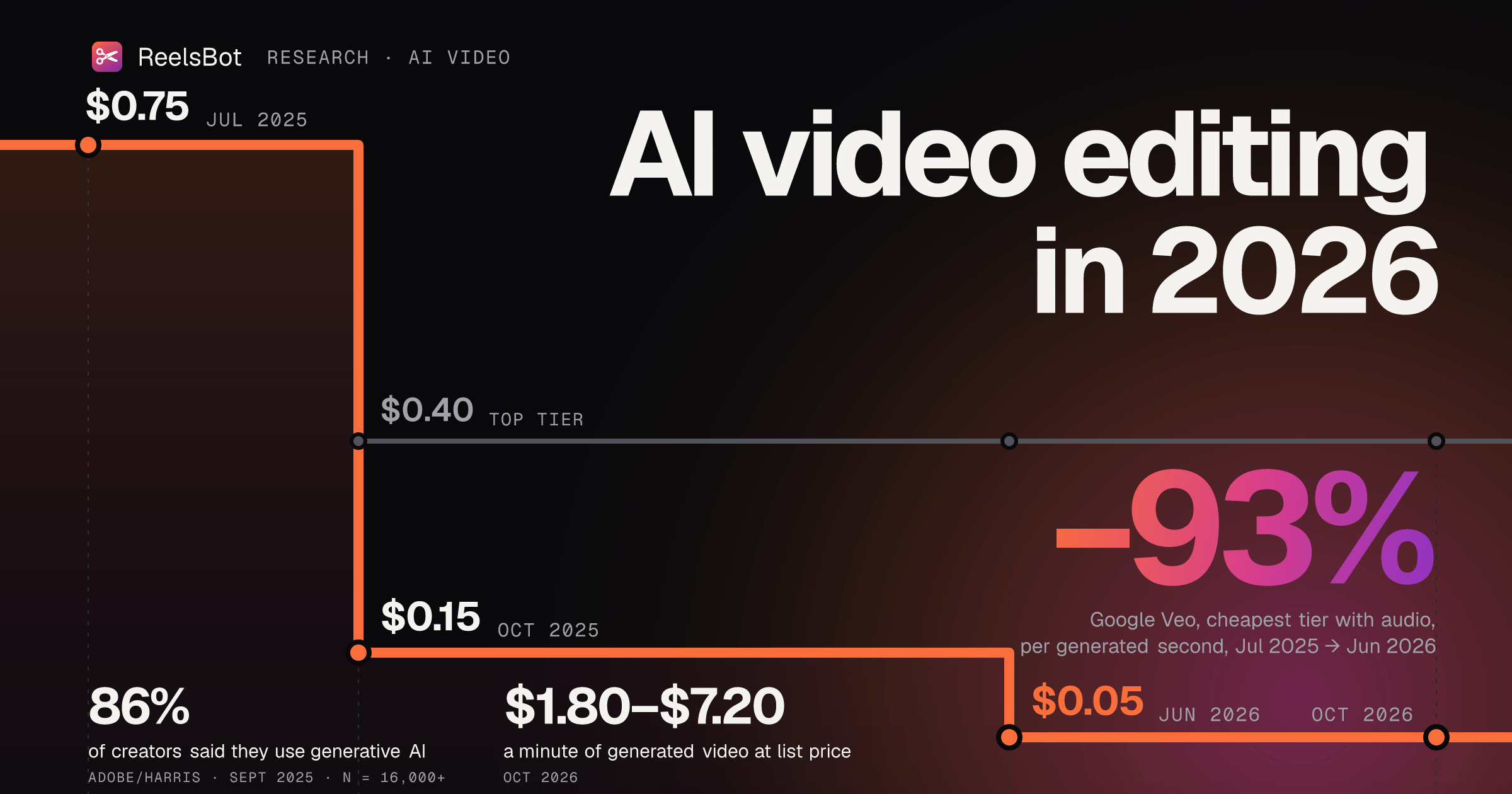
- 4Google's cheapest Veo tier with audio fell from $0.75 to $0.05 per second of generated video between July 2025 and June 2026, −93% in about ten months, on its own price lists.
- 5At list prices, a minute of generated video costs $1.80 to $7.20 on eight cheap and mid-tier models we priced; Veo 3 charged $45 at launch in July 2025. These are prices per generated second, so every retake adds to them.
- 6The newest models don't always get cheaper: Runway's newest (Gen-4.5, 12 credits a second in October 2026) costs 140% more credits per second than its newest did in October 2023 (Gen-2, 5), and Luma's 1080p price rose 41%. Google's top Veo tier fell 47%; its cheapest fell fastest.
- 7Speech-to-text by API fell 87.5%, from $0.024 a minute in 2018 to $0.003 in 2026. Over 2023–2026, Rev's human transcription and captions went up 33%, to $1.99 a minute.
- 8The US had 25,610 employed film and video editors in May 2025, 20.2% fewer than at the May 2022 peak, by BLS estimates; their real median wage is 5.8% below 2019. But the whole US film and sound-recording industry shed 20.8% of its jobs over the same years, and freelance studies found video editing among the work least affected by early generative AI. The data doesn't pin the decline on AI.
86%
Creators 'actively using creative generative AI', Sept 2025, 16,000+ creators in 8 countries
Source: Adobe / Harris Poll
−93%
Google's cheapest Veo tier with audio, per generated second, $0.75 (Jul 2025) → $0.05 (Jun 2026)
list prices, ReelsBot calculation
−20.2%
US film and video editors, May 2022 → May 2025 (25,610), excluding the self-employed
Source: BLS OEWS
Most creators say they use AI, depending on how you ask#
The best-known number comes from Adobe. In September 2025 the Harris Poll surveyed more than 16,000 creators in eight countries for Adobe's first Creators' Toolkit Report, which found "86 percent of creators now actively using creative generative AI". Adobe counted as creators people who publish "at least a few times per month", a group it describes as mostly emerging and semi-professional, and it didn't publish the question. The top use was "editing, upscaling, and enhancement" (55%), ahead of generating images and video (52%) and ideation (48%).
The other surveys land elsewhere. Epidemic Sound's 2026 report, from 3,000 UK and US creators surveyed by Sapio Research in March and April 2026, says "94% already use it, 89% feel some pressure to keep up". In an Adobe Express poll of 384 US video makers on Prolific in December 2025, 71% said they had incorporated AI video tools into their workflow. In 2023, before most of today's tools existed, Descript and Ipsos found 65% of 1,004 US podcasters and video creators had ever used generative AI.
Share of creators who say they use AI
% of respondents, by survey; each asks a different question of a different group, 2023–2026
| Label | Value |
|---|---|
| Epidemic Sound / Sapio, Mar–Apr 2026: 'already use' AI | 94% (n = 3,000) |
| Adobe / Harris, Sept 2025: 'actively using' gen AI | 86% (n = 16,000+) |
| Adobe Express / Prolific, Dec 2025: use AI video tools | 71% (n = 384) |
| Descript / Ipsos, Mar–Apr 2023: ever used gen AI | 65% (n = 1,004) |
Sources: Wistia; Epidemic Sound; Adobe; Adobe Express; Ipsos
 ReelsBot
Ask about editing specifically and the numbers fall. In January 2026 the Influencer Marketing Factory surveyed 1,000 US creators aged 18 to 65, and "a quarter of creators say they're using AI tools for editing", with 21% using it for ideas. Adobe's 55% lumps editing in with upscaling and enhancement. A third figure travels widely as "58% of creators use AI editing", but it comes from the Adobe Express poll, which says editing "tops the list (58%)" of AI uses without saying whether that's 58% of all 384 respondents or of the AI users among them. It isn't an adoption rate.
Share of creators who say they use AI for editing
% of respondents, by survey, 2025–2026; two different questions of two different groups
| Label | Value |
|---|---|
| Influencer Marketing Factory, Jan 2026: AI for editing | 25% (n = 1,000, US) |
| Adobe / Harris, Sept 2025: editing, upscaling, enhancement | 55% (n = 16,000+) |
Sources: MarketingProfs on IMF (Wayback); Adobe
Adobe's second wave, run in May 2026, doesn't update the 86%. Its June 2026 release reports mostly on creators who use or have tried creative AI, and it widened the definition of a creator to people who also "generate income" from their content. Among those AI users, 75% call it integrated or essential, and 57% say their AI outputs "typically require moderate or extensive editing before they're ready to share". So AI hasn't removed the edit: by creators' own account, its output often needs one.
The platforms built it in#
The bigger change is that creators no longer need a separate AI tool. In September 2025 YouTube began testing Edit with AI, which it says "transforms your raw camera roll footage into a compelling first draft". Six weeks later TikTok launched Smart Split, which, TikTok says, "automatically clips, reframes, captions, and transcribes longer content into multiple short videos". At Made on YouTube in September 2026, YouTube showed a Gemini editing assistant for Shorts that takes text prompts to "trim speech, sync music, add text hooks, and reorder frames"; it gave no launch date.
AI editing features the platforms and editors shipped
Selected launches and expansions, YouTube, TikTok, Meta, Adobe and Apple, Sep 2023–Sep 2026
21 Sep 2023
21 Sep 2023
YouTube announces Dream Screen AI backgrounds for Shorts and the YouTube Create app
Source: YouTube
14 Oct 2024
14 Oct 2024
Premiere Pro Generative Extend in beta: new frames at the start or end of a clip
Source: Adobe
13 Nov 2024
10 Dec 2024
10 Dec 2024
YouTube auto dubbing for 'hundreds of thousands' of Partner Program channels
Source: YouTube
22 Apr 2025
11 Jun 2025
16 Sep 2025
28 Oct 2025
28 Jan 2026
28 Jan 2026
Apple Creator Studio; Final Cut Pro adds Transcript Search, Visual Search and Montage Maker
Source: Apple
4 Feb 2026
19 May 2026
23 Sep 2026
23 Sep 2026
YouTube shows a Gemini editing assistant for Shorts and YouTube Create, no date given
Source: YouTube
The platforms give only a few usage numbers, and they're their own. Alphabet's CEO Sundar Pichai said that "on average, every day in December, over one million channels used our new AI creation tools" in his Q4 2025 earnings remarks. YouTube says more than 6 million daily viewers watched at least 10 minutes of auto-dubbed video in December 2025, and in May 2026 it said there are "millions of channels using auto dubbing". None of these isolates editing.
The standalone AI tools report growth too, on their homepages. OpusClip, an AI clipping tool, says on its homepage it is "used by 20M+ creators and businesses", and Kapwing says on its homepage "over 30 million creators". Read through the Wayback Machine, those counters show how fast the claims climbed.
What two AI video tools say about their users
User counts claimed on each homepage, Wayback captures and the live page, Sep 2023–Oct 2026
| Series | x | y |
|---|---|---|
| OpusClip | Sep 2023 | 400K |
| OpusClip | Mar 2024 | 3M |
| OpusClip | May 2024 | 5M |
| OpusClip | Sep 2024 | 6M |
| OpusClip | Mar 2025 | 10M |
| OpusClip | Sep 2025 | 12M |
| OpusClip | May 2026 | 16M |
| OpusClip | Oct 2026 | 20M (20M+) |
| Submagic | Jun 2024 | 1M |
| Submagic | Aug 2024 | 1.4M |
| Submagic | Oct 2024 | 2M |
| Submagic | Apr 2025 | 3M |
| Submagic | Dec 2025 | 4M (4M) |
Sources: ReelsBot Wayback census of homepages; opus.pro; submagic.co
The companies selling AI video are raising and earning more, by their own and their advisers' accounts. HeyGen, which makes AI avatar video, says it passed $200 million in annual recurring revenue in June 2026, "doubling in eight months". Runway announced a $315 million Series E in February 2026. Synthesia's $200 million Series E in January 2026 valued it at US$4 billion, per its lawyers at Latham & Watkins, and Captions, the AI editing app, raised $60 million at a $500 million valuation in 2024, according to its lead investor Index Ventures.
How much AI is in the feed#
TikTok gives a cumulative count. It said it had labeled over 1.3 billion videos by November 2025 and "over 3 billion videos as AIGC" by July 2026, using Content Credentials, creator labels and its own invisible watermarks. That's a total, not a share of what people watch, and no platform publishes the share.
The only feed measurements we found come from Kapwing, which sells an AI video editor. It opened a fresh YouTube account and coded the first 500 Shorts it was served: 104 (21%) were AI-generated. It did the same on TikTok in 2026, and 294 of the first 500 (59%) For You videos were what it calls AI slop. Each is one account and one session, so treat them as snapshots.
AI videos among the first 500 served to a new account
% of the first 500 videos, one fresh account per platform, coded by hand by Kapwing; reports published Nov 2025 (YouTube) and Jun 2026 (TikTok)
| Label | Value |
|---|---|
| TikTok For You feed | 59% (294 of 500) |
| YouTube Shorts feed | 21% (104 of 500) |
The rules caught up#
All three big platforms ask creators to label realistic AI-generated content, and YouTube spells out that light AI help needs no label. Its disclosure tool, live since March 2024, doesn't require a label for "productivity" uses such as scripts, ideas or captions, or for beauty filters, colour correction and background blur. Its Help Center says "disclosing AI content alone won't limit a video's audience or impact its eligibility to earn money." TikTok's Community Guidelines require a label on AI-generated or significantly edited content that shows realistic scenes or people. Meta moved its "AI info" label into the post menu in 2024 for content that AI only edited, rather than generated.
What changed in 2026 is enforcement. In May YouTube said that if a creator doesn't say whether they used AI "but our systems detect significant photorealistic AI use, we will now automatically apply a label". Then its Partner Program rules gained two AI-specific clauses. YouTube's help page isn't dated by change, so we compared Wayback captures of it to find when each phrase first appears.
How the platforms' AI rules changed
Disclosure, labelling and monetization rules for AI content, YouTube, Meta and TikTok, Nov 2023–Jul 2026
14 Nov 2023
18 Mar 2024
18 Mar 2024
YouTube's disclosure tool goes live; AI for scripts, ideas and captions needs no label
Source: YouTube
1 Jul 2024
1 Jul 2024
Meta renames 'Made with AI' to 'AI info'; edited-only content moves to the menu in September
Source: Meta
14 Jul 2025
14 Jul 2025
Facebook: 'simply stitching together clips' isn't original enough to monetize
Source: Facebook
Jul 2025
Jul 2025
YouTube renames 'repetitious' content 'inauthentic content' in its monetization policy
Source: YouTube Help
24 Nov 2025
27 May 2026
31 May–4 Jun 2026
31 May–4 Jun 2026
YouTube policy adds 'AI-generated content made with generic or unoriginal templates'
Added between Wayback snapshots: absent on 31 May, present on 4 June.Source: ReelsBot Wayback check of YouTube Help 1311392
13–14 Jul 2026
13–14 Jul 2026
YouTube policy adds 'AI Personas Related to Sensitive Topics'
Added between Wayback snapshots: absent on 13 July, present on 14 July.Source: ReelsBot Wayback check of YouTube Help 1311392
The June clause lists "AI-generated content made with generic or unoriginal templates giving the impression of mass production without adding the creator's original, authentic insights or perspective" as not monetizable. The same page says "using AI to edit your video scripts or generate a unique background visual" is fine. The July clause, reported by TechCrunch, bars monetization for channels whose AI personas present as human experts on health, legal, financial or political topics, such as an AI "doctor". YouTube hasn't said how many channels either clause affected. In its CEO's 2026 letter, it said that to reduce "low quality AI content" it is "building on our established systems" against spam and clickbait.
What AI video costs now#
For generated video, the price lists moved fast. When Google put Veo 3 on its Gemini API in July 2025, it charged $0.75 per second of video with audio. By October 2025 there was a Standard tier at $0.40 and a Fast tier at $0.15. By June 2026, Veo 3.1 Lite cost $0.05 a second at 720p, with audio: 93% less than Veo 3 about ten months earlier. On 27 October 2026 Google's Vertex AI price list still showed Lite at $0.05.
Google's Veo prices per second of generated video
US dollars per second, video with audio, 720p, Gemini API list prices (Vertex AI for Oct 2026), Jul 2025–Oct 2026
| Series | x | y |
|---|---|---|
| Top tier (Veo 3 → Veo 3.1 Standard) | 20 Jul 2025 | $0.75 |
| Top tier (Veo 3 → Veo 3.1 Standard) | 21 Oct 2025 | $0.4 |
| Top tier (Veo 3 → Veo 3.1 Standard) | 2 Jun 2026 | $0.4 |
| Top tier (Veo 3 → Veo 3.1 Standard) | 27 Oct 2026 | $0.4 ($0.40) |
| Cheapest tier (Veo 3 → Fast → Lite) | 20 Jul 2025 | $0.75 |
| Cheapest tier (Veo 3 → Fast → Lite) | 21 Oct 2025 | $0.15 |
| Cheapest tier (Veo 3 → Fast → Lite) | 2 Jun 2026 | $0.05 |
| Cheapest tier (Veo 3 → Fast → Lite) | 27 Oct 2026 | $0.05 ($0.05) |
Sources: Gemini API pricing (Wayback); Vertex AI pricing; ReelsBot calculation
Other vendors priced in the same range. Multiplying each list price by 60 gives the cost of a minute of generated video: $1.80 for xAI's Grok Imagine 1.5 Lite at 720p, resold through Runway's developer API, up to $7.20 for Runway's own Gen-4.5. Google's newer Gemini Omni Flash model works out to "approximately $0.10 per second", Google says. OpenAI's Sora 2 cost $0.10 a second on its API until OpenAI shut the Videos API down on 24 September 2026, with no replacement named.
What a minute of generated video costs at list price
US dollars for 60 seconds of output, API or plan list price × 60, 720p where the price list sets one, prices read Oct 2026 unless noted
| Label | Value |
|---|---|
| Grok Imagine 1.5 Lite (via Runway) | $1.80 |
| Veo 3.1 Lite | $3.00 |
| Runway Gen-4 Turbo | $3.00 |
| Luma Ray 3.2 | $3.60 |
| Kling 3.0 Standard (via Runway) | $5.40 (no audio) |
| Gemini Omni Flash | ~$6 |
| Sora 2 | $6.00 (API shut Sep 2026) |
| Runway Gen-4.5 | $7.20 |
| Veo 3.1 Standard | $24.00 |
| Veo 3 at launch (Jul 2025) | $45.00 |
Sources: Runway Dev pricing; Vertex AI; Luma API; OpenAI (Wayback); ReelsBot calculation
The newest models don't always get cheaper#
The steepest falls are below the top tier: Google's top Veo tier fell 47% while its cheapest fell 93%, and at Runway the newest model got dearer. Runway sells its plans in credits, and its Standard plan has given 625 credits a month in every capture we read. In October 2023, 625 credits bought 125 seconds of Gen-2, then its newest model: 5 credits a second. In January 2026, the same credits bought 25 seconds of Gen-4.5, 25 a second. Runway has since cut Gen-4.5 by about half, to 12 credits a second (52 seconds per 625 credits), which is still 140% more than Gen-2 cost when it was new. Its cheapest model fell from 14.2 credits a second (Gen-1, March 2023) to 5 (Gen-4 Turbo), −65%.
Runway's price per second, by model and date
Credits per second of generated video, Runway Standard plan (Oct 2026: API rate for Gen-4 Turbo), Mar 2023–Oct 2026
| Label | Value |
|---|---|
| Gen-1, Mar 2023 (only one listed) | 14.2 |
| Gen-2, Oct 2023 (newest) | 5 |
| Gen-4 Turbo, Jan 2026 | 5 |
| Gen-4, Jan 2026 | 12 |
| Gen-4.5, Jan 2026 (newest) | 25 |
| Gen-4 Turbo, Oct 2026 | 5 |
| Gen-4.5, Oct 2026 (newest) | 12 |
Sources: Runway pricing (Wayback, Oct 2023); Runway pricing (Wayback, Jan 2026); runwayml.com; Runway Dev
Luma shows the same split by resolution. Its API charged $0.70 for a 5-second 720p clip from Ray2 in April 2025 and charges $0.30 for the same clip from Ray 3.2 now, 57% less per second. At 1080p it went from $0.85 to $1.20 a clip, 41% more. AI clipping, where a tool cuts a long video into shorts rather than generating new footage, didn't get cheaper either. OpusClip charged $19 for 200 upload minutes in September 2023, $0.095 a minute; it now charges $15 for 150 credits, where "1 credit = 1 minute of video processing": $0.10 a minute.
Transcription got almost free; people didn't#
The AI part of editing that most creators touch daily is the transcript, which drives captions and text-based editing. Its list price has kept falling since 2018. Amazon Transcribe launched in 2018 at $0.0004 a second, or $0.024 a minute. OpenAI's Whisper API cost $0.006 a minute in March 2023, and its gpt-4o-mini-transcribe costs $0.003 today: 87.5% below 2018, about 22% a year.
People got dearer. Rev charged $1.50 a minute for human transcription and English captions in January 2023 and $1.99 now, up 33%. That's about 660 times the cheapest AI rate. Rev's human service promises 99%+ accuracy, so the two aren't the same product.
AI transcription fell 87.5%; human transcription rose 33%
US dollars per minute of audio, list prices, log scale, 2018–Oct 2026
| Series | x | y |
|---|---|---|
| Cheapest big-vendor AI rate | Apr 2018 | $0.024 ($0.024 AWS) |
| Cheapest big-vendor AI rate | Mar 2023 | $0.006 ($0.006 Whisper) |
| Cheapest big-vendor AI rate | Oct 2026 | $0.003 ($0.003) |
| Rev human transcription | Jan 2023 | $1.5 ($1.50) |
| Rev human transcription | Oct 2026 | $1.99 ($1.99) |
Sources: AWS; OpenAI pricing; Rev (Wayback, Jan 2023); rev.com; ReelsBot calculation
What happened to editing jobs#
The obvious question is what all this did to people who edit for a living. In the US, the Bureau of Labor Statistics' Occupational Employment and Wage Statistics (OEWS) put film and video editors at 25,610 in May 2025, down 20.2% from 32,080 at the May 2022 peak. That count excludes the self-employed, who make up about 35% of editors; the BLS Occupational Outlook Handbook, which includes them, has "about 39,400 jobs in 2025", down from 51,000 in 2022. The median employed editor earned $75,420 in May 2025, 18.3% more than in 2019 in dollars but 5.8% less after inflation, while the median across all US occupations gained 2.0% in real terms.
The whole industry around them fell as far. Employment in US motion picture and sound recording averaged 447,300 in 2022 and 354,400 in 2025, by the BLS payroll survey, 20.8% less; in September 2026 it was 328,500 (preliminary). That window holds the 2023 writers' and actors' strikes and the streaming cutbacks that followed. In the same OEWS counts, writers and authors (−11.2%) and graphic designers (−6.6%) fell less than editors from 2022 to 2025, and all arts, design and media jobs were nearly flat (−0.8%).
Editors fell with the film industry, not apart from it
Employment index, 2022 = 100; US film and video editors (OEWS, May, excludes self-employed) and motion picture and sound recording industries (CES, annual average), 2019–2025
| Series | x | y |
|---|---|---|
| Film and video editors | 2019 | 86 |
| Film and video editors | 2020 | 70 |
| Film and video editors | 2021 | 87 |
| Film and video editors | 2022 | 100 |
| Film and video editors | 2023 | 91 |
| Film and video editors | 2024 | 90 |
| Film and video editors | 2025 | 80 |
| Motion picture and sound recording industries | 2019 | 98 |
| Motion picture and sound recording industries | 2020 | 67 |
| Motion picture and sound recording industries | 2021 | 85 |
| Motion picture and sound recording industries | 2022 | 100 |
| Motion picture and sound recording industries | 2023 | 91 |
| Motion picture and sound recording industries | 2024 | 86 |
| Motion picture and sound recording industries | 2025 | 79 |
The BLS's own outlook has dimmed. Each year's Handbook projects editor jobs ten years ahead, and the projection fell from +33% in the 2020–30 edition to +4% in the two latest; the 2020–30 edition started from the 2020 pandemic low. The 2025–35 edition expects 1,500 more editor jobs, to 40,800.
The BLS's ten-year outlook for editors shrank
Projected % change in US film and video editor jobs over ten years, by edition of the Occupational Outlook Handbook, 2018–28 to 2025–35
| Label | Value |
|---|---|
| 2018–28 | +14% |
| 2019–29 | +22% |
| 2020–30 | +33% |
| 2021–31 | +14% |
| 2022–32 | +9% |
| 2023–33 | +5% |
| 2024–34 | +4% |
| 2025–35 | +4% |
Sources: BLS Occupational Outlook Handbook (Wayback, Oct 2026); ReelsBot reading of 8 editions
None of this isolates AI, and the studies that tried to measure AI's effect on freelance work found editing among the least exposed. Demirci, Hannane and Zhu found a 21% drop in job posts for automation-prone writing and coding work after ChatGPT; they used video services as a comparison group because "these are fields where human labor provides unique value", and video's share of posts rose from 2.92% to 3.93%. In Hui and Reshef's Upwork study, video editing was among the categories "expected to experience little or no direct impact from these early AI tools". Both studies end in 2023, before Sora and Veo 3, so they can't speak to video generation.
The freelance platforms describe demand shifting toward AI video work. Upwork says freelancer earnings for AI video generation and editing grew 329% in 2025, its fastest-growing creative skill, and lists video editing as the second most in-demand design and creative skill. Fiverr says business searches for "faceless YouTube video editor" rose 59% and for AI video creators 66% in the six months to December 2025. These are platform claims without base numbers.
What this means if you make videos#
- Label realistic AI; light AI help is fine. YouTube doesn't ask you to label AI used for scripts, ideas, captions, colour correction or background blur. YouTube, TikTok and Meta all want a label on realistic generated people and scenes; YouTube applies one itself from May 2026 if you don't, and says the label alone won't limit reach or earnings.
- Add something a template can't. YouTube's monetization policy now names "AI-generated content made with generic or unoriginal templates" and allows using AI to edit scripts or make a background. The line is your own insight, not the tool. Avoid AI presenters on health, money, legal or political topics if you want to monetize.
- Expect to edit what AI gives you. 57% of the AI-using creators in Adobe's 2026 survey said outputs typically need moderate or extensive editing. AI first drafts (YouTube's Edit with AI, TikTok's Smart Split) are a starting point.
- Budget per kept second, not per generated second. Every retake is billed. Prototype on a cheap tier ($0.05 a second for Veo 3.1 Lite) and save the top tier, which costs several times more, for the shot that needs it.
- Try what's built in before paying. Auto dubbing, Shorts remixing and Veo 3 Fast on YouTube, Smart Split on TikTok and Meta's Edits come inside the apps you post from; YouTube says Veo 3 Fast in Shorts and Omni remixing cost nothing. Pay for a separate tool when it does something those don't.
- Use AI transcripts, and check them. Transcription by API costs fractions of a cent a minute. Check names and jargon before you burn in captions; pay for a human pass ($1.99 a minute at Rev) when accuracy has to be guaranteed.
- Read creator AI stats by their question. "Uses AI" and "uses AI for editing" differ by 31 points in the same Adobe survey (86% vs 55%), and the widely shared 58% has no stated base.
- If you edit for others, the data points to short-form and AI skills. Employed US editor jobs fell with the film industry from 2022, while Upwork and Fiverr say demand for AI video and faceless-channel editing is rising.
We're building ReelsBot, a Mac app that turns raw talking-head clips into a cut: it removes retakes, stutters and dead air, lets you edit by transcript and burns in captions in 9:16. It uses AI (Anthropic's Claude) to plan the edit and has an offline mode, so we have a stake in this topic; none of the numbers above come from our product.
Methodology#
Surveys. We used creator surveys that publish a sample size and fieldwork dates, read back to the publisher's page or PDF: Adobe and the Harris Poll (Sept 2025, May 2026), Adobe Express (Dec 2025), Epidemic Sound and Sapio Research (Mar–Apr 2026), the Influencer Marketing Factory (Jan 2026, via MarketingProfs because its site blocked us), Wistia (2026) and Descript with Ipsos (2023). Only Ipsos publishes its question wording. Figures found only in secondary coverage are left out.
Platform and vendor numbers are as stated on the companies' own blogs, earnings pages and homepages. Homepage user counts come from Wayback captures about every two months, 2023–2026; where a page showed two counters, we took the header figure.
Policy dating. YouTube's monetization policy page isn't dated by change, so we bisected its Wayback captures for the last one without, and the first with, each new phrase. The date is when the text first reached the archive, which can trail the change by a few days.
Prices. 54 observations from official pricing pages and API docs, live on 27 October 2026 and in Wayback captures back to 2018, compared like for like (same vendor, same unit). AI video prices are list prices per generated second; a minute is that × 60, at 720p where the list sets a resolution. Kling and Grok Imagine are Runway's developer-API resale prices at $0.01 a credit. Retakes, volume discounts, free tiers and taxes aren't included.
Labour. OEWS national estimates for film and video editors (27-4032) and comparison occupations, May 2019–May 2025, from the BLS files, with 2025 re-checked on the BLS API; real wages use May CPI-U, in May 2025 dollars. OEWS excludes the self-employed and isn't designed as a time series, so we report the 2022 peak and the direction. Self-employed totals and projections come from eight Wayback editions of the Occupational Outlook Handbook; industry jobs from the BLS payroll survey for NAICS 512. The 2022 = 100 index is our calculation. Alphabet's Q3 2026 remarks, due 28 October, weren't out when we checked on 27 October, so no newer YouTube figure is used.
Open questions#
- How many creators use AI for editing (cuts, captions, reframing, removing silences), asked plainly with a stated base? No survey isolates it from generation.
- What share of what people watch is AI-generated? TikTok gives a cumulative count of labeled videos; no platform gives a share, and the only feed samples are one vendor's single accounts.
- How many channels lost monetization under YouTube's June and July 2026 AI clauses?
- How many takes does a usable second of AI video take? Without it, cost per finished minute is a guess.
- Have Sora, Veo 3 and Runway's Gen-4 models changed demand or pay for editors? The rigorous freelance studies end in 2023.
- What do self-employed editors, a third of the profession, earn? OEWS doesn't cover them.
- How many creators use YouTube's Edit with AI, TikTok's Smart Split or Meta's Edits AI features? Only YouTube gives an aggregate, and it covers all its AI creation tools.