"You have three seconds" is the most repeated rule in short-form video. Instagram's head Adam Mosseri has said it, YouTube's Help Center says something close to it, and hook guides routinely back it with a statistic. But the statistics behind the rule mostly come from advertising research the platforms paid for, and none of the big three apps publishes benchmarks for how fast viewers leave organic videos.
So we measured it. This report combines what each platform says about the opening seconds, what the famous numbers really measured, and survival curves we computed from two public play logs: 2.2 million plays from Kuaishou, a Chinese short-video app, in 2022, and 33.6 million plays from VK, a Russian one, in 2025. Neither is TikTok, Shorts or Reels, and we say where that matters. Platform statements are the platforms' claims, vendor numbers are labelled as vendor numbers, and every number links to its source.
Key findings
- 1Each platform ends "the opening" at a different second. Instagram's skip rate counts skips in the first 3 seconds, TikTok's Creator Rewards doesn't pay for views under 5 seconds, and YouTube's "stayed to watch" means past "the initial seconds", a number YouTube has never published.
- 2The best-known "first seconds" statistics are about ads. Facebook reported, from Nielsen studies, that people who watched a video ad for under 3 seconds created up to 47% of a campaign's value, depending on the metric, and TikTok says 50% of an ad's impact lands in the first 2 seconds. Neither measures how many viewers leave an organic video.
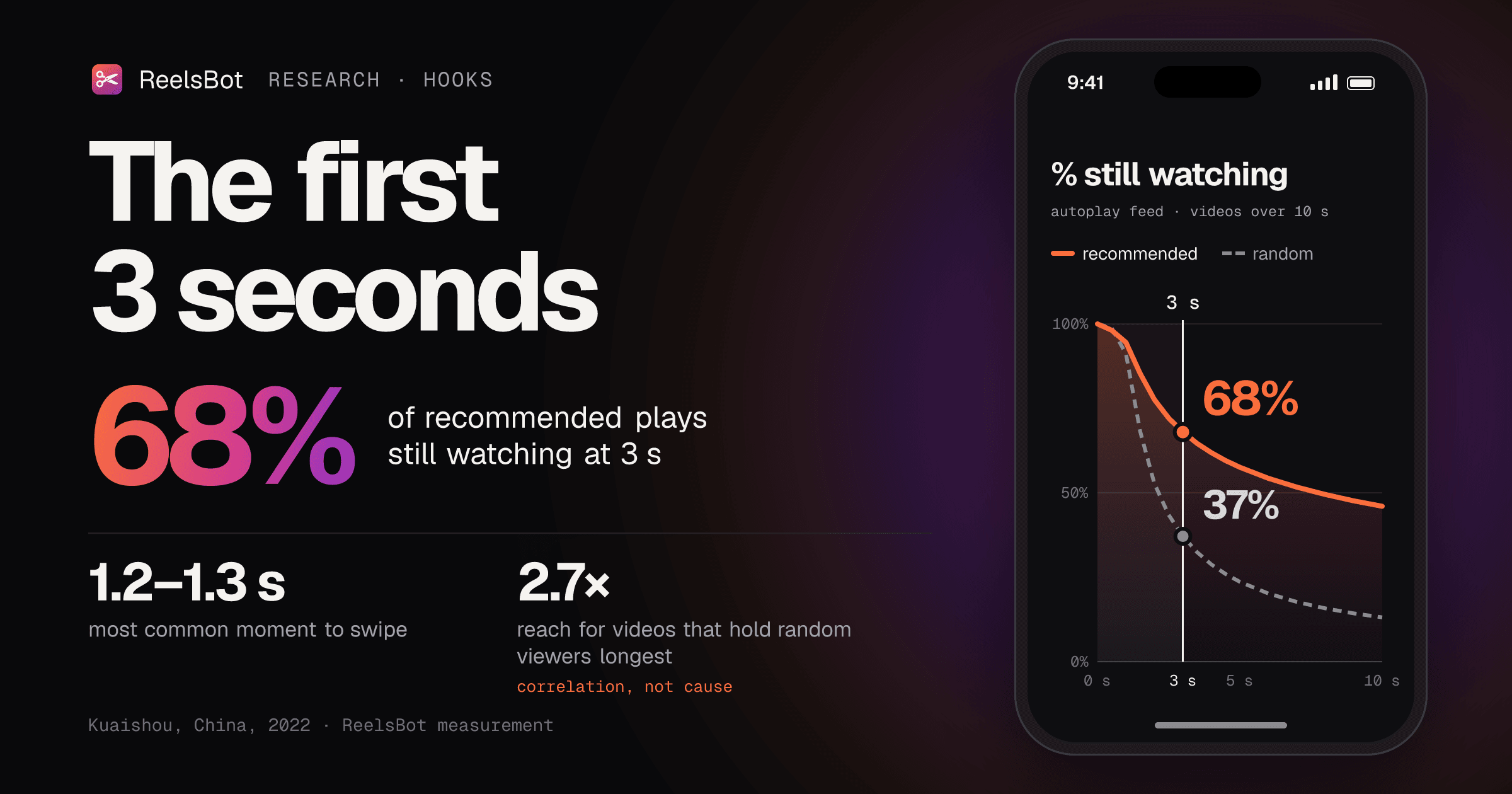
- 3In our measurement of Kuaishou's autoplay feed (China, 2022), 67.9% of recommended plays were still going at 3 seconds and 46.0% at 10 seconds.
- 4When Kuaishou slotted in a random video instead of a recommended one, only 37.2% of plays lasted 3 seconds, and the median play lasted 2.1 seconds. That's the closest public data we found to a stranger meeting a video cold, though it's Kuaishou, not TikTok, Shorts or Reels.
- 5The most common moment to swipe was 1.2–1.3 seconds in. Fewer than 1 in 10 plays ended in the first second; the exits pile up right after it.
- 6In our analysis, videos that held random viewers past 3 seconds got more distribution: the top quarter got 2.7 times the Kuaishou-wide impressions of the bottom quarter. It's a correlation (ρ = 0.28), not proof that a better hook causes reach.
- 7On Kuaishou, the 7-second hold tracked reach better than the 3-second hold (ρ = 0.37 vs 0.28), and once we knew a video's 7-second hold, its 3-second hold added almost nothing (partial ρ = −0.02). Both are correlations. Seven seconds is where Kuaishou draws its own "valid play" line.
- 8VK's 2025 data shows the same shape outside China (VK, like Kuaishou, isn't TikTok, Shorts or Reels): viewers leave fastest in the first three seconds, then the curve flattens.
68%
Recommended plays still watching at 3 s, Kuaishou, 2022
ReelsBot measurement
37%
Plays of randomly inserted videos still watching at 3 s
Kuaishou 2022, ReelsBot measurement
1.2–1.3 s
The most common moment to swipe away
Kuaishou 2022, ReelsBot measurement
2.7×
Impressions for the videos that held random viewers best vs worst (top vs bottom quarter)
Kuaishou 2022, correlation, ReelsBot measurement
Every platform draws the line somewhere else#
Instagram is the most explicit. In August 2025 it announced it was replacing view rate with skip rate, which, as Social Media Today quoted Instagram's @creators account, "is the percentage of views from people who decided to skip your reel during those first 3 seconds". TikTok draws a money line instead: its Creator Rewards Program excludes "views with less than 5 seconds watched".
YouTube never gives a number. Its Shorts metric "stayed to watch" is "the percentage of times viewers stayed to watch past the initial seconds of a Short", and when YouTube explained engaged views in August 2026 it said a view counts from the first frame, and "if you let it keep playing for some amount of seconds after that first frame, it's an engaged view". That matters: YouTube's Help Center says Shorts average view duration covers only viewers "who stayed to watch", so the swipes in the opening never reach that number. The only YouTube metric with a stated cutoff is the long-form "Intro": the share of your audience that "still watched your video after the first 30 seconds".
Ad products have their own clocks: TikTok counts 2- and 6-second views, Meta 3-second plays and 15-second ThruPlays.
Where each platform says the opening ends
Seconds of watch time at which each metric starts counting, as stated by each platform (pages dated 2024–2026)
| Label | Value |
|---|---|
| YouTube stayed to watch | not disclosed (organic) |
| Instagram skip rate | 3 s (organic) |
| TikTok Creator Rewards | 5 s (organic, pay) |
| YouTube long-form intro | 30 s (organic) |
| TikTok ads, 2-second view | 2 s (ads) |
| Meta ads, 3-second play | 3 s (ads) |
| TikTok ads, 6-second view | 6 s (ads) |
| Meta ads, ThruPlay | 15 s (ads) |
Sources: Social Media Today; TikTok Support (Wayback); YouTube Help; TikTok Ads Help; Meta Business Help (Wayback)
 ReelsBot
The definitions also move. YouTube's metric was first "viewed (vs. swiped away)"; in 27 English Wayback captures of the page, it became "stayed to watch" between February and April 2025, around when YouTube started counting every Short that starts to play as a view.
How the opening-seconds metrics changed
Organic creator metrics, YouTube and Instagram, Feb 2023–Aug 2026
22 Feb 2023
22 Feb 2023
YouTube adds 'Viewed vs. swiped away' for Shorts
Reported from a Creator Insider video; in the Help Center by March 2023.Source: Social Media Today
29 Jan 2025
31 Mar 2025
31 Mar 2025
A Shorts view becomes any start or replay, with no minimum watch time
Source: YouTube Help
Feb–Apr 2025
Feb–Apr 2025
YouTube's Help Center renames the metric 'stayed to watch'
First seen in the 6 Apr 2025 capture.Source: Wayback
22 Aug 2025
22 Aug 2025
Instagram replaces view rate with skip rate and adds a retention chart
Source: Social Media Today
24 Aug 2026
24 Aug 2026
YouTube counts a view from the first frame on every format
Engaged views need 'some amount of seconds'.Source: YouTube Blog
The famous numbers are about ads#
The two most quoted statistics about the opening seconds are real, but both come from ad studies. The first is from Facebook in 2015. Nielsen analysed 173 of its BrandEffect studies of Facebook video ads, and Facebook reported that "people who watched under three seconds of the video ad created up to 47 percent of the total campaign value, and people who watched for fewer than 10 seconds created up to 74 percent, depending on the metric". "Value" there means ad recall, brand awareness and purchase consideration. The finding is that a brand can get some of its message across in a glance, not that 47% of viewers leave in three seconds, which is how it's often retold.
The second is from TikTok's Marketing Science team, which says "50% of the impact from a TikTok ad is realized in the first 2 seconds, and the first 6 seconds capture 90% cumulative impact on Ad Recall and around 80% for Awareness". TikTok doesn't publish the sample. The same post adds a caveat that's useful for creators: "the longer videos continue to play, the audience size tends to decrease".
Ad research: how much of an ad's effect lands in the first seconds
Share of total measured ad effect, as reported by each platform; ads only, not organic video
| Label | Value |
|---|---|
| Facebook/Nielsen, viewers under 3 s | up to 47% (value, 2015) |
| Facebook/Nielsen, viewers under 10 s | up to 74% (value, 2015) |
| TikTok, first 2 s | 50% (impact) |
| TikTok, first 6 s, ad recall | 90% (impact) |
| TikTok, first 6 s, awareness | ~80% (impact) |
Sources: Facebook for Business (Wayback); TikTok for Business
Other platform research is also about ads. TikTok says "over 63% of all videos with the highest click-through rate (CTR) highlight their key message or product within the first 3 seconds", without a sample size. Toluna, working with Meta on about 100 short-form video ads, found that ads that set up brand and core message in the first five seconds "were 1.7 times more likely to drive strong purchase intent". On the organic side, the platforms give advice, not data. YouTube's Help Center says "the initial seconds of your content are when viewers decide to stay or move on, especially for Shorts and long-form videos", and Mosseri, in a reel transcribed by Inman, said "the first three seconds of a reel are super important. Now, we call this the hook."
What we measured: the 3-second cliff#
Kuaishou, the Chinese short-video app, published KuaiRand, a research dataset of one month of plays from April to May 2022, with each play's watch time in milliseconds. We used only its single-column feed, which the dataset's paper calls "the most commonly used UI", where "the video will automatically play", like TikTok's For You feed. What makes it unusual is a second log: for two weeks, Kuaishou randomly replaced a small, undisclosed share of recommended videos with one drawn uniformly from a pool of 7,583. Those random plays show what happens when a video meets a viewer who wasn't picked for it.
On recommended plays, 94.5% of viewers were still watching at 1 second, 67.9% at 3 seconds, 51.3% at 7 seconds and 46.0% at 10 seconds (1.04 million plays, 26,460 users, 7,080 videos). On random videos, 91.2% made it to 1 second, 52.8% to 2 seconds and only 37.2% to 3 seconds (1.14 million plays). The median random play lasted 2.1 seconds.
Most of the drop happens between second 1 and second 3
% of plays still watching, by second, Kuaishou autoplay feed, videos longer than 10 s, Apr–May 2022
| Series | x | y |
|---|---|---|
| Recommended video | 0 | 100% |
| Recommended video | 0.5 | 98.1% |
| Recommended video | 1 | 94.5% |
| Recommended video | 1.5 | 85.3% |
| Recommended video | 2 | 77.6% |
| Recommended video | 2.5 | 72.1% |
| Recommended video | 3 | 68% |
| Recommended video | 3.5 | 64.6% |
| Recommended video | 4 | 61.9% |
| Recommended video | 4.5 | 59.5% |
| Recommended video | 5 | 57.6% |
| Recommended video | 6 | 54.3% |
| Recommended video | 7 | 51.7% |
| Recommended video | 8 | 49.5% |
| Recommended video | 9 | 47.6% |
| Recommended video | 10 | 46% |
| Random video | 0 | 100% |
| Random video | 0.5 | 98.8% |
| Random video | 1 | 91.2% |
| Random video | 1.5 | 68.2% |
| Random video | 2 | 52.7% |
| Random video | 2.5 | 43.5% |
| Random video | 3 | 37.1% |
| Random video | 3.5 | 32.4% |
| Random video | 4 | 28.8% |
| Random video | 4.5 | 26% |
| Random video | 5 | 23.6% |
| Random video | 6 | 20.2% |
| Random video | 7 | 17.7% |
| Random video | 8 | 15.8% |
| Random video | 9 | 14.3% |
| Random video | 10 | 13.1% |
Source: ReelsBot measurement on KuaiRand-Pure (Gao et al., CIKM 2022), CC BY-SA 4.0
Put another way, 32.1% of recommended plays and 62.8% of random ones ended before 3 seconds. Of all the recommended plays that didn't reach the end of the video, 39.6% ended inside those first 3 seconds; for random videos it was 65.2%. Only 18.9% of recommended plays and 3.6% of random ones reached the end.
The swipe comes at about 1.2 seconds#
Few leave in the first second. Then the exits pile up. The busiest 100-millisecond window started at 1.3 seconds for recommended plays and 1.2 seconds for random ones, and 16.9% of recommended plays and 38.4% of random plays ended between 1.0 and 2.0 seconds.
The most common moment to swipe is 1.2–1.3 seconds
% of all plays ending in each 100-ms window, first 5 s, Kuaishou autoplay feed, videos longer than 10 s, Apr–May 2022
| Series | x | y |
|---|---|---|
| Recommended video | 0 | 1.15% |
| Recommended video | 0.1 | 0.15% |
| Recommended video | 0.2 | 0.16% |
| Recommended video | 0.3 | 0.2% |
| Recommended video | 0.4 | 0.23% |
| Recommended video | 0.5 | 0.28% |
| Recommended video | 0.6 | 0.41% |
| Recommended video | 0.7 | 0.65% |
| Recommended video | 0.8 | 0.97% |
| Recommended video | 0.9 | 1.3% |
| Recommended video | 1 | 1.62% |
| Recommended video | 1.1 | 1.83% |
| Recommended video | 1.2 | 1.94% |
| Recommended video | 1.3 | 1.94% |
| Recommended video | 1.4 | 1.88% |
| Recommended video | 1.5 | 1.76% |
| Recommended video | 1.6 | 1.65% |
| Recommended video | 1.7 | 1.54% |
| Recommended video | 1.8 | 1.43% |
| Recommended video | 1.9 | 1.35% |
| Recommended video | 2 | 1.24% |
| Recommended video | 2.1 | 1.17% |
| Recommended video | 2.2 | 1.07% |
| Recommended video | 2.3 | 1.03% |
| Recommended video | 2.4 | 0.95% |
| Recommended video | 2.5 | 0.92% |
| Recommended video | 2.6 | 0.86% |
| Recommended video | 2.7 | 0.82% |
| Recommended video | 2.8 | 0.77% |
| Recommended video | 2.9 | 0.76% |
| Recommended video | 3 | 0.73% |
| Recommended video | 3.1 | 0.69% |
| Recommended video | 3.2 | 0.66% |
| Recommended video | 3.3 | 0.67% |
| Recommended video | 3.4 | 0.63% |
| Recommended video | 3.5 | 0.58% |
| Recommended video | 3.6 | 0.57% |
| Recommended video | 3.7 | 0.55% |
| Recommended video | 3.8 | 0.53% |
| Recommended video | 3.9 | 0.51% |
| Recommended video | 4 | 0.5% |
| Recommended video | 4.1 | 0.47% |
| Recommended video | 4.2 | 0.47% |
| Recommended video | 4.3 | 0.45% |
| Recommended video | 4.4 | 0.43% |
| Recommended video | 4.5 | 0.42% |
| Recommended video | 4.6 | 0.4% |
| Recommended video | 4.7 | 0.4% |
| Recommended video | 4.8 | 0.37% |
| Recommended video | 4.9 | 0.39% |
| Random video | 0 | 0.39% |
| Random video | 0.1 | 0.16% |
| Random video | 0.2 | 0.19% |
| Random video | 0.3 | 0.22% |
| Random video | 0.4 | 0.26% |
| Random video | 0.5 | 0.38% |
| Random video | 0.6 | 0.63% |
| Random video | 0.7 | 1.19% |
| Random video | 0.8 | 2.14% |
| Random video | 0.9 | 3.29% |
| Random video | 1 | 4.15% |
| Random video | 1.1 | 4.75% |
| Random video | 1.2 | 4.96% |
| Random video | 1.3 | 4.8% |
| Random video | 1.4 | 4.32% |
| Random video | 1.5 | 3.86% |
| Random video | 1.6 | 3.41% |
| Random video | 1.7 | 3.05% |
| Random video | 1.8 | 2.71% |
| Random video | 1.9 | 2.42% |
| Random video | 2 | 2.2% |
| Random video | 2.1 | 2% |
| Random video | 2.2 | 1.84% |
| Random video | 2.3 | 1.66% |
| Random video | 2.4 | 1.54% |
| Random video | 2.5 | 1.46% |
| Random video | 2.6 | 1.34% |
| Random video | 2.7 | 1.25% |
| Random video | 2.8 | 1.18% |
| Random video | 2.9 | 1.12% |
| Random video | 3 | 1.06% |
| Random video | 3.1 | 1% |
| Random video | 3.2 | 0.94% |
| Random video | 3.3 | 0.89% |
| Random video | 3.4 | 0.83% |
| Random video | 3.5 | 0.8% |
| Random video | 3.6 | 0.75% |
| Random video | 3.7 | 0.72% |
| Random video | 3.8 | 0.69% |
| Random video | 3.9 | 0.65% |
| Random video | 4 | 0.62% |
| Random video | 4.1 | 0.58% |
| Random video | 4.2 | 0.58% |
| Random video | 4.3 | 0.54% |
| Random video | 4.4 | 0.52% |
| Random video | 4.5 | 0.49% |
| Random video | 4.6 | 0.49% |
| Random video | 4.7 | 0.45% |
| Random video | 4.8 | 0.44% |
| Random video | 4.9 | 0.43% |
Source: ReelsBot measurement on KuaiRand-Pure, CC BY-SA 4.0
Logs can't tell us whether the 1.2-second peak is a judgement about the video or partly reaction time and loading; the dataset doesn't say whether play time starts at the first frame. Either way, most of those viewers have seen little more than the first frame and the first second.
The risk is highest at the start and falls quickly. Among recommended videos of a minute or longer, 16.4% of the viewers still watching at 1 second left before 2 seconds, 11.7% in the next second and 8.8% in the one after. By seconds 10–11 the rate was 2.9%, and by seconds 30–31 it was 1.3%. In that second, leaving was 6–13 times likelier than at 10 or 30 seconds.
The chance of leaving peaks in the second second
% of viewers still watching who leave during each second, Kuaishou autoplay feed, videos 60 s or longer, Apr–May 2022
| Series | x | y |
|---|---|---|
| Recommended video | 0 | 5.1% |
| Recommended video | 1 | 16.4% |
| Recommended video | 2 | 11.7% |
| Recommended video | 3 | 8.8% |
| Recommended video | 4 | 6.9% |
| Recommended video | 5 | 5.7% |
| Recommended video | 6 | 4.7% |
| Recommended video | 7 | 4.1% |
| Recommended video | 8 | 3.6% |
| Recommended video | 9 | 3.1% |
| Recommended video | 10 | 2.9% |
| Recommended video | 20 | 1.6% |
| Recommended video | 30 | 1.3% |
| Random video | 0 | 8.9% |
| Random video | 1 | 42.5% |
| Random video | 2 | 29.8% |
| Random video | 3 | 22.6% |
| Random video | 4 | 18% |
| Random video | 5 | 14.8% |
| Random video | 6 | 12.5% |
| Random video | 7 | 10.8% |
| Random video | 8 | 9.3% |
| Random video | 9 | 8.2% |
| Random video | 10 | 7.3% |
| Random video | 20 | 3.4% |
| Random video | 30 | 2.3% |
Source: ReelsBot measurement on KuaiRand-Pure, CC BY-SA 4.0
Video length barely moves the cliff. Recommended plays held at 3 seconds between 63.1% and 71.8% in every length bucket, from under 10 seconds to over 2 minutes, and random plays between 35.9% and 39.3%. Length shapes what happens later, which we covered in how long should a short be; the first three seconds look about the same for every length.
The 3-second hold is about the same at every length
% of plays still watching at 3 s, by video length, Kuaishou autoplay feed, Apr–May 2022
| Label | Value |
|---|---|
| Under 10 s | 66.3% (random 38.3%) |
| 10–15 s | 63.1% (random 39.3%) |
| 15–30 s | 64.4% (random 37.4%) |
| 30–60 s | 66.6% (random 37.1%) |
| 60–120 s | 71.8% (random 37.8%) |
| Over 120 s | 68.6% (random 35.9%) |
Source: ReelsBot measurement on KuaiRand-Pure, CC BY-SA 4.0
Videos that held strangers got more reach#
Does the opening matter for distribution? The random log lets us test that without the recommender's targeting in the way. For 7,107 videos with at least 50 random plays (median 161), we measured the share of random plays that lasted 3 seconds. That share is a stable property of a video: split the viewers in two and the halves agree closely (reliability 0.80). Across videos it ranged from 22.4% at the 10th percentile to 52.8% at the 90th.
Then we compared it with how many impressions each video got across all of Kuaishou in the same period. The quarter of videos that held random viewers best (median 51.1% at 3 seconds) had a median of 1,072,183 impressions. The quarter that held them worst (23.8%) had 392,787, so the top quarter got 2.7 times as many. Inside our sample of users, the recommender showed the top quarter 4.4 times as often (median 123 impressions vs 28).
Videos that held random viewers longer got more impressions
Median Kuaishou-wide impressions, by quarter of 3-second hold among random viewers, 7,107 videos, Apr–May 2022
| Label | Value |
|---|---|
| Bottom quarter | 393K (23.8% held) |
| Second | 545K (32.9% held) |
| Third | 775K (40.8% held) |
| Top quarter | 1.07M (51.1% held) |
Source: ReelsBot measurement on KuaiRand-Pure (random log and video counters), CC BY-SA 4.0
This is a correlation, not an experiment: a video that grabs strangers is probably better in other ways too. Video age doesn't explain it: every pool video was uploaded within the same three days, and impressions per day give a similar correlation (0.31). Controlling for length, every 10 extra points of 3-second hold went with 1.40 times the impressions.
The more surprising result is which second matters. We repeated the analysis at 1, 3 and 7 seconds. The 1-second hold barely tracked reach (ρ = 0.12), the 3-second hold did better (0.28), and the 7-second hold did best (0.37). Once we accounted for a video's 7-second hold, its 3-second hold told us nothing more about reach (partial ρ = −0.02), while the 7-second hold still mattered after accounting for the 3-second one (0.24). Seven seconds is the line Kuaishou itself uses: in the dataset's field definitions, a "valid play" is more than 7,000 milliseconds, or the whole video if it's shorter.
The 7-second hold tracks reach best
Spearman correlation between the share of random viewers still watching at N seconds and Kuaishou-wide impressions, 7,107 videos, Apr–May 2022
| Label | Value |
|---|---|
| Held 1 s | 0.12 |
| Held 3 s | 0.28 |
| Held 7 s | 0.37 |
Source: ReelsBot measurement on KuaiRand-Pure, CC BY-SA 4.0
So "the first 3 seconds" is half the story. Surviving second 3 is necessary, because that's where most viewers go, but on Kuaishou it was getting viewers to second 7 that went with reach. An opening has to stop the swipe and then give a reason to keep watching. TikTok's pay line also sits past second 3, at 5 seconds; TikTok doesn't say how the opening seconds feed its ranking.
The same shape on VK in 2025#
VK-LSVD is a public log from VK, the Russian social network, covering six months of 2025, with watch time in whole seconds. We took a 1% random sample of users over two weeks: 33.6 million plays by 89,332 users of 1.86 million videos.
VK's numbers are higher than Kuaishou's at every second, but its watch time is rounded to whole seconds, so its "3 seconds" is probably closer to Kuaishou's 2 to 2.5. The shape is the same: 80.3% were still watching at 3 seconds, 56.1% at 10 and 42.7% at 30. For videos of a minute or more, VK lost 10.6%, 9.5% and 7.5% of remaining viewers in its first three whole seconds, and 2.6% in second 10.
VK in 2025 shows the same early drop as Kuaishou in 2022
% of plays still watching, all video lengths; VK 2025 (whole seconds) vs Kuaishou recommended plays, Apr–May 2022
| Series | x | y |
|---|---|---|
| VK, 2025 | 2 | 89% |
| VK, 2025 | 3 | 80.3% |
| VK, 2025 | 5 | 69% |
| VK, 2025 | 7 | 62.1% |
| VK, 2025 | 10 | 56.1% |
| VK, 2025 | 15 | 51% |
| VK, 2025 | 20 | 47.4% |
| VK, 2025 | 30 | 42.7% |
| Kuaishou, recommended, 2022 | 2 | 77.5% |
| Kuaishou, recommended, 2022 | 3 | 67.9% |
| Kuaishou, recommended, 2022 | 5 | 57.4% |
| Kuaishou, recommended, 2022 | 7 | 51.3% |
| Kuaishou, recommended, 2022 | 10 | 46% |
| Kuaishou, recommended, 2022 | 15 | 41.4% |
| Kuaishou, recommended, 2022 | 20 | 38.2% |
| Kuaishou, recommended, 2022 | 30 | 33% |
Sources: ReelsBot measurement on VK-LSVD (Poslavsky et al.), Apache-2.0; ReelsBot measurement on KuaiRand-Pure, CC BY-SA 4.0
VK has no random exposures, so the reach test is weaker there: the 3-second hold correlates with popularity rank at 0.21 overall and about zero for videos under 30 seconds.
What other studies found#
No independent study we found measures second-by-second retention on TikTok, Shorts or Reels. The closest is a CHI 2024 study by Zannettou and colleagues, who analysed 9.2 million TikTok views donated by 347 users recruited in early 2022 (views from July 2020 to February 2022), inferring watch time from timestamps. They counted views by the share of the video watched, not seconds: 24% of views were skipped "before watching 20% of the entire video duration".
On TikTok, a quarter of views end in the first fifth of the video
% of recommended-video views, 347 TikTok users' donated data, 9.2M views, recruited Jan–Feb 2022
| Label | Value |
|---|---|
| Watched to the end | 45% |
| Skipped before half | 40% |
| Skipped before 20% | 24% |
Source: Zannettou et al., CHI 2024
A 2025 AAAI paper that used KuaiRand and a second micro-video dataset found that "most skips occur within the first five seconds of the video", but published the result only as a figure.
On what to put in the opening, evidence is thinner. A study of 4,983 TikTok hooks by Nastisin and colleagues found "no statistically significant correlation" between how often particular words appeared in hooks and their views, likes or comments, though hooks with above-median views differed in emotional tone. The largest dataset is from OpusClip, a clipping tool, which classified the hooks of 34,635 TikTok clips made with its product from January to March 2026 and published average views after seven days.
OpusClip's hook types: a 2× spread, and the top one has 40 clips
Average views within 7 days, TikTok clips made with OpusClip, by hook type, Jan–Mar 2026 (vendor data)
| Label | Value |
|---|---|
| Project/product showcase | 6,037 (40 clips) |
| Comparative showdown | 5,306 (240 clips) |
| Direct audience engagement | 4,776 (323 clips) |
| Absurd statement | 4,452 (782 clips) |
| Process explainer | 3,994 (1,427 clips) |
| Question opener | 3,708 (3,338 clips) |
| Story/anecdote teaser | 3,602 (790 clips) |
| Personal anecdote | 3,371 (1,522 clips) |
| Unexpected discovery | 3,168 (265 clips) |
| Rare event/achievement | 2,983 (345 clips) |
Source: OpusClip research, Apr 2026
Read it as a description of what OpusClip users posted, not a ranking of hooks: there's no retention data, and showcases may simply suit topics that do well.
For long-form YouTube, the most cited inside view is MrBeast's leaked internal onboarding guide from 2024. It describes one video's retention graph for "the 60 million people that clicked", says "we lost 21 million viewers in the first minute of the video (which surprisingly compared to other channels is above average)", and adds that "the first minute has the most loss" on almost every video. That's long-form, in minutes, not seconds, but the steepest loss is again at the start.
What this means if you make videos#
We found no published A/B test of hooks on organic short-form video with a disclosed sample, so no data says which opening works best. What the data supports is when viewers decide and which seconds matter. Each point says which is which.
- Treat the first second as the decision window. Supported: in our data few viewers left before 1 second and the most common exit came at 1.2–1.3 seconds. Open on something worth judging: the result, a face mid-sentence, the problem on screen. Not a logo, a title card or a breath before the first word. Untested: which kind of first frame works best.
- Cut everything before the content starts. Consistent with the data: any pause at the start uses up part of a window that, for most leavers, is barely over a second, and YouTube's Help Center tells creators to "get straight to providing that value". In editing terms, trim the silence before the first word and the "hey guys" that delays the point. Untested: how many tenths of a second a tighter start buys.
- Plan the opening for second 7, not just second 3. Supported by a correlation: on Kuaishou the 7-second hold tracked reach best, and TikTok pays only for views of 5 seconds or more. Between 3 and 7 seconds the random-video curve still fell from 37% to 18%, so there's a lot left to lose. Put a second beat there: the first step, the reveal starting, the answer half-given. Untested: whether that ordering raises reach on TikTok, Shorts or Reels.
- Deliver what the title or caption promised. Supported as advice: YouTube says "ensure your intro delivers on the promise made by your thumbnail and title", and MrBeast's guide says the same for the first minute. It's a platform recommendation, not a measured effect.
- Make the opening work without sound. Platform advice: in the reel Inman wrote up, Mosseri suggested putting text on the video because many people scroll with the sound off. Captions or a line of on-screen text in the first second mean a muted viewer gets the hook too. We have no data on how much it helps.
- Don't pick hooks from a ranking. Not supported: the hook-type data available is vendor data with averages, a 40-clip top category and at most a 2× spread. In the one academic study we found, word frequency in hooks didn't predict engagement; only emotional tone differed.
- Measure your own openings with your platform's own metric. Instagram's skip rate covers the first 3 seconds, YouTube's "stayed to watch" covers an undisclosed opening, and on TikTok, 5 seconds is the pay line. Change one thing in the opening across several similar videos and compare: the closest thing to a hook test you can run.
If you want starting points to test, our free hook generator writes opening lines for TikTok and Reels. We're building ReelsBot, a Mac app that turns raw talking-head clips into a cut: it removes retakes, stutters and dead air (including the pause before your first word), lets you edit by transcript and burns in captions in 9:16.
Methodology#
Platform definitions and ad research. Quotes come from the platforms' Help Centers, blogs and ad documentation, with Wayback captures where a page changed or blocks automated reads (YouTube's wording history: 27 English captures, July 2022 to October 2026). On 27 October 2026 we re-opened the pages behind every number this post leans on and matched the exact sentence. Meta, TikTok and their research partners are interested parties.
KuaiRand. KuaiRand-Pure (Gao et al., CIKM 2022, CC BY-SA 4.0) logs exposures on Kuaishou from 8 April to 8 May 2022 with play time in milliseconds. We kept only tab 1, the single-column autoplay feed: over 99% of its exposures have play time above zero, so every impression autoplays. The recommended log has 1,036,765 plays by 26,460 users of 7,080 videos; the random log, from 22 April to 8 May, has 1,141,393 plays by 27,000 users of 7,299 videos. Survival at t seconds is the share of plays still going at t, counting only plays of videos longer than t, so a 5-second video that ended isn't counted as someone who left before second 7. Exit rates per second use videos of 60 seconds or more. The swipe histogram uses videos longer than 10 seconds.
Reach. For 7,107 pool videos with at least 50 random plays, we computed the share of random plays lasting 1, 3 and 7 seconds and compared it with each video's Kuaishou-wide impression count from the dataset's video statistics. Correlations are Spearman's; the partial correlations control for the other hold. All the pool videos were uploaded between 9 and 11 April 2022. Robustness: weighting users equally gives median 3-second holds of 71.7% (recommended) and 36.4% (random), and the two halves of the random period give 36.3% and 37.8%. The reach analysis is correlation only.
VK-LSVD. VK-LSVD (Poslavsky et al., Apache-2.0) covers six months of 2025 on VK's short-video service. We used the 1% random-user subsample for weeks 24–25. Watch time is in whole seconds with an undocumented rounding rule, so VK figures carry about one second of uncertainty at the start.
What we left out. Per-play watch times from KuaiRec, an older Kuaishou dataset: its mean watch time is flat at 8–11 seconds for every length, which contradicts its own platform counters, so we treat it as an artefact. We also left out widely shared figures we couldn't trace to a primary source, including "71% of viewers decide in 3 seconds", the "8-second attention span" and "Shorts benchmarks" for viewed-vs-swiped.
Limits. Kuaishou (China, 2022) and VK (Russia, 2025) aren't TikTok, YouTube Shorts or Instagram Reels, and their audiences, feeds and years differ. Apart from KuaiRand's random log, the viewers were chosen by a recommender. Heavy users make most of the plays and swipe fastest. Nothing here shows that changing an opening changes a video's reach.
Open questions#
- What is a typical skip rate on Instagram, or "stayed to watch" rate on YouTube Shorts? No platform publishes benchmarks.
- How many seconds make a YouTube engaged view? YouTube says "some amount of seconds".
- Does a different opening on the same video change its reach? That needs an A/B test of hooks on organic content, and we found none with a disclosed sample.
- What in the first second matters most: a face, text, motion, a question, sound? We found no study that links first-frame content to second-by-second retention.
- Is the 1.2-second swipe peak a judgement about the video, or reaction time plus loading?
- Would TikTok, Shorts or Reels show the same 7-second effect? We found no public per-play watch-time data for them.