Every short-form app started with a stopwatch: 15 seconds on TikTok and Instagram Reels, 60 on YouTube Shorts. Over the last five years each one raised the cap. YouTube says Shorts can now run three minutes, Instagram's Help Center says Reels can run 20, and TikTok takes ten-minute uploads. Two of them also tie pay to length: TikTok says its Creator Rewards Program pays only for videos over a minute, and Snap's did the same when it launched.
So the question creators keep asking, "how long should my short be?", has a new edge: should you go long because the platforms now allow it and pay for it? This report pulls together the rules as the platforms state them, the published studies (which disagree with each other more than their headlines suggest), a completion curve we computed from a public Kuaishou dataset, and our own sample of 2,077 YouTube Shorts from 177 channels. Platform statements are the platforms' claims, every study is labelled with what it measured, and every number links to its source.
Key findings
- 1Upload caps went up everywhere. Shorts can be up to 3 minutes from 15 October 2024, YouTube says. Instagram raised Reels to 3 minutes in January 2025, and its Help Center now says 20 minutes. TikTok takes 10-minute uploads and has tested 60.
- 2Pay tilts long. TikTok's Creator Rewards Program pays only for original content "over a minute long". Snap paid only for Spotlight videos longer than 1 minute when its program launched in February 2025, and now pays from 30 seconds.
- 3Recommendation stays short. Instagram's Help Center says "Reels over 3 minutes won't be recommended to new audiences". In October 2024 YouTube said it would work to improve recommendations for longer Shorts; we found no update since.
- 4Completion falls as length goes up in every dataset we found that reports it. In our measurement of public Kuaishou data (China, 2020), median completion fell from 48.5% for 5–10 second videos to 21.5% for 90–180 seconds (only 43 videos), while median seconds watched per play rose from 9.3 to 53.2.
- 5The industry studies disagree because they measure different things. On TikTok, Buffer finds the highest median reach at 1–10 minutes and Fanpage Karma the highest average reach per follower at 0–10 seconds. On Instagram, Socialinsider finds brand Reels get the highest median views at 45–60 seconds.
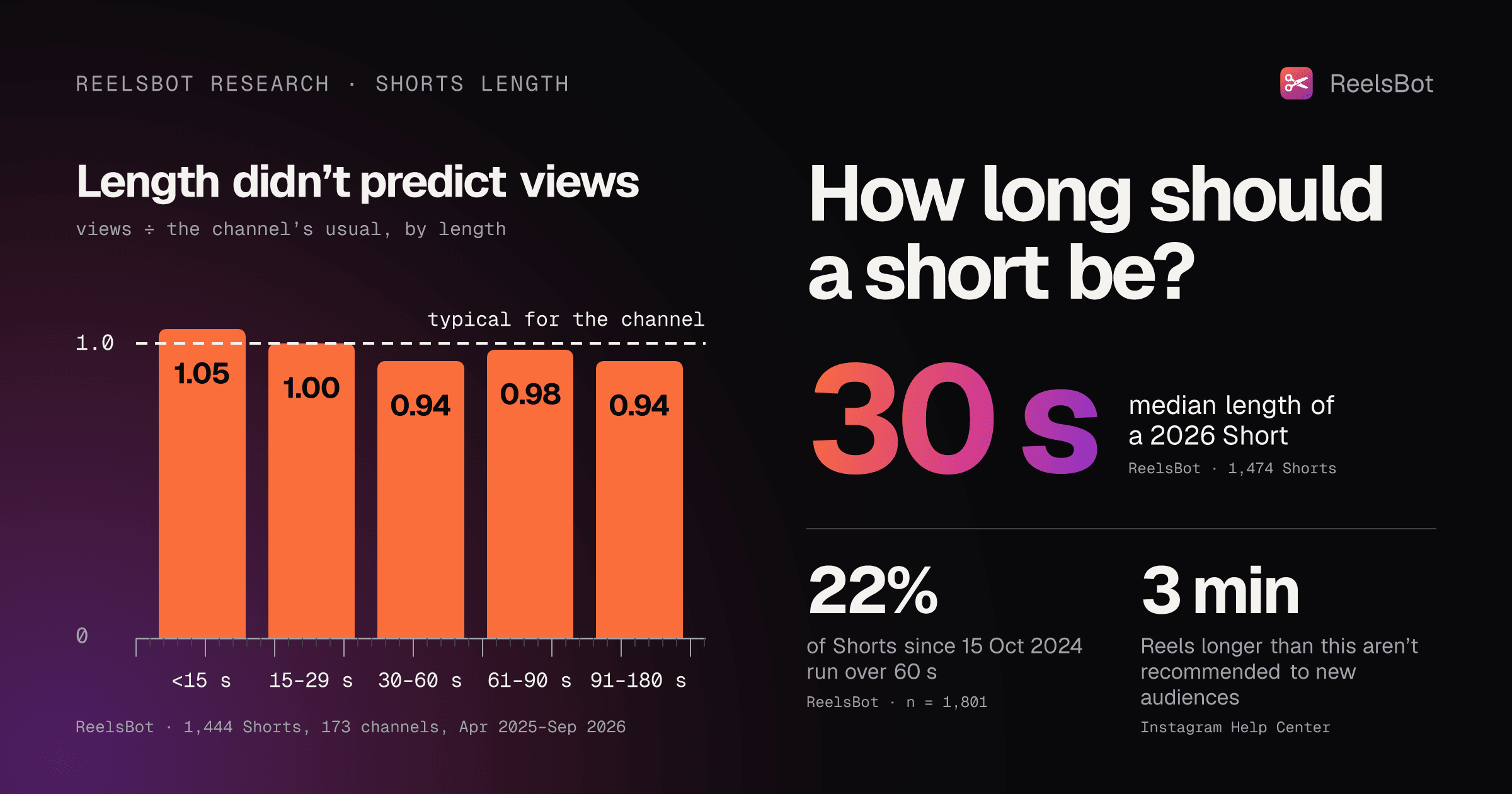
- 6In our sample, a Short's length didn't predict its views compared with the channel's other Shorts. The median ratio was between 0.94 and 1.05 in every length bucket, from under 15 seconds to 91–180 seconds, and every 95% interval included 1.
- 7In our sample the typical Short published in 2026 runs 30 seconds. Of Shorts published since the 3-minute change, 22% run over 60 seconds, and 52.2% of channels with five or more sampled Shorts since then have posted at least one that long.
- 8The old 60-second cap shaped habits. In the cooking and fitness channels we could follow back that far, 24.3% of Shorts ran 55–60 seconds before the change and 11.8% after it. Across our whole post-change sample it's 7.3%.
30 s
Median length of a 2026 Short, our sample of 1,474
ReelsBot measurement
22%
Shorts over 60 s, published since 15 Oct 2024, our sample of 1,801
ReelsBot measurement
~1.0
Median views vs the channel's neighbouring Shorts, in every length bucket
ReelsBot measurement
Every platform raised the cap#
The limits only went one way. TikTok went from 15 to 60 seconds, then rolled out three-minute videos to everyone in July 2021 and ten-minute uploads in February 2022, TechCrunch reported. Since then it has tested 15-, 30- and 60-minute uploads with limited groups of users; of the 60-minute test, TikTok told TechCrunch it didn't have "any immediate plans to make the feature available widely".
Instagram moved in steps: 15 seconds at launch in August 2020, 30, 60 in July 2021 and 90 in 2022. In January 2025 Adam Mosseri raised Reels to three minutes, saying that historically "it's only been 90 seconds, and that's because we've wanted to focus Instagram on short-form video", as Social Media Today quoted him. Since mid-2025, Instagram's Help Center has said you can record and edit Reels of up to 20 minutes. We found no announcement of that; it showed up in the Help Center text, which we tracked through the Wayback Machine.
YouTube held out at 60 seconds the longest. In August 2023 its Shorts product lead Todd Sherman said on the Creator Insider channel that YouTube was "going to remain focused on 60 and under". Fourteen months later YouTube announced that "starting on October 15, you can upload Shorts up to 3 minutes long", for square or vertical videos only.
Maximum upload length, by platform
Seconds, log scale, by date the limit changed, Aug 2020–Oct 2026
| Series | x | y |
|---|---|---|
| Instagram Reels | 5 Aug 2020 | 15 s |
| Instagram Reels | 1 Sep 2020 | 30 s |
| Instagram Reels | 27 Jul 2021 | 60 s |
| Instagram Reels | 2 Jun 2022 | 90 s |
| Instagram Reels | 18 Jan 2025 | 180 s |
| Instagram Reels | 12 Jun 2025 | 1,200 s |
| Instagram Reels | 26 Oct 2026 | 1,200 s |
| TikTok | 1 Jul 2021 | 180 s |
| TikTok | 28 Feb 2022 | 600 s |
| TikTok | 26 Oct 2026 | 600 s |
| YouTube Shorts | 14 Sep 2020 | 60 s |
| YouTube Shorts | 15 Oct 2024 | 180 s |
| YouTube Shorts | 26 Oct 2026 | 180 s |
Sources: TikTok Newsroom; TechCrunch; YouTube blog; Instagram Help (Wayback)
 ReelsBot
Upload, recommend and pay are three different limits#
The cap on what you can upload is not the cap on what the platform will push to strangers, and neither is the rule for what gets paid. Put side by side, the three line up differently on every app.
What each platform lets you upload, recommends and pays for
Stated limits, as of 27 Oct 2026
- YouTube Shorts: upload up to 3 min · recommendation limit not stated · paid at any length
- Instagram Reels: upload up to 20 min · recommended up to 3 min · pay by length not stated
- TikTok: upload up to 10 min · recommendation limit not stated · paid over 1 min
- Snapchat Spotlight: upload up to 5 min · recommendation limit not stated · paid from 30 s
Sources: YouTube Help; Instagram Help (Wayback); TikTok Newsroom; Snapchat Help
The money side is the clearest push toward length. TikTok's Creator Rewards Program pays only for videos over one minute, and when it announced the program in March 2024, TikTok said "the TikTok community now spends 50% of their time on TikTok watching videos longer than one minute". One of its four payout metrics is "play duration", which, TikTok says, "accounts for both watch time and finish rate". Snap's Help Center says its ads are served "based on the amount of time Snapchatters spend watching". Longer videos hold more ad time, so it makes sense that both platforms pay for them. On YouTube, a 1–3 minute Short is paid from the same Shorts revenue share as a shorter one; what that share works out to per view is the subject of our post on what Shorts pay.
Recommendation is where the platforms pull back. Instagram is the only one that publishes a line, and it has moved it twice.
How Instagram's recommendation limit moved
21 Jul 2022
21 Jul 2022
Only reels under 90 seconds are recommended
Meta, as new video posts under 15 minutes start being shared as reels.Source: Meta Newsroom
May 2024
May 2024
Creator-event slide: Reels over 90 seconds can hurt reach
As reported by Social Media Today, citing The Information.Source: Social Media Today
21 Jan 2025
21 Jan 2025
Reels up to 3 minutes eligible to be seen by non-followers
US creators first. 'Appetite around long-form content is changing.'Source: Instagram for Creators
12 Jun 2025
12 Jun 2025
Help Center: up to 20 minutes, but over 3 minutes won't be recommended to new audiences
First Wayback capture with this text; in every capture from Sep 2025 to Jul 2026.Source: Instagram Help (Wayback)
YouTube publishes no such limit. When it launched 3-minute Shorts it said "we'll be working to improve recommendations for longer Shorts in the coming months", which suggests they weren't recommended as well at launch. We found no later statement saying the work was done. One rule is firm: per YouTube's Help Center, any Short "over one minute in duration with an active copyright claim of any type, including manual claims, will be blocked globally". It won't play, won't be recommended and won't earn. Under a minute, nothing changes.
Completion falls as videos get longer; seconds watched rise#
Why would a platform that pays for long videos hold back on recommending them? Its own engineers have described the problem. A recommender that maximises watch time favours long videos simply because they have more seconds to watch. In a 2022 KDD paper, Kuaishou engineers showed that on their app, with the goal of raising watch time, impressions became "progressively biased towards videos with long duration", and the fix they described was deployed on Kuaishou. Instagram says it scores both measures: "we look at not only the percentage of a video that was watched, but also the number of seconds", Mosseri said in February 2025, as quoted by Social Media Today, so that longer videos aren't penalized. Neither Instagram nor TikTok publishes how the two are weighted.
No platform publishes completion rates by length either, so we computed them from KuaiRec, a public research dataset from the Chinese short-video app Kuaishou. Its platform-wide daily counters cover 10,087 videos with at least 100 plays, 32.08 billion plays in total, from July to September 2020.
Viewers watch more seconds of longer videos, but less of each one
Median seconds watched per play vs video length, Kuaishou, 10,087 videos, 5 Jul–5 Sep 2020
| Series | x | y |
|---|---|---|
| Seconds watched per play | 4.1 | 6.8 s |
| Seconds watched per play | 7.4 | 9.3 s |
| Seconds watched per play | 11.5 | 12.1 s |
| Seconds watched per play | 16.4 | 15.7 s |
| Seconds watched per play | 23.5 | 19.1 s |
| Seconds watched per play | 34.8 | 23.8 s |
| Seconds watched per play | 54.6 | 31.5 s |
| Seconds watched per play | 70 | 36.7 s |
| Seconds watched per play | 118.1 | 53.2 s |
| Video length | 4.1 | 4.1 s |
| Video length | 7.4 | 7.4 s |
| Video length | 11.5 | 11.5 s |
| Video length | 16.4 | 16.4 s |
| Video length | 23.5 | 23.5 s |
| Video length | 34.8 | 34.8 s |
| Video length | 54.6 | 54.6 s |
| Video length | 70 | 70 s |
| Video length | 118.1 | 118.1 s |
Source: ReelsBot measurement on KuaiRec 2.0 (Gao et al., CIKM 2022), CC BY-SA 4.0
The share of plays that reach the end falls with length
Median completion rate (complete plays ÷ plays) by video length, Kuaishou, 10,087 videos, Jul–Sep 2020
| Label | Value |
|---|---|
| 0–5 s | 63.5% |
| 5–10 s | 48.5% |
| 10–15 s | 40.2% |
| 15–20 s | 41.1% |
| 20–30 s | 34.7% |
| 30–45 s | 30.5% |
| 45–60 s | 27.2% |
| 60–90 s | 26.2% (61 videos) |
| 90–180 s | 21.5% (43 videos) |
Source: ReelsBot measurement on KuaiRec 2.0, platform-wide daily counters
Treat this as a shape, not a benchmark. It's China in 2020, few videos in the set ran past a minute, and Kuaishou's recommender picked who saw each video. But the shape matches what others report. Fanpage Karma, in 32,000 TikToks from one month, found that completion "decreases linearly as the video length increases", and Quan et al., on Kuaishou and WeChat Channels data, found average view time "nearly linear" in video length. A longer video collects more seconds watched while a smaller share of its audience sees the end. Watch-time metrics reward the first, finish rates punish the second, and TikTok says its payout metric uses both.
The industry studies disagree#
If you've searched for an ideal length, you've seen confident answers from social-media tool companies. They come from large samples, but each measures something different, and the answers move with the metric.
Buffer's analysis of 1.1 million TikToks, published in March 2025, is the strongest case for going long. It found that videos longer than a minute got 43.2% more reach than 30–60 second videos and 63.8% more watch time.
On TikTok, Buffer finds the longest videos reach the most people
Median reach per video by length, 1.1M TikToks, published Mar 2025
| Label | Value |
|---|---|
| 5–10 s | 194 (3.1 s watched) |
| 30–60 s | 302 (6.9 s watched) |
| 1–10 min | 432.5 (11.3 s watched) |
Source: Buffer
Fanpage Karma, looking at TikTok too, reached the opposite headline: videos of 0–10 seconds "achieve the highest average reach per follower", while those over 90 seconds "see a significant drop in reach", and 30–90 second videos got "twice as much engagement as very short or very long videos". It published no table of numbers. Median reach (Buffer) and reach per follower (Fanpage Karma) are different measures: big accounts that post long videos can raise the first without changing the second. Neither study controls for account size or topic.
On Instagram, Socialinsider analysed 9,771,822 organic Reels from brand accounts posted from January to June 2026. Its "views" are the old impressions metric, and its engagement rate is likes plus comments divided by followers.
Brand Reels peak at 45–60 seconds, then fall off after 3 minutes
Median views per Reel by length, 9,771,822 organic brand Reels, Jan–Jun 2026
| Label | Value |
|---|---|
| Under 30 s | 4,700 |
| 30–45 s | 8,564 |
| 45–60 s | 10,374 |
| 60–90 s | 9,790 |
| 90–120 s | 8,000 |
| 120–180 s | 9,000 |
| Over 180 s | 4,428 |
Source: Socialinsider
And the most quoted official tip is much smaller than it sounds. In 2021 TikTok's business blog said "1 in 4 top-performing videos have a duration between 21 and 34 seconds and see an average of a 1.6% increase in impressions". That's a 1.6 percent lift, not the "1.6×" it's often quoted as.
Same question, different metrics, different answers
Which length each study finds best, by the metric it uses
- Buffer (1.1M TikToks), median reach: 1–10 min
- Fanpage Karma (32K TikToks), average reach per follower: 0–10 s
- Fanpage Karma (32K TikToks), engagement: 30–90 s
- Socialinsider (9.8M brand Reels), median views: 45–60 s
- KuaiRec, our measurement (10K Kuaishou videos), median completion: 0–5 s
Sources: Buffer; Fanpage Karma; Socialinsider; ReelsBot measurement on KuaiRec
None of these covers YouTube Shorts since the 3-minute change. So we measured it.
What YouTube creators post now#
We sampled 2,077 public Shorts from 177 channels on 26 October 2026: 834 from 43 cooking and fitness channels we found through YouTube channel search (collection stopped at a bot check before it reached other niches), and 1,243 from 134 channels across many niches, found through Shorts search by a sibling project the same evening. The methodology below has the details.
The 3-minute option is used, but it hasn't taken over. In 2026 the median Short in our sample runs 30 seconds: 49.2% are under 30 seconds and 78.2% are a minute or less. Of everything published since 15 October 2024, 22% runs over 60 seconds, 11.6% over 90 seconds and 6.7% over two minutes.
Most Shorts still run under a minute
% of sampled Shorts by length, 10-second bins, published 15 Oct 2024–26 Oct 2026, n = 1,801
| Label | Value |
|---|---|
| 1–10 s | 12.5% |
| 11–20 s | 21.1% |
| 21–30 s | 15.5% |
| 31–40 s | 9.9% |
| 41–50 s | 9.1% |
| 51–60 s | 9.9% |
| 61–70 s | 5% |
| 71–80 s | 3.2% |
| 81–90 s | 2.2% |
| 91–100 s | 2.1% |
| 101–110 s | 1.3% |
| 111–120 s | 1.5% |
| 121–130 s | 1.6% |
| 131–140 s | 1.2% |
| 141–150 s | 0.6% |
| 151–160 s | 0.5% |
| 161–170 s | 1.2% |
| 171–180 s | 1.6% |
Source: ReelsBot measurement, public YouTube Shorts metadata, 177 channels, collected 26 Oct 2026
Length depends heavily on the niche. Gaming Shorts in our 2025–26 sample have a median of 14 seconds; cooking and education run past 50. Many niches here are a handful of channels, so read the order, not the exact values.
Recipes run long, gaming runs short
Median Short length by niche, seconds, our sample, published 1 Jan 2025–26 Oct 2026
| Label | Value |
|---|---|
| Education | 56 s (7 channels) |
| Cooking | 53 s (25 channels) |
| Comedy / anime | 36 s (9 channels) |
| Cars | 34 s (25 channels) |
| Fitness | 33 s (20 channels) |
| Music / dance | 31 s (8 channels) |
| DIY / home | 30 s (11 channels) |
| Beauty | 28 s (20 channels) |
| Sports | 28 s (7 channels) |
| Tech | 23 s (9 channels) |
| Animals | 20 s (11 channels) |
| Travel / outdoors | 20 s (15 channels) |
| Motivation | 15.5 s (5 channels) |
| Gaming | 14 s (4 channels) |
Source: ReelsBot measurement, public YouTube Shorts metadata, collected 26 Oct 2026
Channels are split. Among the 157 channels with at least five sampled Shorts since the change, 52.2% have posted at least one over 60 seconds, and 16.6% make most of their Shorts that long. The other 47.8% haven't posted one in our sample (we sampled a dozen or so Shorts per channel, so some will have).
We can also see what the old cap did, but only for cooking and fitness. Those are the only channels we sampled far enough back to compare years, so the next chart covers them alone and isn't a YouTube-wide trend. Before October 2024, about a quarter of their Shorts sat at 55–60 seconds, squeezed against the limit: 23.9% of all 276 pre-change Shorts in our sample, nearly all from these channels. None ran over 60 seconds, which confirms the cap held.
In cooking and fitness channels, Shorts moved off the old 60-second wall
% of sampled Shorts by half-year of upload, cooking and fitness channels only (21–35 channels per half), 2023–Oct 2026
| Series | x | y |
|---|---|---|
| Over 60 s | Jan 2023 | 0% |
| Over 60 s | Jul 2023 | 0% |
| Over 60 s | Jan 2024 | 0% |
| Over 60 s | Jul 2024 | 8.2% |
| Over 60 s | Jan 2025 | 25.6% |
| Over 60 s | Jul 2025 | 24.8% |
| Over 60 s | Jan 2026 | 35.1% |
| Over 60 s | Jul 2026 | 33.1% |
| 55–60 s | Jan 2023 | 19% |
| 55–60 s | Jul 2023 | 24.6% |
| 55–60 s | Jan 2024 | 23.9% |
| 55–60 s | Jul 2024 | 26% |
| 55–60 s | Jan 2025 | 12.8% |
| 55–60 s | Jul 2025 | 10.7% |
| 55–60 s | Jan 2026 | 9.5% |
| 55–60 s | Jul 2026 | 11.6% |
Source: ReelsBot measurement, 43 cooking and fitness channels, public YouTube Shorts metadata, collected 26 Oct 2026
In the same channels, the share at 55–60 seconds fell from 24.3% before the change to 11.8% after it. The 16 of these channels with at least three Shorts both from July 2023 to the change and in 2026 went from a median of 35 to 44.5 seconds; 12 of the 16 got longer. Before, a lot of Shorts were exactly as long as the cap allowed, and once the cap went up, many of them got longer. That's a reasonable sign that creators were trimming to fit 60 seconds, not because the content needed it.
Did longer Shorts get more views?#
Comparing raw view counts across lengths would mostly compare channels: a cooking channel with a million subscribers posts long Shorts and gets big numbers for reasons that have nothing to do with length. So we compared each Short with its own channel. For every Short we divided its views by the median views of the Shorts posted around it on the same channel, up to ten on each side (20 for most Shorts, never fewer than 10). A ratio of 1.0 means it did as well as that channel's Shorts usually did at the time. We used Shorts published from April 2025, after YouTube changed what counts as a view, to late September 2026, so each was at least a month old: 1,444 Shorts from 173 channels.
Longer Shorts didn't get more views than their channel's usual
Median views ÷ the channel's neighbouring Shorts, by length, 1,444 Shorts from 173 channels, published Apr 2025–Sep 2026
| Label | Value |
|---|---|
| Under 15 s | 1.05 (n = 299) |
| 15–29 s | 1.00 (n = 390) |
| 30–60 s | 0.94 (n = 437) |
| 61–90 s | 0.98 (n = 156) |
| 91–180 s | 0.94 (n = 161) |
Source: ReelsBot measurement, public YouTube Shorts view counts, collected 26 Oct 2026
Every bucket sits around 1. The rank correlation between length and relative views is −0.02, effectively zero, and it was −0.045 for the cooking and fitness Shorts from before the change. Long Shorts were more hit-or-miss: the middle half of 91–180 second Shorts ranges from 0.56 to 2.26 times the channel's usual, the widest of any bucket. On average, though, going long didn't earn extra views.
We also looked at the 24 channels that posted at least three Shorts on each side of 60 seconds. In 17 of them the longer Shorts did a little worse, and a model that compares Shorts within each channel puts 61–90 second Shorts at 0.76 times the 30–60 second ones (95% interval 0.59–0.99). That's a small sample, the 91–180 second estimate (0.83) is consistent with no difference, and creators choose length by topic, so it doesn't show that length lowered anyone's views. The safe reading is the one the main chart gives: longer didn't help.
What public view counts can't show is how much of each Short people watched. Since 31 March 2025 YouTube has counted a Shorts view every time a Short "starts to play or replay, with no minimum watch time requirement", so loops on short videos inflate their views (we covered that change in our state of short-form video report). Creators can see the missing piece in their own analytics: YouTube's "stayed to watch" is "the percentage of times viewers stayed to watch past the initial seconds of a Short".
What this means if you make videos#
- Let the content set the length. In August 2023 YouTube's Shorts lead put it as "to what length do you need to tell your story?", as opposed to aiming for an exact number. In our sample, length didn't predict a Short's views compared with its channel's other Shorts, and a recipe and a meme ended up at very different lengths.
- Don't pad to cross a pay line. TikTok's Creator Rewards needs over a minute, and Snap's program needs 30 seconds. If a video genuinely needs that time, make it. Stretching a 40-second idea to 61 seconds puts it in the range where, in every dataset we found that reports completion, fewer viewers reach the end, and TikTok says finish rate is part of what it pays on.
- Stay at or under 3 minutes on Instagram. Its Help Center says longer Reels won't be recommended to new audiences, and Socialinsider's brand data shows the drop past 3 minutes.
- Under a minute, the old habits are optional. If your cut keeps landing at 59 seconds, you may be trimming for a cap that's gone. The cooking and fitness channels in our sample moved off that wall once the cap went up.
- Clear the music before you go past a minute on YouTube. A Short over one minute with any active copyright claim is blocked worldwide, and YouTube says most songs can be used for up to 90 seconds in a 3-minute Short, some for only 60 or 30.
- Judge your own Shorts on retention, not views. Replays inflate views on short loops. Compare "stayed to watch" and engaged views across your own Shorts of different lengths: that's the test no outside study can run for your channel.
- Cut dead time first. The completion curve punishes every second the viewer doesn't need, so the first edit is removing retakes, pauses and slow intros, not picking a target length.
We're building ReelsBot, a Mac app that turns raw talking-head clips into a cut: it removes retakes, stutters and dead air, lets you edit by transcript and burns in captions in 9:16. If you want a starting point by platform and goal, our free video length optimizer suggests a range to test against your own analytics.
Methodology#
Platform rules. Limits, recommendation rules and pay rules come from the platforms' own blogs, newsrooms and Help Centers, with press reports where no primary exists (marked in the captions). Instagram's Help Center blocks automated reads, so we read its history through Wayback Machine captures from January 2025 to July 2026. On 27 October 2026 we re-opened the primary page behind each number this post leans on and matched the exact sentence. The full data pack lists every claim, its tier and what we checked.
Industry studies. Buffer, Fanpage Karma and Socialinsider are tool vendors reporting on their own data. We quote their figures with their metric definitions and don't combine them. Survey and "statistics" sites were used only as leads. We left out widely shared figures we couldn't trace to a primary source, and OpusClip's and Adobe Express's length figures, which describe what creators make or believe, not how videos perform.
KuaiRec. KuaiRec 2.0 (Gao et al., CIKM 2022, CC BY-SA 4.0) is a dataset from Kuaishou's recommendation logs, 5 July to 5 September 2020. We used its platform-wide daily counters for videos with at least 100 plays (10,087 videos, 32.08 billion plays), computed completion as complete plays ÷ plays and took medians by length bucket. Videos with at least 100,000 plays alone give the same shape. Limits: China, 2020; only 111 videos of 60 seconds or more; audiences selected by the recommender; correlation only.
Our YouTube sample. On 26 October 2026 we read the public metadata (duration in whole seconds, view count, publish date) of 2,077 Shorts from 177 channels, logged out, from a US locale, at no more than about one request per second. 834 Shorts from 43 channels came from our own collection: YouTube channel searches across 15 niches, stratified by subscriber count, 20 Shorts spread evenly across each channel's history. YouTube's bot check stopped it while it was still on cooking (24 channels) and fitness (19), and we didn't retry. The other 1,243 Shorts from 134 channels across niches were collected the same evening by a sibling project from YouTube Shorts search results, mostly published July to October 2026; we reused its data and made no new requests.
For the views comparison, each Short's view count is divided by the median of up to 20 Shorts nearest to it on the channel's Shorts tab (at least 10), which matches Shorts by age and removes channel size. Intervals are 95% bootstrap intervals that resample whole channels. We checked that no Short in the sample published before 15 October 2024 runs over 60 seconds (0 of 276) and that public rounded view labels match exact counts.
Limits: 177 channels is small; channels found through search skew toward active, discoverable ones; English queries only; the year-by-year comparison covers only cooking and fitness channels; views include replays; we have no watch time or engaged views; deleted and private Shorts are invisible. This is correlation: creators choose length by content, so nothing here says that re-cutting the same Short to a different length would change its views.
Open questions#
- Does YouTube recommend 1–3 minute Shorts as widely as shorter ones? It promised better recommendations for longer Shorts in October 2024 and hasn't said more.
- What is a good "stayed to watch" or completion rate for a given length? No platform publishes benchmarks.
- Is there an independent study of 1–3 minute YouTube Shorts, with a disclosed sample and watch-time data, since the October 2024 change? We found none.
- How do TikTok and Instagram weigh watch time against completion? Both say they use both; neither publishes the weights.
- Would the same video do better shorter or longer? That needs an experiment on one channel's content, which no public dataset provides.