Advice on talking to camera tends to pull in two directions. One camp says talk faster, because attention is short and viewers will skip anything slow. The other says slow down, because rushed speech sounds nervous and loses people. Both camps usually skip the measuring part: how fast do people who make videos actually talk, and does it matter?
So we measured it. We counted words against time in 97,004 CC-BY English YouTube videos (uploaded 2008–2019, from channels with more than 10,000 subscribers in 2019), in the caption timing of 8,001 auto-captioned CC-BY English YouTube videos (crawled up to July 2023), in 3,939 TED talks and in 7,576 clips of audiobooks read aloud. Then we set those numbers next to the research on conversation, radio, playback speed and filler words. Our own numbers are labelled as our measurements, platform figures are the platforms' claims, and every outside number links to its source.
Key findings
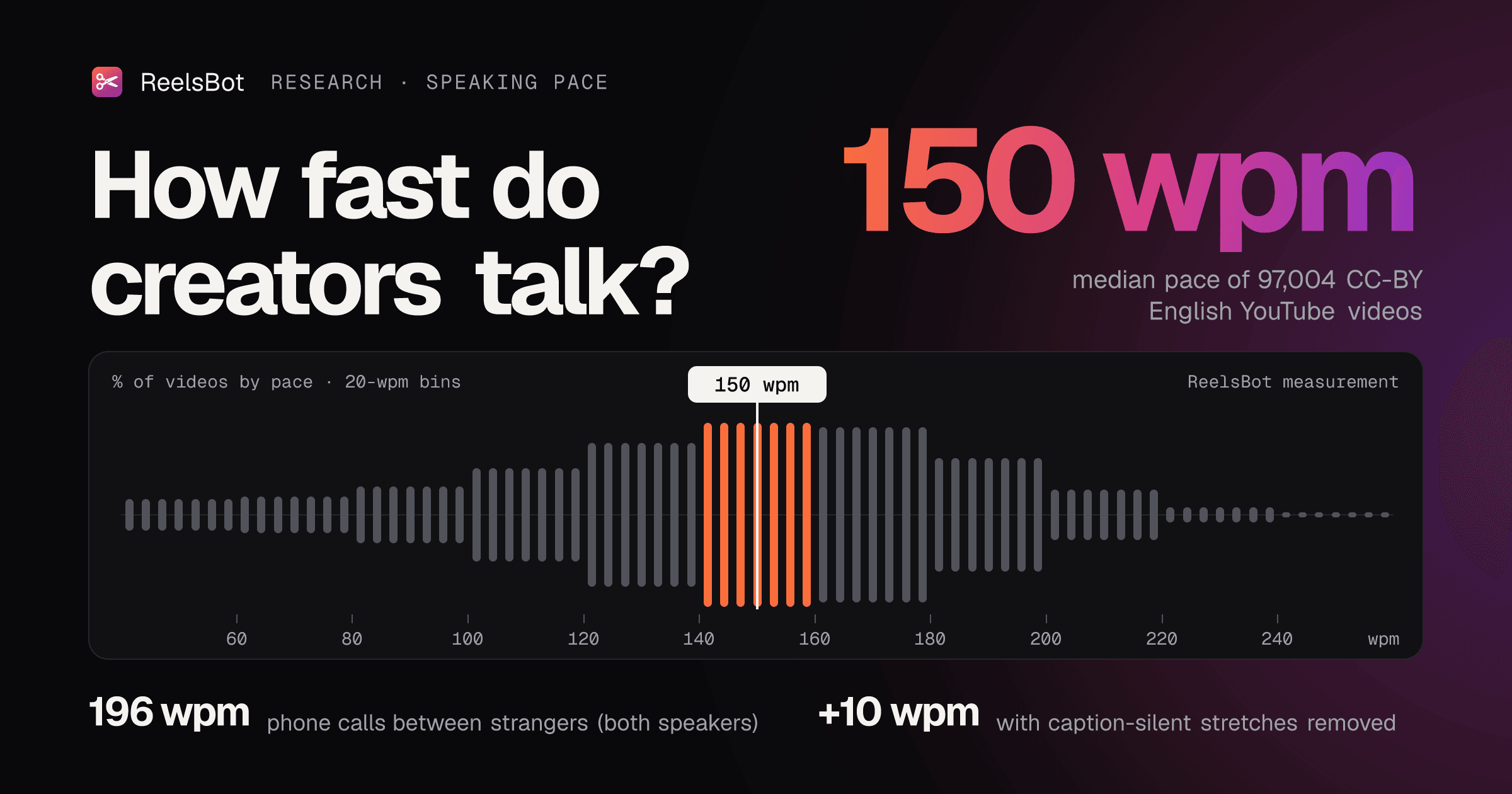
- 1In our sample of 97,004 CC-BY English YouTube videos (2008–2019, channels with more than 10k subscribers in 2019), the median video runs at 150 words per minute, counting words over the full video length. Taking one median per channel gives 144. TED talks (148) and audiobooks read aloud (155) land in the same place.
- 2That's slower than phone conversation on the clock: 196 words per minute in the Switchboard corpus, counting both speakers' words over elapsed time, Yuan, Liberman and Cieri found in 2006. News radio ran from 167.5 (BBC) to 210 (Spanish RNE) in Rodero's 2010 recordings.
- 3Dead air accounts for part of the gap. In 8,001 auto-captioned CC-BY English YouTube videos (crawled to July 2023), removing caption-silent stretches of 2 seconds or more raised the median pace from 142 to 153 words per minute.
- 4In our sample, pace didn't predict views within a channel. Across 896 channels, the median rank correlation between a video's pace and its views was 0.003, and a channel's top-10% videos ran at the same 151 words per minute as its bottom half.
- 5Very short videos weren't spoken faster. With caption-silent stretches removed, videos of a minute or less ran at 146 words per minute, against 153 for 3–10 minute videos.
- 6In auto captions, "um" and "uh" climb with length, from 1.8 per 1,000 words in videos of a minute or less to 8.7 in videos over an hour. Captions under-count them: about 1 per minute of speech in auto captions, against at least 4 per minute of audio in hand-labelled podcasts.
- 7Creators get to the point. The median auto-captioned video has its first captioned word 0.5 seconds in, and 87% of videos a minute or shorter start talking within 2 seconds.
- 8Viewers speed things up anyway. YouTube says that when people change playback speed, more than 85% of the time they speed up, with 1.5× the most used (June 2022). In one UCLA study, lecture comprehension showed no significant drop up to 2×; a 2025 meta-analysis finds a retention cost on average.
150 wpm
Median pace, 97,004 CC-BY English YouTube videos, 2008–2019 (144 per channel)
ReelsBot measurement
+10 wpm
Pace gained by removing caption-silent stretches of 2 s or more (142 → 153), 8,001 videos
ReelsBot measurement
0.003
Median within-channel rank correlation of pace and views, 896 channels
ReelsBot measurement
Creators talk at audiobook pace#
The simplest measure of pace is words divided by the length of the video. It counts intros, B-roll and pauses as time, which is how a viewer experiences it. On that measure the median video in our main sample, 97,004 CC-BY English YouTube videos uploaded from 2008 to 2019, runs at 150 words per minute; the middle half sits between 121 and 175. Because a few channels contribute thousands of videos, we also took one median per channel: across 3,331 channels that gives 144.
Three other corpora land within a few words of that. TED talks, measured the same way, have a median of 148. Audiobook clips from Multilingual LibriSpeech, read aloud by volunteers, have a median of 155, and ACX, Audible's narration marketplace, says "most performers narrate about 9,300 words per hour", which is the same 155. The 862 edX lecture videos that Guo, Kim and Rubin studied averaged 156.
Creators talk at about audiobook pace
Words per minute, medians unless noted, by setting
| Label | Value |
|---|---|
| Phone calls with friends (CallHome) | 214 (both speakers) |
| Spanish radio news (RNE) | 210 |
| Phone calls with strangers (Switchboard) | 196 (both speakers) |
| Phone calls with strangers (Fisher) | 193 (both speakers) |
| Italian radio news (RAI) | 192.5 |
| French radio news (Radio France) | 188.9 |
| BBC radio news | 167.5 |
| Phone calls, per speaker's turns | 164 (Switchboard) |
| Business meetings (AMI) | 156.5 (our measurement) |
| edX lecture videos | 156 (mean) |
| Audiobooks read aloud | 155.4 (our measurement) |
| Auto-captioned videos, silences out | 152.7 (our measurement) |
| CC-BY YouTube videos | 150.2 (our measurement) |
| TED talks | 148.3 (our measurement) |
| CC-BY YouTube, per channel | 143.9 (our measurement) |
Sources: Yuan, Liberman & Cieri 2006; Rodero 2012; Guo, Kim & Rubin 2014; ReelsBot measurement on YouTube-Commons, YODAS2, TED, Multilingual LibriSpeech and AMI
 ReelsBot
Conversation is faster on the clock. In 2,438 recorded phone calls between strangers, Yuan, Liberman and Cieri found "an overall average rate of 196 words per minute". In two other corpora they compared, calls between strangers (Fisher) ran at 193 and calls between friends and family (CallHome) at 214. Those figures add up both people's words, though, and two people overlap and fill each other's pauses. Divided by each speaker's own turns, Switchboard drops to 164, and in our count of the AMI meeting corpus (190 people, recorded in 2004–05) each speaker ran at 156.5. Measured per speaker, the gap narrows: with caption-silent stretches removed, creators (153) come close to meeting talk and sit a little below phone turns.
Radio news is faster again. Rodero's analysis of 2010 bulletins clocked the BBC at 167.5 words per minute and Spain's RNE at 210, and notes that radio textbooks recommend "between 160 and 180 words per minute" for news.
Most videos sit in a fairly narrow band. Of the 97,004 videos, 55.7% run between 120 and 180 words per minute; per channel it's 53.9%.
Most videos run between 120 and 180 words per minute
% of videos by pace, words ÷ full video length, 20-wpm bins, 97,004 CC-BY English YouTube videos, 2008–2019
| Label | Value |
|---|---|
| Under 60 | 3.5% |
| 60–80 | 4.1% |
| 80–100 | 6.2% |
| 100–120 | 10.3% |
| 120–140 | 15.9% |
| 140–160 | 20.4% |
| 160–180 | 19.4% |
| 180–200 | 12.6% |
| 200–220 | 5.6% |
| 220–240 | 1.6% |
| 240+ | 0.5% |
Source: ReelsBot measurement, YouTube-Commons transcripts × YouNiverse metadata (channels with >10k subscribers in Oct 2019)
Dead air accounts for part of the gap#
Words over full length mixes two things: how fast someone talks while talking, and how much of the video has no talking at all. To pull them apart we used a second sample: caption files from 8,001 auto-captioned CC-BY English YouTube videos in the YODAS2 dataset, crawled up to July 2023, which record when each caption line starts and ends.
Auto-caption lines run back to back, so a pause shows up as a line held on screen longer than its words need. We counted any such excess of 2 seconds or more, plus real gaps between lines, as a caption-silent stretch. It's a model of the silence, estimated from caption timing, not a measurement of the audio.
Take out the caption-silent stretches and pace rises about 10 words a minute
Median words per minute, 8,001 auto-captioned CC-BY English YouTube videos, crawled to Jul 2023
| Label | Value |
|---|---|
| Words ÷ full video length | 142.3 |
| Words ÷ first-to-last-word span | 143.9 |
| Silent stretches of 2 s+ removed | 152.7 |
| Creator-uploaded captions, same measure | 155.4 (5,004 videos) |
| Audiobooks read aloud (reference) | 155.4 (7,576 clips) |
Source: ReelsBot measurement on YODAS2 (CC-BY-3.0) and Multilingual LibriSpeech
The typical video doesn't have much dead air by this measure. The median has 0.6 caption-silent stretches of 2 seconds or more per minute of its talking span, and they take up 4.2% of the time between its first and last word. The tail is where it piles up: a quarter of videos spend more than 10% of their talking span in such stretches, and a tenth spend more than 20%. In 35% of videos there is at least one per minute.
Pace by category#
Pace varies more by subject than by video length or channel size. Howto & Style and Science & Technology videos run fastest in our main sample, around 158–159 words per minute; Pets & Animals and Travel videos run slowest, probably because so much of their running time is footage without narration.
Tutorials and tech talk fastest; pets and travel slowest
Median words per minute (words ÷ full length) by YouTube category, 97,004 CC-BY English YouTube videos, 2008–2019
| Label | Value |
|---|---|
| Howto & Style | 159.2 (per channel 154.1) |
| Science & Technology | 158 (per channel 150.8) |
| News & Politics | 154.1 (per channel 147.2) |
| Gaming | 150.1 (per channel 142) |
| Sports | 150 (per channel 148.5) |
| Nonprofits & Activism | 149.3 (per channel 145.6) |
| People & Blogs | 149 (per channel 147.6) |
| Entertainment | 148.9 (per channel 136.4) |
| Autos & Vehicles | 145.4 (per channel 137.9) |
| Education | 142.1 (per channel 148.9) |
| Comedy | 140.3 (per channel 128.5) |
| Film & Animation | 139.5 (per channel 129.9) |
| Travel & Events | 132.9 (per channel 110.1) |
| Pets & Animals | 117.3 (per channel 127.3) |
Source: ReelsBot measurement, YouTube-Commons × YouNiverse, 51–686 channels per category
If you keep only videos with steady talking (at least 90 words per minute over the full length), the order shifts: Sports rises to the top at 166, ahead of Howto & Style and Gaming at 163, while Education stays near the bottom at 145. Sports videos with steady commentary are among the fastest in the sample; the many sports videos with long stretches of no voice pull the all-videos median down.
Short videos aren't spoken faster#
You might expect a 45-second video to be delivered at a sprint. In our samples it isn't. With caption-silent stretches removed, auto-captioned videos of a minute or less ran at 146 words per minute, a little slower than every longer bucket.
Videos of a minute or less run slightly slower, not faster
Median words per minute with caption-silent stretches of 2 s+ removed, by video length, 8,001 auto-captioned CC-BY English YouTube videos, crawled to Jul 2023
| Label | Value |
|---|---|
| 1 min or less | 146 (n = 418) |
| 1–3 min | 150.5 (n = 1,352) |
| 3–10 min | 152.7 (n = 2,480) |
| 10–20 min | 154.3 (n = 1,499) |
| 20–60 min | 154 (n = 1,696) |
| Over 60 min | 153.1 (n = 556) |
Source: ReelsBot measurement on YODAS2 and YouTube-Commons × YouNiverse
TED shows the same pattern from the other end: its talks over 18 minutes run at 154, against 146 for talks under 12. Longer talks aren't slower. For short videos, the length decision matters more than the speed of delivery; our post on Shorts length found that completion falls as videos get longer in every dataset we found that reports it.
Faster talkers didn't get more views#
The obvious next question: do faster videos do better? Comparing fast and slow videos across channels mostly compares channels, so we compared each channel with itself. For the 896 channels in our main sample with at least 20 videos, we ranked each channel's videos by pace and by views, and measured how well the two rankings line up.
They don't. The median within-channel rank correlation was 0.003, where 0 means no relationship and 1 a perfect one; the middle half of channels ranged from −0.14 to 0.18.
A channel's most-viewed videos weren't faster than its least-viewed
Median words per minute, by view group, CC-BY English YouTube (896 channels with 20+ videos, views as of Nov 2019) and TED (3,939 talks, views as of 2020)
| Label | Value |
|---|---|
| Channel's top 10% by views | 151 (per channel 151.5) |
| Channel's bottom half by views | 150.6 (per channel 152.3) |
| TED, top 10% by views | 149.3 |
| TED, middle 40% | 147.9 |
| TED, bottom half by views | 148.5 |
Source: ReelsBot measurement, YouTube-Commons × YouNiverse and TED Ultimate Dataset
Channel size made no consistent difference either. Videos from channels with over a million subscribers in 2019 had a median of 141.3 words per minute (143.2 per channel), against 151.1 (142.7 per channel) for channels with 10,000–100,000.
The closest published evidence on engagement points the same way once you read past the headline. Guo, Kim and Rubin's study of 862 edX videos found that "students generally engaged more with videos where instructors spoke faster", but the authors add that "speaking rate is merely a surface feature that correlates with enthusiasm and thus engagement", and they advise against pushing instructors to speak faster.
Is everyone slowing down?#
TED talks have got slower: the median fell from 161 words per minute in 2006 to 141 in 2018. It would be easy to read that as people talking more slowly. Our YouTube sample doesn't show that.
TED slowed down; channels in our YouTube sample didn't
Median words per minute by year of upload (TED: year published), TED talks 2006–2020 and CC-BY English YouTube videos 2011–2019
| Series | x | y |
|---|---|---|
| TED talks | 2006 | 161.1 |
| TED talks | 2007 | 158.4 |
| TED talks | 2008 | 156.9 |
| TED talks | 2009 | 158.5 |
| TED talks | 2010 | 160 |
| TED talks | 2011 | 154.4 |
| TED talks | 2012 | 154.2 |
| TED talks | 2013 | 150.4 |
| TED talks | 2014 | 149 |
| TED talks | 2015 | 147.3 |
| TED talks | 2016 | 146.9 |
| TED talks | 2017 | 142.2 |
| TED talks | 2018 | 141 |
| TED talks | 2019 | 144.7 |
| TED talks | 2020 | 145.4 |
| YouTube, per video | 2011 | 144.4 |
| YouTube, per video | 2012 | 143.7 |
| YouTube, per video | 2013 | 145.7 |
| YouTube, per video | 2014 | 143.1 |
| YouTube, per video | 2015 | 147.4 |
| YouTube, per video | 2016 | 151.6 |
| YouTube, per video | 2017 | 154.2 |
| YouTube, per video | 2018 | 152.7 |
| YouTube, per video | 2019 | 153.4 |
| YouTube, per channel | 2011 | 148 |
| YouTube, per channel | 2012 | 144.2 |
| YouTube, per channel | 2013 | 142.8 |
| YouTube, per channel | 2014 | 147.5 |
| YouTube, per channel | 2015 | 147.4 |
| YouTube, per channel | 2016 | 148.3 |
| YouTube, per channel | 2017 | 148.1 |
| YouTube, per channel | 2018 | 145.1 |
| YouTube, per channel | 2019 | 144.5 |
Source: ReelsBot measurement, TED Ultimate Dataset and YouTube-Commons × YouNiverse
TED's decline is about TED, and its own data doesn't say exactly why. The catalogue changed over those years: TEDx talks from 2009, many more TED-Ed animations from 2017, and shorter talks overall. But the drop also shows up within TED's main annual conferences alone, from 163 words per minute in 2006 to 139 in 2018, so it isn't only TEDx and TED-Ed. Whatever drove it, whether whom TED invites or how its talks are produced, it's one organiser's catalogue, not evidence that people in general speak more slowly.
Creators get to the point#
One place where online video is quick is the start. In the caption sample, the median video has its first captioned word half a second in. Short videos are quickest: 87% of videos a minute or less have speech within 2 seconds.
Most videos start talking within 2 seconds
% of videos with a captioned word in the first 2 seconds, by video length, 8,001 auto-captioned CC-BY English YouTube videos, crawled to Jul 2023
| Label | Value |
|---|---|
| 1 min or less | 87.1% |
| 1–3 min | 78.9% |
| 3–10 min | 71% |
| 10–20 min | 70.8% |
| 20–60 min | 63.3% |
| Over 60 min | 65.8% |
Source: ReelsBot measurement on YODAS2
The long tail matters more than the median. Across all lengths, 18% of videos go more than 5 seconds before anyone speaks; in videos over 20 minutes it's 22–24%, probably an intro sequence or music.
Ums rise with video length#
Filler words are where captions mislead. A common belief is that YouTube's automatic captions drop "um" and "uh" altogether. In our caption sample they don't: 45% of auto-captioned videos contain at least one. But they keep far fewer than speakers actually say.
Within auto captions, the count climbs steadily with length. Videos of a minute or less have 1.8 "um" or "uh" per 1,000 words, and only 11% have any; videos over an hour have 8.7 per 1,000 words, and 84% have at least one.
In auto captions, ums and uhs climb with video length
'Um' and 'uh' per 1,000 words in auto captions, by video length, 8,001 CC-BY English YouTube videos, crawled to Jul 2023
| Label | Value |
|---|---|
| 1 min or less | 1.8 (11% have any) |
| 1–3 min | 2.2 (17% have any) |
| 3–10 min | 3.1 (34% have any) |
| 10–20 min | 3.9 (54% have any) |
| 20–60 min | 6.7 (71% have any) |
| Over 60 min | 8.7 (84% have any) |
Source: ReelsBot measurement on YODAS2
How far do captions under-count? When people transcribe by hand, the numbers are several times higher. PodcastFillers, a dataset from Adobe Research, hand-labelled "approximately 35,000 filler words" ("uh" and "um") in 145 hours of podcasts, at least 4 per minute of audio, and that's a floor, since only spots the speech recogniser had skipped were checked. In the human transcripts of the AMI meeting corpus, our count gives 6.1 per minute of each speaker's talk. The PodcastFillers authors note that "ASR systems typically do not transcribe non-lexical fillers in spontaneous speech", and OpenAI's Whisper paper strips "uh" and "um" from transcripts before it scores accuracy.
Transcripts made by people find far more ums than captions do
'Um' and 'uh' per minute of speech, by source of the transcript
| Label | Value |
|---|---|
| Meetings, human transcripts (AMI) | 6.1 (2004–05) |
| Podcasts, human labels | ≥4.0 (floor) |
| YouTube auto captions | 1.0 |
| Creator-uploaded captions | 0.4 |
| TED transcripts | 0.01 |
Sources: PodcastFillers (Zhu, Caceres & Salamon 2022); ReelsBot measurement on AMI, YODAS2 and TED
Other common filler words can't be counted the same way, because they have ordinary uses too. As plain word frequency, auto captions show "so" 10.1 times per 1,000 words, "like" 5.1, "you know" 3.1 and "okay" 1.7; TED's transcripts show "so" 8.0, "like" 3.8 and "you know" 0.9. Some of those are fillers and some aren't.
Fillers aren't pure noise#
Before you cut every "um", know that listeners use them. In memory experiments by Fraundorf and Watson, in which people listened to recorded passages from Alice's Adventures in Wonderland, "fillers facilitated recall" of the story, while coughs of the same length hurt it. In an EEG study, Corley, MacGregor and Donaldson found that words preceded by an "er" were easier to integrate when they were unpredictable, and in a later memory test "words preceded by disfluency were more likely to be remembered". Both teams point to attention: a filler seems to make listeners attend more closely to what comes next. These are lab studies of recorded speech; none of them tested online video, and none of it argues for leaving in a 3-second stall or a botched take, but it's a reason to cut the stumbles and leave some natural hesitation.
Viewers speed it up anyway#
Whatever pace a creator picks, viewers can change it, and they mostly change it upward. YouTube said in 2022 that "most people watch on the default speed", but when they use the speed control, it "was used to speed up content more than 85 percent of the time". That's a share of speed changes, not of viewers. "Apart from normal, 1.5x is used the most often, followed by 2x as a close second and 1.25x at third", YouTube said, and among speeds other than normal, viewers on youtube.com spent the most time at 2×.
Playback speed and filler removal, step by step
2010
10 Nov 2019
25 Aug 2022
25 Aug 2022
YouTube: over 85% of speed changes are speed-ups
June 2022 data; 1.5× most used, then 2×, then 1.25×.Source: YouTube blog (Wayback)
Jul 2023
Jul 2023
Press-and-hold for 2× tested with Premium members
As reported by 9to5Google.Source: 9to5Google
13 Sep 2023
13 Sep 2023
Premiere Pro shows filler-word detection in beta
In the December 2023 release.Source: Adobe blog
By Feb 2024
By Feb 2024
CapCut desktop lists Remove Filler Words
Earliest archived capture; launch date unknown.Source: CapCut (Wayback)
Sep 2025
Sep 2025
Premium speeds up to 4× on Android, iOS and the web
As reported by 9to5Google.Source: 9to5Google
28 May 2026
28 May 2026
YouTube Auto speed for Premium
Adjusts speed during 'slower speech or information-dense segments'.Source: YouTube blog (Wayback)
The newest step automates the choice. In May 2026 YouTube introduced Auto speed for Premium members, starting on Android, which "intelligently adjusts playback speed during relevant moments like slower speech or information-dense segments". YouTube hasn't said how it decides what counts as slow.
Does speeding up cost understanding? In a study at UCLA by Murphy and colleagues, 231 students watched two lecture videos, recorded at 157 and 166 words per minute, at 1×, 1.5×, 2× or 2.5×. The authors found "minimal costs incurred by increasing video speed from 1x to 1.5x, or 2x speed, but performance declined beyond 2x speed." Across the immediate and one-week tests, the only statistically significant gap between speed groups was 1× against 2.5×.
Lecture comprehension held up to 2×, then dropped
Share of test questions answered correctly right after watching, by playback speed, 231 UCLA undergraduates
| Label | Value |
|---|---|
| 1× | 65% |
| 1.5× | 60% |
| 2× | 62% |
| 2.5× | 55% |
Source: Murphy et al. 2022, Applied Cognitive Psychology, Table 2
That's one study of lectures. Pooling 12 papers, a 2025 meta-analysis by Huang, Du and Yang found that sped-up instructional video "increased learners' cognitive load (g = 0.59) and decreased maintenance test scores (g = −0.41)", a small-to-moderate cost on retention tests. Viewers who speed up trade some retention for time, and they make that trade often.
What this means if you make videos#
- Don't try to talk faster for views. In our sample, a channel's most-viewed videos ran at the same pace as its least-viewed, and the edX researchers tie faster speech to enthusiasm, not speed itself. Talk at the pace that sounds like you.
- Script at about 150 words a minute. A 60-second video is roughly 150 words, a 30-second one about 75. The middle half of videos in our sample ran 121–175 words per minute, so a 60-second script anywhere from about 120 to 175 words is normal. Our free video script generator can draft one to that length.
- Cut the dead air, not the words. Removing caption-silent stretches raised the median pace by about 10 words a minute. Tightening pauses and retakes changes how fast a video feels without making you rush.
- Decide your own pace before the viewer's player does. Viewers who change speed mostly speed up, and Premium's Auto speed now adjusts playback during "slower speech" on its own. Trimming the slow parts yourself means you choose what gets compressed.
- Keep the start fast. Most videos already speak within 2 seconds. If yours is in the 18% that wait more than 5, that's the easiest edit in this list.
- Cut stumbles and retakes; let some ums stay. Lab studies find fillers can help listeners remember what follows. A filler pass is worth the most on long, unscripted recordings, where even auto captions show ums piling up.
- Put key information on screen. People watch at 1.5× and 2×. The edX researchers could follow even 254-words-per-minute videos because the slides repeated the content.
- Measure your own pace. Take a transcript's word count and divide it by the minutes of talking. If you're far outside 120–180, it's worth a listen; if you're inside it, pace probably isn't your problem.
We're building ReelsBot, a Mac app that turns raw talking-head clips into a cut: it removes retakes, stutters and dead air, lets you edit by transcript and burns in captions in 9:16.
Methodology#
Main sample. We joined the transcripts in YouTube-Commons, a collection of transcripts of 2,063,066 CC-BY YouTube videos, to video and channel metadata from YouNiverse, which covers channels with more than 10,000 subscribers and more than 10 videos on 27 October 2019 and video metadata crawled from 29 October to 23 November 2019. We kept English-original videos of 15 seconds to 4 hours with at least 40 words, outside the Music category and between 30 and 350 words per minute: 97,004 videos from 3,331 channels, uploaded 2008–2019. Pace is words divided by full video length. The biggest channel contributes 2,203 videos, so every per-video figure comes with one median per channel.
Caption sample. We drew a seeded random sample of English caption files from YODAS2 (CC-BY YouTube videos crawled up to July 2023; text and timing only, no audio). After filters for speech coverage, music tags and garbage transcription, 8,001 of 12,659 auto-captioned videos remained, plus 5,004 with creator-uploaded captions (which can include translations). YODAS2 ids aren't YouTube ids, so this sample has no channel, category or date. A caption-silent stretch is any caption line held at least 2 seconds longer than its words need at a slow 100 words per minute, or a gap of 2 seconds or more between lines; it's estimated from caption timing, not measured in the audio. Measured per video rather than as a difference of medians, removing those stretches adds a median 8.4 words per minute.
TED, audiobooks and meetings. TED: 3,939 talks from the TED Ultimate Dataset (official transcripts and listed durations, 2006–2020), excluding talks with fewer than 150 words or under 60 words per minute, mostly performances; years are publication years. Audiobooks: 7,576 clips from 84 readers in Multilingual LibriSpeech English. Meetings: the AMI corpus's manual transcripts (190 people, 974,512 words, recorded 2004–05), pace over each speaker's own segment time; its filler counts are from meetings, not videos.
Words and fillers. Words are tokens after removing tags like [Music]; numbers written as digits count as one word, which slightly under-counts. Auto captions mis-hear words but mostly swap them rather than drop them, so pace is affected less than accuracy; speech over music is under-transcribed. Filler counts from captions are what the captions kept, not what was said. "Like", "so", "right" and "okay" are raw word counts including non-filler uses.
Outside sources. On 27 October 2026 we re-opened the primary source behind each outside number this post leans on (the Yuan et al. and Murphy et al. papers, the YouTube blog posts through the Wayback Machine, ACX, Zenodo, PubMed Central and Europe PMC) and matched the exact sentence. YouTube's speed figures are YouTube's own claims about June 2022 data.
Limits. CC-BY videos are not a random slice of YouTube: creators opt in to the licence, so the sample likely leans toward educational, news and institutional channels and away from the biggest entertainment creators. None of our measurements is newer than mid-2023, and none of it identifies Shorts. View counts are lifetime totals at the crawl, not retention. All of it is correlation.
Open questions#
- How much silence is in creator videos when measured from the audio, word by word? That needs word timestamps on creator content licensed for this use; we found none.
- Has pace changed since 2023, with Shorts, newer captioning and heavier editing? No open dataset pairs transcripts with durations for recent uploads.
- Does pace affect retention, as opposed to views? No public data links transcripts to audience-retention curves.
- How many "ums" do YouTube creators really say? There's no hand-annotated, verbatim set of creator videos.
- Does removing fillers and pauses change how long people watch? We found no study that tests it.
- How much YouTube watch time happens at speeds other than 1×, on Shorts or elsewhere, and how does Auto speed decide what's slow? YouTube hasn't said.