"85% of videos are watched on mute" is the reason caption guides often give for burning text into a short. The number is ten years old: publishers reported it to Digiday in 2016, when Facebook autoplayed video without sound. Since then the platforms have changed their story. Meta now says most Instagram Reels views are sound on, and TikTok sells itself as "sound-on".
And yet plenty of people switch captions on, for a different reason: they want to catch every word. This report traces the sound-off numbers to their sources, sets them against recent surveys of who uses captions and why, and adds our own measurement: text recognition over 2,000 random videos from a public Snapchat Spotlight dataset, to see how many carry captions and how those videos rank on Snap's engagement measures. Spotlight isn't TikTok, Shorts or Reels, and our numbers are correlations. Platform figures are the platforms' claims, surveys come with their samples, and every number links to its source.
Key findings
- 1The "85% watch without sound" figure came from publishers and an ad agency reporting their own Facebook views to Digiday in May 2016, not from Facebook, at a time when Facebook video autoplayed muted.
- 2The other famous figure, 69%, is from a 2019 survey by Verizon Media and Publicis Media, two advertising companies: the share of people who said they watch video without sound in public places. In private places it was 25%. Streaming Media reported the sample as an online survey of 5,616 US adults aged 18–54.
- 3Newer platform statements point the other way. Meta says "over 75% of Reels views on Instagram are sound on" (November 2024, no method given), and TikTok calls itself "a sound-on entertainment experience".
- 4Caption use is common anyway. In an AP-NORC poll of 1,182 US adults in August 2025, 34% always or often used captions or subtitles for TV and movies. The top reason was "want to catch every word" (55% of users); "watching with the sound off" was 10%.
- 5The young lead. In a YouGov poll of 3,609 British adults in 2023, 61% of 18–24s preferred subtitles on for shows in their own language, against 28% of all adults.
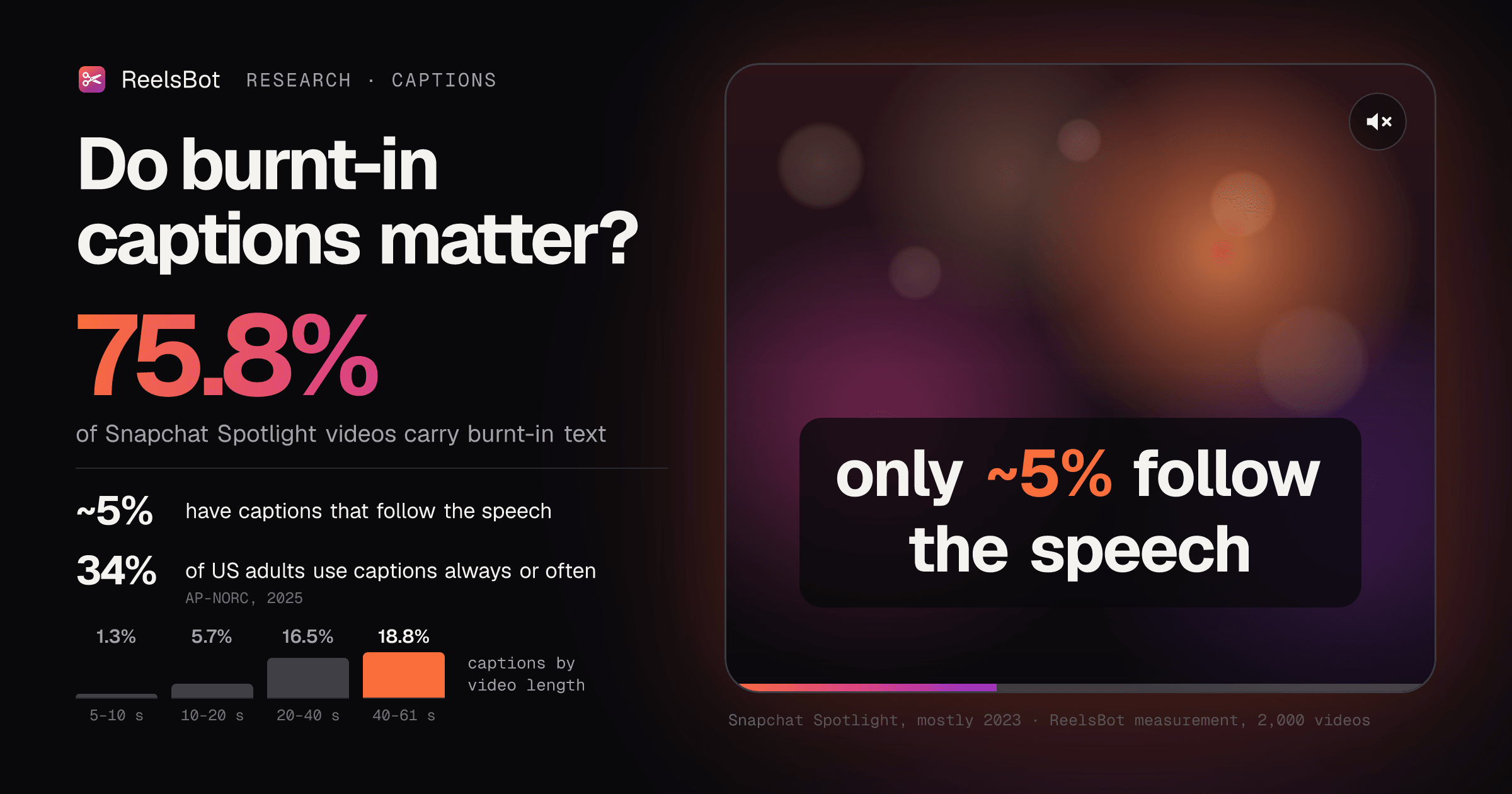
- 6In our sample of 2,000 Snapchat Spotlight videos (mostly from 2023), 75.8% carried burnt-in text, but only about 5% had captions that follow the speech. Among videos where someone talks, it was still only 11.2%.
- 7Captioned videos ranked far higher on Snap's engagement measures: on average at the 69th percentile of Snap's ranking by share of views lasting past 5 seconds, against the 37th for videos with no text. With length, speech and a title or description held constant, the gap was 25 percentile points. It's a correlation: we can't rule out that better creators simply caption more.
- 8Lab research mostly finds captions help people understand and remember video, but a 2021 study found subtitles didn't rescue muted ads, and we found no study that tests word-by-word "karaoke" captions in a feed or compares burnt-in captions with the platforms' own.
>75%
Instagram Reels views that are sound on, Meta says (Nov 2024, no method given)
Source: Meta for Developers
34%
US adults who always or often use captions or subtitles for TV and movies, Aug 2025
Source: AP-NORC, n = 1,182
75.8%
Snapchat Spotlight videos with burnt-in text, 2,000-video sample, mostly 2023
ReelsBot measurement
~5%
Spotlight videos with captions that follow the speech, same sample
ReelsBot measurement
Where "85% watch on mute" came from#
The number traces back to one article. In May 2016, Digiday reported that "as much as 85 percent of video views happen with the sound off, according to multiple publishers." The figures were the publishers' own: LittleThings said 85% of its Facebook viewership happened without sound, and the agency MEC said its clients' branded videos averaged "85-90 percent silent video views". They didn't all count the same views: Mic's 85% was of its 30-second views, while Facebook counted a view at 3 seconds.
Facebook itself said something vaguer that year. Its February 2016 ad guidance stated that "most video ads in mobile feed are viewed without sound", and that "internal tests show that captioned video ads increase video view time by an average of 12%". Facebook gave no method or sample for either. A year later, in February 2017, it announced that News Feed videos would start playing with sound unless the phone was on silent, rolling out "in coming months". The 2016 numbers describe a feed that started every video muted.
The sound-off claims, and how they changed
Statements about viewing without sound, 2016–2024; each measures a different population
10 Feb 2016
10 Feb 2016
Facebook: most mobile feed video ads are viewed without sound
Ad guidance; no figure or method given.Source: Facebook for Business (Wayback)
17 May 2016
17 May 2016
Digiday: up to 85% of Facebook video views silent, per publishers
Self-reported by LittleThings and others; MEC said 85–90% for client videos.Source: Digiday
14 Feb 2017
14 Feb 2017
Facebook announces News Feed video with sound
Not when the phone is on silent.Source: The Next Web
Apr 2019
Apr 2019
Verizon Media × Publicis: 69% watch without sound in public, 25% in private
Online survey, 5,616 US adults aged 18–54, per Streaming Media's coverage.Source: Verizon Media (Wayback)
21 Dec 2021
14 Oct 2022
7 Nov 2024
7 Nov 2024
Meta: over 75% of Instagram Reels views are sound on
No method given.Source: Meta for Developers
 ReelsBot
The second famous number is from a survey, not a log. In April 2019 Verizon Media and Publicis Media asked 5,616 US adults aged 18 to 54 about their habits, and their infographic reports that "69% of people report viewing videos without sound in public places". The same survey found 25% do so in private places, a number that is rarely quoted. Both companies work in video advertising.
Why people said they watched without sound
% citing each top reason, as published (base not stated), online survey of US adults aged 18–54, April 2019
| Label | Value |
|---|---|
| I was in a quiet space | 38% |
| I didn't have headphones | 31% |
| I was waiting in line or somewhere | 29% |
| I was multitasking | 28% |
The platforms now say sound is on#
The recent platform statements are just as self-interested, in the opposite direction. In ad-creative advice from November 2024, Meta wrote: "Over 75% of Reels views on Instagram are sound on." It gave no method, period or sample. TikTok's ad blog says "TikTok delivers a sound-on entertainment experience", and doesn't publish a sound-on share at all. YouTube hasn't published one for Shorts.
Independent data is scarce, but it doesn't suggest a silent majority either, at least among the young. In 2022 the UK regulator Ofcom found that 46% of people say they watch videos without headphones in a public place, which it called "loudcasting". Among 13–17s it was 83%.
Most teenagers watch videos out loud in public
% who say they watch videos without headphones in a public place, UK, 2022
| Label | Value |
|---|---|
| Ages 13–17 | 83% |
| Everyone | 46% |
| Over 55 | 21% |
Source: Ofcom, Oct 2022
None of this measures how many people watch a short on mute; no platform publishes that with a method. But "most people watch on mute" isn't a safe premise in 2026, and there's a better reason to caption.
People turn captions on anyway#
Caption use has grown on its own. In August 2025, AP-NORC asked 1,182 US adults on its probability panel how often they use captions or subtitles when watching TV shows or movies. A third (34%) said always or often, 23% sometimes, and 44% rarely or never. "Adults under 45 are particularly likely to say they regularly watch" with captions on, AP-NORC wrote.
A third of US adults use captions always or often
% of US adults, how often they use closed captions or subtitles for TV shows or movies, Aug 2025
| Label | Value |
|---|---|
| Always | 16% |
| Often | 17% |
| Sometimes | 23% |
| Rarely | 17% |
| Never | 27% |
Source: AP-NORC topline, Aug 2025
The reasons are the interesting part. Of the 864 respondents who use captions at least rarely, 55% said they want to catch every word. Accents and foreign-language shows came next at 39% each. Watching with the sound off came near the bottom, at 10%, below hearing impairment (13%). Younger adults were more likely to cite a noisy environment (40% of under-45s vs 25% of those 45 and over) and multitasking (30% vs 19%).
People use captions to catch every word, not because the sound is off
% of US adults who use captions, by reason (several allowed), Aug 2025, n = 864
| Label | Value |
|---|---|
| Want to catch every word | 55% |
| Watching a foreign movie or show | 39% |
| Difficulty understanding accents | 39% |
| Watching in a noisy environment | 33% |
| Poor audio quality | 26% |
| Watching while multitasking | 25% |
| Hearing impairment | 13% |
| Watching with the sound off | 10% |
| Trying to learn a new language | 9% |
Source: AP-NORC topline, question TV6
YouGov asks a slightly different question: whether people generally prefer subtitles on or off for TV and movies in their own language. In Britain in February 2023, 28% of 3,609 adults said on, but 61% of 18–24s did. A 2021 US poll of 12,159 adults found the same slope: 33% overall, 50% of 18–24s.
Britain's 18–24s prefer subtitles on
% who generally prefer subtitles on for native-language TV shows or movies, GB adults, 24 Feb 2023, n = 3,609
| Label | Value |
|---|---|
| All adults | 28% |
| 18–24 | 61% |
| 25–49 | 31% |
| 50–64 | 13% |
| 65+ | 22% |
Source: YouGov daily question, Feb 2023
In the US, the preference for subtitles falls with each older age group
% who generally prefer subtitles on for native-language TV shows or movies, US adults, 7 Apr 2021, n = 12,159
| Label | Value |
|---|---|
| All adults | 33% |
| 18–24 | 50% |
| 25–34 | 46% |
| 35–44 | 37% |
| 45–54 | 28% |
| 55+ | 22% |
Source: YouGov daily question, Apr 2021
Netflix reports the habit in its own viewing hours. It said in April 2025 that "nearly half of all viewing hours on Netflix in the US happen with subtitles or captions on", and in 2023 that more than 40% of viewing hours worldwide did. Most caption users aren't deaf or hard of hearing: Ofcom estimated back in 2006 that of about 7.5 million UK people who had used TV subtitles, about 6 million had no hearing impairment.
Two commercial sources point the same way in 2026, with less disclosure. Kapwing, an online editor, says 51% of videos exported from its product now include subtitles, up from 38% in 2024, without describing its method. An ad-tech firm, XR, says nearly 60% of US 18–24s use captions always or often, without fieldwork dates.
All of these are about TV, movies or a vendor's users, not short-form feeds, but they describe the same people who scroll: viewers with the sound on who read along anyway.
What we measured: text everywhere, captions rare#
To see what creators actually do, we used SnapUGC, a research dataset from Snap Research and the Chinese University of Hong Kong, published at ECCV 2024. It holds Snapchat Spotlight videos (Snapchat's TikTok-style feed) that each had more than 2,000 views, with Snap's engagement measures for each. We took 2,000 at random, ran Apple's on-device text recognition on two frames per second, and sorted each video by what was on screen. On-screen dates put most of the videos in 2023.
Burnt-in text is the norm: 75.8% of videos carried creator-added text, and 71.7% showed it in the first second. But most of it is static. In the median text video, text sat on screen in every frame we sampled: a title, a sticker, or Snapchat's own one-line caption bar, a typed line of text that about half the text videos we checked by hand used. Captions that follow the speech, changing every few seconds in one band of the screen, were rare: our detector flagged 5.7% of videos, and after checking a sample by hand we put the true share at about 5%.
Three in four Spotlight videos carry text; about 1 in 20 carries captions
% of 2,000 random Snapchat Spotlight videos, by the burnt-in text they show, mostly 2023
| Label | Value |
|---|---|
| Static text only | 70.2% (titles, stickers) |
| No burnt-in text | 24.2% |
| Captions that follow the speech | 5.7% (≈5% checked) |
Source: ReelsBot measurement on SnapUGC (Li et al., ECCV 2024)
Talking videos are where captions would make most sense, so we used Apple's sound classifier to find the 902 videos (45.1%) where speech filled at least a quarter of the soundtrack. Among them, captions were still uncommon: 11.2% had a caption stream, 67.1% carried only static text and 21.7% had no text at all.
Even when someone talks, nine in ten videos have no captions
% of the 902 Spotlight videos with speech in at least 25% of the soundtrack, by burnt-in text, mostly 2023
| Label | Value |
|---|---|
| Static text only | 67.1% |
| No burnt-in text | 21.7% |
| Captions that follow the speech | 11.2% |
Source: ReelsBot measurement on SnapUGC
Captions are also a habit of longer videos. Only 1.3% of videos of 5–10 seconds had them, against 16.5% of 20–40 second videos and 18.8% of those over 40 seconds. Text of any kind was about as common at every length, 75–79%.
Captions get more common as videos get longer
% of Spotlight videos with captions that follow the speech, by video length, 2,000-video sample, mostly 2023
| Label | Value |
|---|---|
| 5–10 s | 1.3% (n = 1,095) |
| 10–20 s | 5.7% (n = 490) |
| 20–40 s | 16.5% (n = 261) |
| 40–61 s | 18.8% (n = 154) |
Source: ReelsBot measurement on SnapUGC
Our data can't say whether that's because longer clips have more speech to follow or because the people who make them edit more; we looked at length on its own in how long should a short be.
Captioned videos rank higher, but that isn't proof#
SnapUGC comes with two engagement measures that Snap computed from real viewing. ECR, the engagement continuation rate, is the share of a video's views that lasted more than 5 seconds. NAWP, the normalised average watch percentage, is how much of the video people watched on average, normalised so that short and long videos can be compared. The dataset doesn't publish the raw values. It publishes each video's rank, so we turned the ranks into percentiles: 50 is the median video in the dataset, 70 means a video ranked above 70% of them. These are positions in a ranking, not shares of viewers.
Videos with captions sat much higher. On ECR, videos with no text averaged the 37th percentile, videos with static text the 53rd, and videos with captions the 69th. NAWP showed the same order, from 36 to 53 to 71.
Captioned Spotlight videos rank much higher on engagement
Mean percentile rank in Snap's ECR measure (share of views lasting more than 5 s), 50 = median video, 2,000-video sample, mostly 2023
| Label | Value |
|---|---|
| No text | 37.4 (NAWP 36.1) |
| Static text only | 52.6 (NAWP 53.1) |
| Captions | 68.7 (NAWP 71.2) |
Source: ReelsBot measurement on SnapUGC (engagement ranks from Li et al., ECCV 2024)
The obvious objection is that captioned videos differ in other ways: they're longer, more often have someone talking, and come from people who take more care. So we fitted a regression with video length, speech, and whether the creator wrote a title or description as controls. Captions still went with 24.7 percentile points more ECR and 27.8 more NAWP than no text. Static text alone went with about 11. Among talking videos only, captions went with 22.5 and 25.5 points.
The gap survives controls for length, speech and effort
Difference from videos with no burnt-in text, in percentile points, regression with controls, Spotlight sample, mostly 2023
| Label | Value |
|---|---|
| Captions, NAWP | +27.8 |
| Captions, ECR | +24.7 |
| Captions, talking videos, NAWP | +25.5 |
| Captions, talking videos, ECR | +22.5 |
| Static text only, NAWP | +11.9 |
| Static text only, ECR | +10.7 |
Source: ReelsBot measurement on SnapUGC
The pattern held in every check we ran: at every length, among videos with no title or description, and in the 1,880 videos we never looked at while tuning the detector. One thing didn't show up: among videos with text, putting it on screen in the first second made no difference (53.9 vs 53.2), though only 83 videos showed their text later.
What this can't tell you is whether adding captions to your video would raise its numbers. Creators who caption may also script, cut and light better, and SnapUGC has no creator ID to compare one creator's captioned and uncaptioned videos. An outside study points the same way, with the same limits: Ling and colleagues hand-labelled 400 TikToks and found text in 67% of viral videos against 30% of non-viral ones.
The platforms' numbers are no stronger. Facebook's "+12% view time" for captioned ads came from internal tests without a method. TikTok's "+55.68% impressions" is from TikTok ad data reported by Search Engine Journal, also counts ads that showed a call to action or offer as on-screen text, and is correlational. And the often-cited +7.32% in views is from a captioning vendor's case study of 125 YouTube videos given caption files, not burnt-in text, without random assignment.
What the research says captions do#
Outside social media, the research is broad and mostly positive. A 2015 review by psychologist Morton Ann Gernsbacher counted more than 100 studies showing that captions improve "comprehension of, attention to, and memory for the video", with the biggest gains for people watching in a second language, children and adults learning to read, and deaf and hard-of-hearing viewers. Most of those studies are of education and television.
The closer the setting gets to a feed, the thinner and more mixed it becomes. Bellman, Arismendez and Varan tested ads with sound, muted, and muted with subtitles in 2021, and found that adding subtitles "did not improve effectiveness" on brand recall and recognition. In a mobile social feed, muted ads did as well as sound-on ones on every measure except brand recognition, and the authors concluded that muting "makes little difference" there. Where muting did cut recall, in a desktop news setting, it was for ads with a lot of speech and audio branding, and two visual strategies, visual storytelling and referencing shared understandings, offset it.
What the studies tested
Selected experiments and reviews on captions and on-screen text, 2012–2024
- Review of 100+ studies, 2015: captions help comprehension and memory, mostly in education and TV.
- Muted ads, 2021: subtitles didn't improve recall of muted ads.
- Subtitle speed, 2018 (74 viewers): viewers coped with up to 20 characters per second.
- Word-by-word reveal, 2013 (24 viewers): more eye jumps than phrase-by-phrase, same comprehension.
- Keyword highlights, 2024 (66 viewers): liked for learning, "too distracting" for everyday viewing.
- Meta-analysis of 57 studies, 2012: key terms on screen beat full verbatim text for learning.
Sources: Gernsbacher 2015; Bellman et al. 2021; Rajendran et al. 2013; Weingärtner et al. 2024; Szarkowska & Gerber-Morón 2018; Adesope & Nesbit 2012
On style, the evidence cuts against some popular habits. In an eye-tracking study by Rajendran and colleagues, subtitles revealed one word at a time made eyes jump between text and picture more often than subtitles shown a phrase at a time, with no difference in comprehension. Timed keyword highlights, similar in spirit to karaoke captions, were preferred for language learning but "too distracting" for everyday viewing in a 2024 study, though highlighting important words made lecture captions easier to follow for 30 deaf and hard-of-hearing viewers. Speed may matter less than expected: 74 viewers coped with subtitles at 12, 16 and 20 characters per second and found slow ones frustrating.
Education research adds a caution: on-screen text that repeats narration word for word lowered learning in experiments by Mayer and colleagues, and a meta-analysis of 57 studies found key terms beat full verbatim text. Gernsbacher's review found standard verbatim captions as effective as more detailed, elaborated ones, a different comparison. Lessons aren't shorts, so treat this as a reason to test.
Captions on the platforms, and the rules#
Every major app now offers its own captions, which live only in that app's player; TikTok's can be switched off by the viewer. Burnt-in captions are part of the picture: they show wherever the file goes and can't be turned off.
How the platforms added captions
Caption features on YouTube, Facebook, TikTok and Instagram, 2008–2024
2008
4 Mar 2010
4 Mar 2010
YouTube opens automatic captions to all users
English only at first; tested with partners from Nov 2009.Source: YouTube Blog
10 Feb 2016
6 Apr 2021
6 Apr 2021
TikTok launches auto captions
US English and Japanese; viewers can switch them off from the share panel.Source: TikTok Newsroom
4 May 2021
1 Mar 2022
1 Mar 2022
Instagram turns on auto-generated captions for feed videos
'Default ON for creators', in 17 languages.Source: Social Media Today
11 Jul 2024
11 Jul 2024
YouTube announces styled auto captions creators can add directly on Shorts
Announced as coming 'soon'; pitched as 'helpful for people watching on mute'.Source: YouTube Blog
Are captions a legal requirement? For a solo creator posting to TikTok, Reels or Shorts, the main rules don't broadly require them. The FCC's internet captioning rules cover programmes shown on US TV with captions; the FCC says "consumer-generated media (e.g., home videos) shown on the Internet are not required to be captioned, unless they were shown on TV with captions". The Justice Department's 2024 ADA rule on web accessibility applies to state and local governments, with compliance dates from April 2027. The European Accessibility Act, which has applied since June 2025, covers listed products and services, including services that give access to audiovisual media, and exempts microenterprises providing services. Broadcasters, public bodies and larger businesses may have obligations; check your own situation.
The audience that needs captions is large regardless. The WHO says 430 million people need rehabilitation for disabling hearing loss, and about 15% of American adults report some trouble hearing.
What this means if you make videos#
No public experiment shows what adding captions does to a short's reach, so none of this is a guarantee. Each point says how strong the evidence is.
- Caption for people who read along, not for a muted majority. Supported by surveys: the sound-off numbers are old and interested, but a third of US adults use captions always or often, mostly to catch every word, the young most of all. Captions are a second way to follow you, not a substitute for sound.
- Make captions follow the speech, not just a title. Consistent with our data: in our Spotlight sample most burnt-in text was a static title or caption bar, and speech-synced captions went with more than twice the engagement gap of static text (+24.7 vs +10.7 percentile points). That's a correlation, not proof that captions cause it.
- Caption anything where you talk for more than a few seconds. Descriptive: in our sample captions were rare in 5–10 second clips (1.3%) and much more common at 20–61 seconds (16.5–18.8%). A 6-second visual gag may need one line of text; a 40-second explainer is where captions have speech to follow.
- Show phrases, not single words. Supported by lab studies, not feeds: one-word-at-a-time display made eyes jump more, and keyword highlighting was "too distracting" for everyday viewing in one study, though it helped deaf and hard-of-hearing viewers in another. Viewers coped with subtitles at up to 20 characters per second, so captions can keep up with creators' typical 150 words per minute without trimming words. Karaoke styles are untested in feeds: a style choice, not a proven boost.
- Don't rely on captions to rescue a muted video. Supported by one ad study: subtitles didn't restore recall for muted ads, while visual storytelling offset the loss for speech-heavy ads in a desktop news setting. Make the picture carry the story, especially in the first seconds, and use text for what the picture can't show.
- Burn them in if you want them everywhere. By definition: burnt-in captions travel with the file and can't be switched off; platform captions stay in one player. No study compares the two on engagement.
- Keep captions accurate. Supported by research: Gernsbacher's review found verbatim captions as effective as elaborate ones, and warned in 2015 that automatic captions still made errors. Read your auto captions before you post.
- Test on your own videos. Post similar videos with and without captions, or with static text against speech captions, and compare each platform's retention metric. It's the only way to know what they do for your audience.
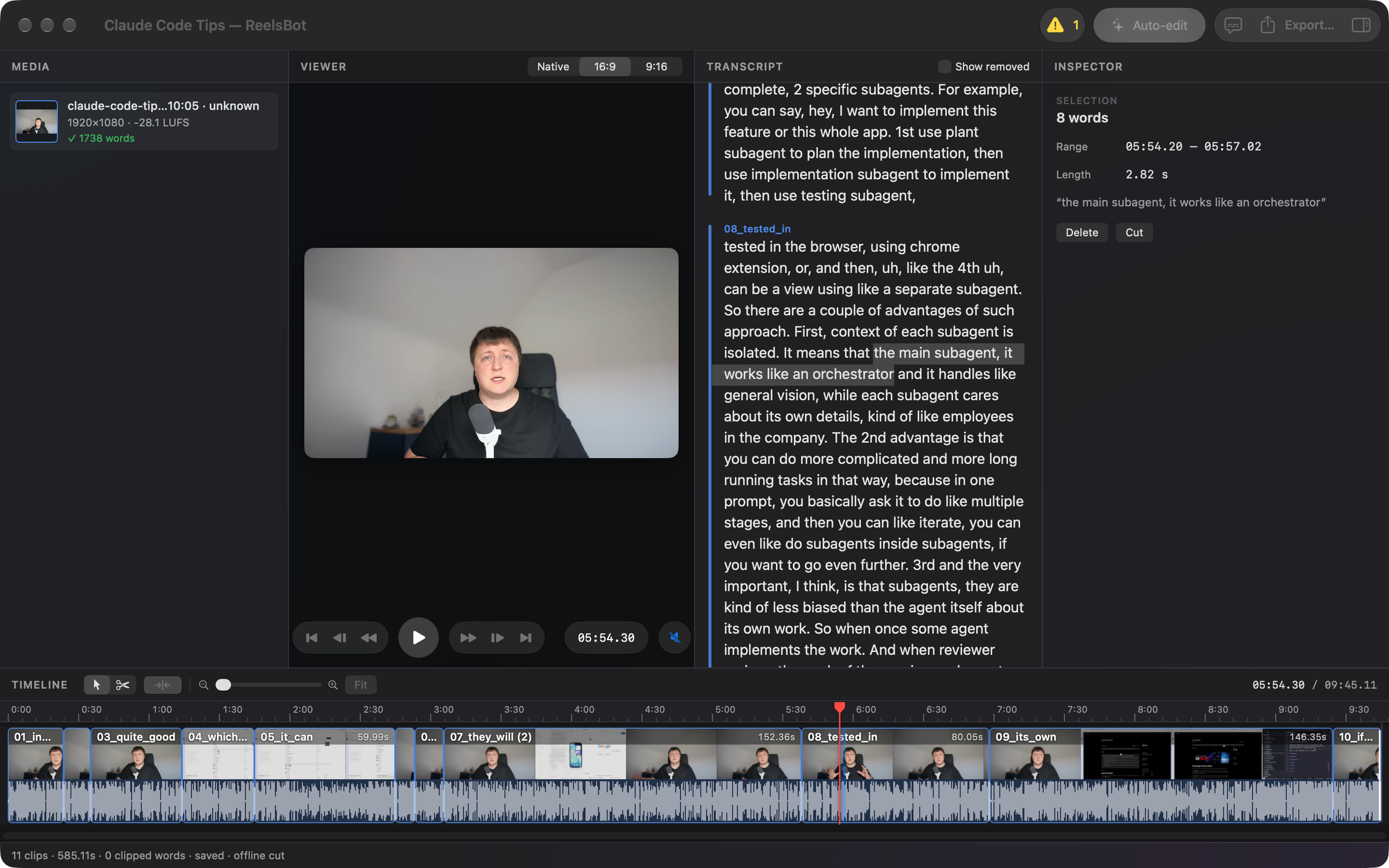
We're building ReelsBot, a Mac app that turns raw talking-head clips into a cut: it removes retakes, stutters and dead air, lets you edit by transcript and burns in captions in 9:16.
Methodology#
Claims, surveys and studies. Numbers come from the original articles, platform blogs, survey toplines and study abstracts, with Wayback captures where a page has moved or blocks automated reads. On 27 October 2026 we re-opened the pages behind every number this post leans on and matched the exact sentence. Platforms, ad sellers and caption vendors are interested parties. AP-NORC, YouGov and Ofcom figures are self-reports about TV, movies or video in general, not logs of short-form viewing. For several studies, including Bellman et al. 2021, we read the abstract, not the paywalled full text.
The Spotlight sample. SnapUGC (Li et al., ECCV 2024, Snap Research and CUHK) holds Snapchat Spotlight videos with more than 2,000 views each and each video's rank on two engagement measures computed from real viewing: ECR, the probability a view lasts more than 5 seconds, and NAWP, the normalised average watch percentage. The labels are normalised ranks, not raw rates; we turned them into percentiles across the 115,379-video training file, assuming a higher rank means more engagement (the README doesn't say, but every sanity check agrees). The official download link was over quota, so we drew 2,000 videos at random from the 106,905 training videos on a public Hugging Face mirror, which its uploader labels apache-2.0; the original repository states no licence. We publish aggregate statistics only, and show no frames or text from the videos. The sample is representative of the training set: median length 9.5 seconds (9.8 for the full set), mean percentiles 49.9 and 50.0.
Detecting text and captions. We ran Apple's Vision text recogniser on frames at 2 per second over the first 30 seconds (51,686 frames), kept lines with at least three Latin letters, dropped watermarks and @handles, and linked lines across frames into tracks. A video has captions when at least six short-lived tracks (4 seconds or less each) appear in one band of the screen, changing at least every 3 seconds and made mostly of real words; other text is static. A video has speech when Apple's sound classifier finds it in at least 25% of 1-second windows. Blind hand checks: frame-level precision 0.91 and recall 0.94 (50 frames); any-text precision and recall 0.96 (40 videos); caption precision 21 of 24, with no misses among 24 talking videos the detector called static. An upper bound on misses puts the caption share at no more than about 9%.
Engagement analysis. Means with 95% bootstrap intervals by group; ordinary least squares on the percentile with robust standard errors, controlling for length bucket, speech, and whether a title or description was present. The ECR and NAWP percentiles correlate at 0.90 in our sample.
Limits. Snapchat Spotlight, mostly in 2023, isn't TikTok, Shorts or Reels, and its conventions (the native caption bar, stickers) differ. The detector reads English and other Latin-script text only, so it misses Arabic and Chinese text and under-counts non-English captions. SnapUGC has no creator ID, so we can't hold creator skill fixed, and it says nothing about whether viewers had sound on. Everything here is correlation.
Open questions#
- What share of TikTok and YouTube Shorts views are sound on? Neither publishes one, and Meta's figure for Reels has no method.
- Does adding captions to the same video change its retention or reach? That needs an A/B test, and no public dataset has captioned and uncaptioned versions of the same video.
- Do burnt-in captions do better or worse than the platforms' own captions? We found no study comparing them.
- Do word-by-word "karaoke" captions help or distract in a feed? The only experiments we found are lab studies of subtitles, lectures and language learning.
- How many viewers switch on the platforms' auto captions? No platform publishes it.
- Where on screen should captions go, and how big? We found no sourced data for short-form feeds, and our captioned group (114 videos) is too small to slice by style or position.