Creator-economy reports like to announce a middle class. The Influencer Marketing Factory said it in February, when its survey of 1,000 US creators found 45.6% earning between $10,000 and $100,000 a year, "signaling the emergence of a viable 'middle class'". Other surveys disagree, at the top by a factor of six or more. They also disagree with the same firm's own 2023 report, which surveyed different people.
So we put two kinds of evidence side by side. First, the surveys, each with the sample it reached, because a creator-income survey describes the creators it asked and nobody else. Second, the hard numbers: what the platforms that publish both a payout total and a creator count actually paid, divided by our own arithmetic. That's OnlyFans' UK company filings, Roblox's SEC filings, Spotify's royalty ladder, and YouTube's and Patreon's stated totals. The short answer: there is a middle, but it's thin, and on every platform that discloses enough to check, the number of creators has grown faster than the money since 2021.
Key findings
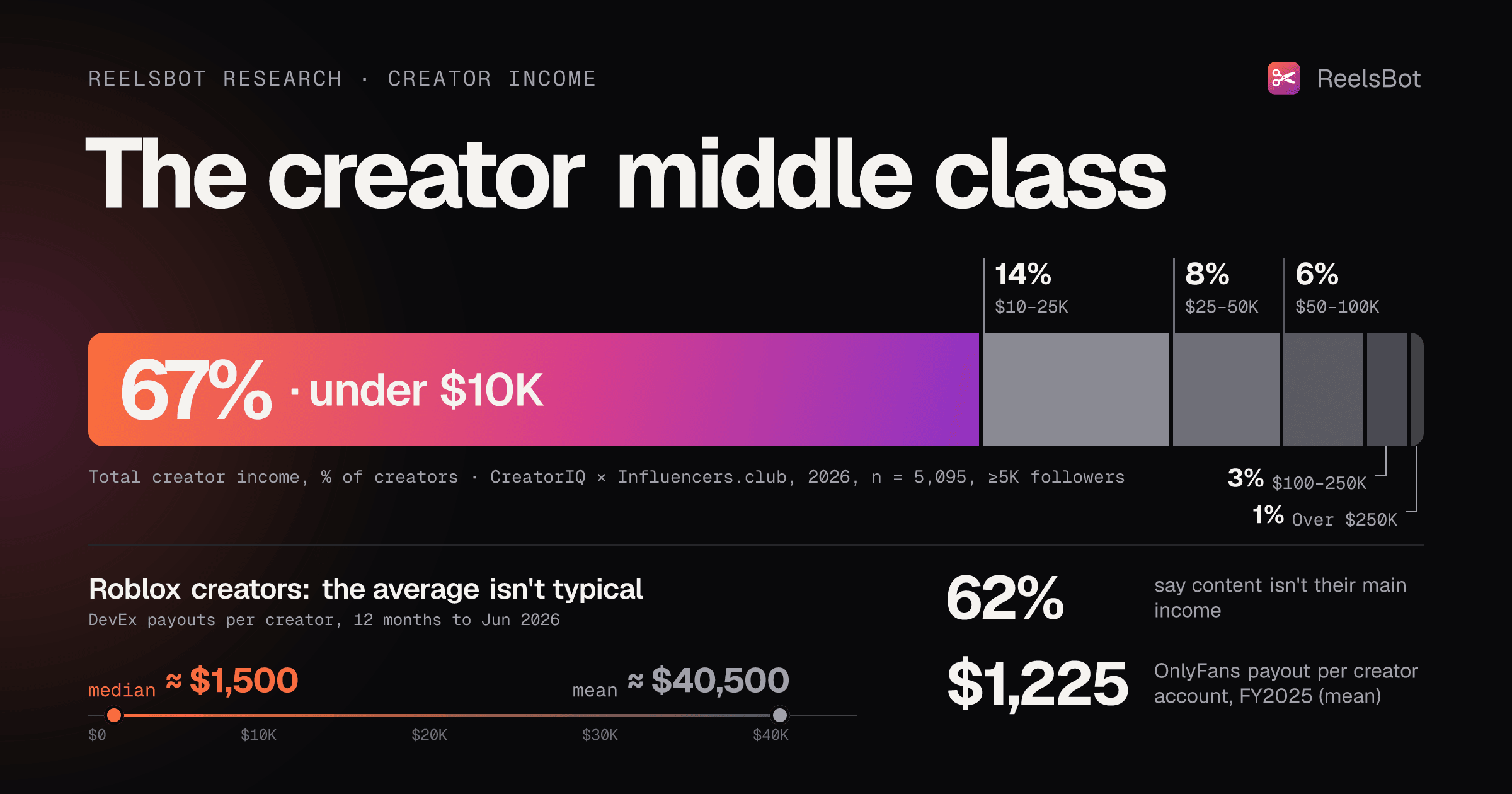
- 1In CreatorIQ and Influencers.club's 2026 survey of 5,095 creators with at least 5,000 followers, 67% earned under $10,000 from creating in the past year, 10% earned $50,000 or more and about 4% passed $100,000. For 62%, content isn't their main income.
- 2Surveys land far apart because they ask different people. At the top, the share earning $100,000+ ranges from about 4% (CreatorIQ, 2026) and 5.7% (TIMF, 1,000 US creators, 2026) through 9% in MBO Partners' population-weighted US survey (2023) to 18% in Kit's 2024 survey. The same agency, TIMF, reported 37% in April 2023 from a different sample of 660.
- 3The "middle class" band of $10,000 to $100,000 holds 45.6% of TIMF's 2026 sample and 28% of CreatorIQ's.
- 4OnlyFans' filings show $6.2 billion paid to creators in the year to November 2025: by our math, about $1,225 per creator account, an average across every account that hasn't been deleted. That's down from about $1,790 in FY2021, because creator accounts grew 2.3× while payouts grew 1.6×.
- 5Roblox creators earned about $1.7 billion in the 12 months to June 2026, but the median creator in its payout program got about $1,500, by Roblox's figures as reported in the press. By our math the top 1,000 took about 82%.
- 6Spotify's royalty ladder, the only full one any creator platform publishes (it's music, not video), has more artists on every rung each year but the same shape: about a quarter of artists who make $1,000 reach $10,000, in 2017 and in 2025.
- 7YouTube's "over $100 billion" paid in the four years to 2025 works out to at most about $8,300 a year per Partner Program channel on average, a ceiling, since labels and media companies are in the total. TikTok publishes no total for Creator Rewards.
67%
Of surveyed creators earned under $10K from creating in the past year, 2026
n = 5,095, ≥5K followers
Source: CreatorIQ
$1,225
OnlyFans payouts per creator account, FY2025, a mean across all non-deleted accounts
ReelsBot math from filings
~$1,500
Median Roblox creator's payout, 12 months to June 2026, against a mean of about $40,500
Roblox via press; mean is our math
What creators say they earn#
The newest and largest income survey is CreatorIQ and Influencers.club's State of Creators, fielded from 29 May to 29 June 2026. It reached 5,095 creators in 100 countries (63% in the US), each with at least 5,000 followers on one platform, and enriched their answers with Influencers.club's verified creator data. CreatorIQ gives a margin of error of ±1.4 points. Its summary: "67% of creators earned less than $10k annually, while just under 5% cleared $100k".
Two-thirds of creators earned under $10,000 from creating
% of respondents by total creator income in the past year, survey fielded May–June 2026
| Label | Value |
|---|---|
| Under $10K | 67% |
| $10–25K | 14% |
| $25–50K | 8% |
| $50–100K | 6% |
| $100–250K | 3% |
| Over $250K | 1% |
Source: CreatorIQ × Influencers.club, State of Creators 2026 (n = 5,095)
 ReelsBot
The same survey asked whether content creation is their primary income. 62% said no. That frames the 67%: most of these creators aren't trying and failing to live on $10,000; most have another income. CreatorIQ also found that a majority of creators with more than a million followers earn $50,000 to $250,000 or more, so income rises with audience size.
Other surveys give other answers. MBO Partners is the only one weighted to a population: 886 independent creators within 6,575 US adults, surveyed in July 2023. It found 34% earning under $5,000 a year, 37% earning $5,000 to $30,000, and 9% over $100,000. The Influencer Marketing Factory (TIMF) surveyed 1,000 US creators aged 18 to 65 in January 2026 and found 48.7% under $10,000, 45.6% at $10,000–100,000 and 5.7% at $100,000+. Its report doesn't say how respondents were recruited.
How many creators earn $100,000 depends on who was asked
% of each survey's respondents reporting $100K+ a year from creating, by survey
| Label | Value |
|---|---|
| TIMF Apr 2023 | 37% (660, US) |
| Kit 2024 | 18% (1,000+, Kit survey) |
| MBO Partners 2023 | 9% (886, US weighted) |
| TIMF Jan 2026 | 5.7% (1,000, US) |
| CreatorIQ 2026 | ~4% (5,095, ≥5K followers) |
Sources: TIMF 2023; Kit; MBO Partners; TIMF 2026; CreatorIQ
Same agency, different sample#
The clearest proof that samples drive these numbers comes from one firm. In its 2023 report, TIMF asked 660 US creators in April 2023 "What is your annual income as a creator?" and 37% answered $100,000 or more: 24% at $100,000–500,000, 11% at $500,000–1 million and 2% above. Its 2021 survey, shown in the same chart, had 21%. In January 2026, a new sample of 1,000 answered a similar question and 5.7% were at $100,000+.
One agency's three surveys, three answers
% of TIMF respondents reporting $100K+ a year as a creator, US, by survey wave
| Label | Value |
|---|---|
| 2021 survey | 21% (n not given) |
| Apr 2023 survey | 37% (n = 660) |
| Jan 2026 survey | 5.7% (n = 1,000) |
Sources: TIMF 2023 report, p. 33; TIMF 2026 release
That's why the "middle class" depends on the survey. TIMF puts 45.6% of its 2026 respondents in the $10,000–100,000 band. CreatorIQ, with brackets that add up to the same band, puts 28% there. And $10,000 to $100,000 is a wide band: at the bottom it's a side income, at the top a good salary.
Full-time doesn't guarantee a full income, either. Linktree's creator survey, 9,576 of its own users surveyed in 2021, is older, but it split answers by how much time people put in. 46% of self-described full-time creators reported under $1,000 in annual revenue, and 12% over $50,000. Among beginners (under a year), 59% hadn't monetized at all.
Full-time didn't mean a full-time income
% of Linktree users reporting each annual revenue level from creating, survey fielded 2021
| Label | Value |
|---|---|
| Full-time: under $1K | 46% |
| Part-time: under $1K | 68% |
| Full-time: over $50K | 12% |
| Part-time: over $50K | 3% |
Source: Linktree Creator Report (survey of 9,576 users, 2021)
What OnlyFans' filings show#
Surveys depend on who answers. Company filings don't, though few creator platforms file anything that counts both money and creators. OnlyFans' UK parent, Fenix International, does. Its accounts for the year to 30 November 2025 say the company "paid out $6.2bn (2024: $5.7bn) to Creators", out of $7.8 billion in fan payments. The same filing counts 5,063,000 creator accounts.
Divide one by the other and you get about $1,225 per creator account for the year. That figure is a mean, and its denominator matters: the filing defines accounts as those "that have not been deleted by the user or deactivated by the platform". That includes accounts that never earned, so the mean per earning creator is higher. But OnlyFans publishes no distribution, and a mean always overstates what the typical creator gets when a few earn a lot.
The trend is the stronger point. For FY2020 to FY2023 the filings give fan payments and revenue but not payouts, so we derived payouts as the difference (the filings describe an 80/20 split between creators and the company). From FY2021 to FY2025, payouts rose 60%. Creator accounts rose 134%.
OnlyFans creator accounts grew faster than the money paid to them
Index, FY2021 = 100; fiscal years ending 30 November, FY2021–FY2025
| Series | x | y |
|---|---|---|
| Creator accounts | 2021 | 100 |
| Creator accounts | 2022 | 147 |
| Creator accounts | 2023 | 191 |
| Creator accounts | 2024 | 214 |
| Creator accounts | 2025 | 234 |
| Payouts to creators | 2021 | 100 |
| Payouts to creators | 2022 | 117 |
| Payouts to creators | 2023 | 137 |
| Payouts to creators | 2024 | 147 |
| Payouts to creators | 2025 | 160 |
Source: Fenix International Ltd annual accounts, Companies House 10354575; ReelsBot calculation
OnlyFans payouts per creator account
US dollars per non-deleted creator account per fiscal year (a mean), FY2020–FY2025
| Label | Value |
|---|---|
| FY2020 | $1,137 (derived) |
| FY2021 | $1,791 (derived) |
| FY2022 | $1,417 (derived) |
| FY2023 | $1,285 (derived) |
| FY2024 | $1,230 (stated) |
| FY2025 | $1,225 (stated) |
Source: Fenix International Ltd annual accounts FY2020–FY2025; ReelsBot calculation
Roblox: the mean and the median#
Roblox is the one creator platform that has put a median on the record, at least as reported. At its developer conference in September 2026, Roblox said creators had earned approximately $1.7 billion in the past 12 months. Per Dexerto and IBTimes UK, Roblox also said more than 42,000 creators take part in its Developer Exchange (DevEx) cash-out program, that the median one received about $1,500 in the 12 months to June 2026, and that its top 10, top 100 and top 1,000 averaged $65.7 million, $10.8 million and $1.4 million. We couldn't find those tier figures on a Roblox page.
Multiplying those rounded averages out, the top 10 creators took about 39% of the pool and the top 1,000 about 82%. The remaining roughly 41,000 shared about $300 million, a mean of about $7,300 each.
Where Roblox's $1.7 billion went
% of creator earnings by creator rank, 12 months to June 2026
| Label | Value |
|---|---|
| Top 10 | 38.6% (≈ $65.7M each) |
| Ranks 11–100 | 24.9% (≈ $4.7M each) |
| Ranks 101–1,000 | 18.8% (≈ $356K each) |
| Everyone else | 17.6% (≈ 41,000 creators) |
Sources: Roblox Newsroom; Dexerto; ReelsBot calculation
Across all 42,000-plus participants, $1.7 billion is a mean of about $40,500, 27 times the reported median. It's the clearest case we found of how far an average sits from the typical creator.
Roblox's annual reports show the same squeeze as OnlyFans. Its 10-K filings count DevEx-registered creators at each year-end: "over 7,000" shared $538.3 million in 2021, and "over 35,500" shared $1,503.1 million in 2025. Payouts rose 2.8 times while registered creators rose five times, so the mean per registered creator fell from about $77,000 to about $42,000.
Roblox's earnings per registered creator fell as more qualified
Creator earnings ÷ DevEx-registered creators at year-end, US dollars (a mean), 2021–2025
| Label | Value |
|---|---|
| 2021 | $76.9K (7,000+) |
| 2022 | $56.7K (11,000+) |
| 2023 | $44.9K (16,500+) |
| 2024 | $37.7K (24,500+) |
| 2025 | $42.3K (35,500+) |
Source: Roblox 10-K filings FY2022–FY2025; ReelsBot calculation
The only full ladder is Spotify's#
No video platform publishes how many creators earn how much. Spotify does, for music. Its Loud & Clear site counts artists whose recordings generated at least a given amount of royalties from Spotify in a year. In 2025 that was 303,200 artists at $1,000 or more, 81,100 at $10,000, 13,800 at $100,000 and 1,540 at $1 million. Spotify says the 100,000th-highest-earning artist "generated more than $7,300 in royalties from Spotify alone", against about $350 in 2015.
These are royalties paid to rights holders for an artist's music, not what the artist keeps, and they cover Spotify only. We include them because no other creator platform publishes a ladder like this.
Spotify's 2025 royalty ladder
Number of artists by royalties generated from Spotify in 2025, US dollars
| Label | Value |
|---|---|
| $1K–10K | 222,100 |
| $10K–50K | 56,400 |
| $50K–100K | 10,900 |
| $100K–1M | 12,260 |
| $1M+ | 1,540 |
Over time, every rung of the ladder got more crowded. The number of artists reaching $10,000 more than tripled from 2017 to 2025, and those reaching $100,000 did too. But the shape held: 25.7% of artists who made $1,000 reached $10,000 in 2017, and 26.7% did in 2025. A growing pool raises the number of people in the middle without making the middle a bigger share.
More artists on each rung, same shape
Number of artists generating at least $10K and at least $100K a year from Spotify, 2017–2025
| Series | x | y |
|---|---|---|
| At least $10K | 2017 | 23.4K |
| At least $10K | 2018 | 29.3K |
| At least $10K | 2019 | 34.9K |
| At least $10K | 2020 | 42.5K |
| At least $10K | 2021 | 52.7K |
| At least $10K | 2022 | 57.9K |
| At least $10K | 2023 | 66K |
| At least $10K | 2024 | 71.2K |
| At least $10K | 2025 | 81.1K |
| At least $100K | 2017 | 4.3K |
| At least $100K | 2018 | 5.6K |
| At least $100K | 2019 | 6.7K |
| At least $100K | 2020 | 7.8K |
| At least $100K | 2021 | 9.5K |
| At least $100K | 2022 | 10.1K |
| At least $100K | 2023 | 11.6K |
| At least $100K | 2024 | 12.5K |
| At least $100K | 2025 | 13.8K |
Source: Spotify Loud & Clear, parsed from the site's chart data
YouTube, Patreon and Facebook: totals without a ladder#
The biggest video platforms publish totals and, sometimes, a headcount, but no distribution. All we can compute is an average, and each one uses a different denominator.
YouTube says it has paid "over $100 billion to creators, artists, and media companies" over "the last four years" (it said so in September 2025), about $25 billion a year, and said in February 2024 that "more than 3 million channels" were in its Partner Program, a figure it still used in 2026. Spread evenly, that's at most about $8,300 per Partner Program channel per year. It's a ceiling twice over: music labels and media companies are in the total, and the channel count is a floor. (YouTube's separate estimates of its US "economic impact", over $60 billion of GDP in 2025, come from Oxford Economics research published by YouTube and include indirect effects. They aren't payouts.) For what Shorts in particular pay, see our breakdown of Shorts RPM and the 2027 threshold.
Patreon's About page says fans have sent "$10 billion to creators" since 2013 and lists "300,000+ creators". Its CEO told Axios in August 2025 that "more than $2 billion flows to creators annually", and the same report put Patreon at 300,000 creators. That's a mean of about $6,700 a year, or about $5,800 if the third-party tracker Graphtreon's count of more than 340,000 creators with at least one paying member is closer.
Facebook paid creators nearly $3 billion in 2025, 35% more than in 2024, and Meta says the number of creators earning more than $10,000 a year there grew by over 30% year over year. It gives no count of creators, so there's no average to compute. TikTok publishes no total for its Creator Rewards program at all.
Averages per creator overstate the typical creator
Platform payouts ÷ the creator count each platform gives, US dollars per year; one median for contrast
| Label | Value |
|---|---|
| Roblox mean | ≈ $40,500 (per DevEx creator) |
| YouTube mean | ≤ $8,300 (per YPP channel) |
| Patreon mean | ≈ $6,700 (per creator) |
| Roblox median | ≈ $1,500 (reported) |
| OnlyFans mean | ≈ $1,225 (per account) |
Sources: Roblox; YouTube; Patreon via Net Influencer; Fenix International; ReelsBot calculation
Where researchers have had row-level data, it shows how lopsided these averages are. Regner's study of leaked Patreon transactions from 2013 to 2015 found that 115,183 of 139,366 campaigns never got a pledge. Among those that did, the median campaign's best month brought in $31; only 25% got more than $120, 5% more than $750 and 1% more than $2,500. That's old data from a much smaller Patreon, but the shape is the point. On Twitch, an academic analysis of the 2021 leaked payout data measured a Gini index of 0.57 among just the top 10,000 earners (August 2019 to October 2021), and about 0.93 when extrapolated to all streamers, near the maximum of 1.
On Patreon, the median campaign's best month brought in $31
Peak monthly pledges of campaigns with at least one pledge, US dollars, May 2013–Oct 2015
| Label | Value |
|---|---|
| Median | $31 |
| Top 25% | $120 (more than) |
| Top 5% | $750 (more than) |
| Top 1% | $2,500 (more than) |
Where the money comes from#
No survey measures the true income mix, meaning the share of all creator dollars by source. What exists is "your largest source" and "pick all that apply", and the two get confused. When you see "brand deals fell to 49%", it comes from NeoReach's Creator Earnings Report 2025: "Over 49% of surveyed creators earn most of their revenue from brand deals". That's the share of creators whose biggest source is brand deals, not brand deals' share of income. NeoReach's sample skews large: 56% of its 3,000-plus respondents had 100,000 followers or more.
Brand deals are still the biggest source for the most creators
% of NeoReach respondents naming each as the source they earn the most from, 2025
| Label | Value |
|---|---|
| Brand deals | 49% (2023: ~64%) |
| Ad revenue | ~23% (2023: ~14%) |
| Own business | ~18% (2023: ~16%) |
| Affiliate links | ~2% |
| Creator funds | ~2% |
| Merch | ~2% |
| Subscriptions | ~1% |
Source: NeoReach Creator Earnings Report 2025, via Influencer Marketing Hub
Brand deals are also the hardest part to count on. In CreatorIQ's survey, "lack of consistent brand deals is the #1 barrier" to growing a creator business, and in Linktree's 2021 survey 67% of creators had never worked with a brand. Patreon's State of Create survey of more than 1,000 US creators found that only 30% of YouTube creators, 25% of TikTok creators and 19% of Instagram creators find their income on those platforms easy to predict.
What this means if you make videos#
- Plan on the median, not the mean. Every per-creator average here, from OnlyFans' $1,225 to YouTube's ceiling of about $8,300, is pulled up by a few large earners. Roblox's one public median is 27 times below its mean. If you're budgeting from a "creators earn $X on average" headline, cut it hard.
- Expect the first year to earn little. In Linktree's survey, 59% of creators in their first year hadn't monetized. In CreatorIQ's, two-thirds of creators with 5,000+ followers made under $10,000. Treat early income as a bonus, not rent.
- Keep the other income until the creator income is boring. 62% of CreatorIQ's respondents don't rely on content as their main income. That's not failure; it's how most of the sample works. Move over when the creator money has been steady for a while, not after one good month.
- Don't rely on one stream. Brand deals are the top source for about half of NeoReach's sample and the top complaint in CreatorIQ's, and most creators find platform income hard to predict. Ad revenue, your own products, memberships and affiliate links fail at different times.
- Know how each platform pays. Shorts, Creator Rewards and Reels each have their own rules and thresholds; our post on what Shorts pay in 2026 covers YouTube's change on 1 February 2027.
- Watch fixed costs against median income. At under $10,000 a year, subscriptions add up fast. Our editing software price tracker shows what the main tools cost.
- Read every income survey by its sample. Before quoting a number, check who was asked: an agency's panel, a platform's users or a weighted population. The same firm went from 37% to 5.7% at $100,000+ by asking different people.
We're building ReelsBot, a Mac app that turns raw talking-head clips into a cut: it removes retakes, stutters and dead air, lets you edit by transcript and burns in captions in 9:16. Our free YouTube money calculator gives a rough estimate of what a channel's long-form ads might earn.
Methodology#
Surveys. We used every creator-income survey we could trace to a primary page with a stated sample: CreatorIQ × Influencers.club (2026), The Influencer Marketing Factory (2021, 2023, 2026), MBO Partners (2023), Linktree (2021), Kit (2024) and NeoReach (2025). Each is shown with its own brackets and sample. We don't merge brackets across surveys or draw trends between them. Question wording differs (TIMF 2026 asks about "income from your job as content creator/influencer", Linktree about "annual revenue"). Only MBO weights its results to a population; TIMF, NeoReach and Kit don't describe how they recruited respondents. Values marked ~ in the NeoReach chart are read from its published chart.
Payouts. We took payout totals and creator counts from primary filings and platform pages: Fenix International's annual accounts at Companies House (OnlyFans, FY2020–FY2025, read from the scanned PDFs), Roblox's 10-K filings and newsroom, Spotify's Loud & Clear site, YouTube's blog, Meta's newsroom and Patreon's About page. Roblox's median and tier averages come from two news outlets reporting Roblox's figures; Patreon's annual total comes from an interview with its CEO, reported secondhand. Every per-creator figure is our division and is a mean. OnlyFans payouts for FY2020–FY2023 are fan payments minus company revenue; FY2024 and FY2025 are the stated amounts. We didn't subtract YouTube's overlapping cumulative payout claims to get annual figures; "about $25 billion a year" is the four-year average of its "over $100 billion".
Not used. Several widely shared numbers didn't hold up: "3% of YouTubers capture 90% of earnings" (it traces to a stats aggregator; the underlying study measured views), "brand deals are ~70% of creator revenue" (no survey named), NeoReach 2023's "92%" (contradicted on the same page) and Kajabi's "brand deals −52%" (no baseline). TIMF's "21.2% of creator income" from products and affiliate links is a share of multi-select answers, not income. Graphtreon's Patreon figures exclude hidden earnings, so we use its creator count only. Alphabet reports Q3 2026 results on 28 October; no newer YouTube payout total was on a primary page when this was written.
Cut-off. Everything here was public by 27 October 2026. Full sources, every chart's data and our spot-checks are in the data pack behind this post.
Open questions#
- What does the median YouTube, TikTok or Instagram creator earn? None of the three publishes a distribution, and TikTok and Instagram publish no payout totals.
- How many creators actually earn? OnlyFans counts every account not deleted, YouTube's "more than 3 million" hasn't changed since February 2024, and Meta gives no count.
- How does YouTube's $100 billion split between creators, music labels and media companies?
- Will Roblox publish its median and tier figures itself? So far they reached us through the press.
- What share of all creator dollars comes from brand deals, ads, memberships and products? No survey measures it.